
The practical answer
- Short answer
- At ~50 reps, quota attainment falls to 43% as founder heroics break. Why the cliff hits, the 8.5-rep span-of-control fix, and the 5.7-month ramp tax.
- Best fit
- Industry: B2B Tech. Function: Sales
- Operating path
- GTM Execution → Commercial Performance → Performance Improvement
- Key metric
- 5.7 Months Avg. SaaS Sales Ramp Time (2025)
The Linear Fallacy: Why More Reps ≠ More Revenue
There is a dangerous spreadsheet that exists on the laptop of every Series B CEO. I call it the "Linear Fantasy." It takes the average productivity of your first 10 sales reps—the founding commandos who lived off tribal knowledge and founder heroics—and extrapolates it across 50 new hires. If 10 reps generated $5M, surely 50 reps will generate $25M. The board loves this spreadsheet. The bank loves this spreadsheet.
But in the real world, that spreadsheet creates a dangerous false signal. As you scale past 20, 30, and eventually hit the 50-rep inflection point, a phenomenon known as the "Efficiency Cliff" kicks in. According to Q4 2024 data from RepVue, the average quota attainment for B2B sales organizations has plummeted to 43.14%. This isn't a bad quarter; it is a structural failure of scaling.
When you had 12 reps, you (the Founder) or your VP of Sales could inspect every deal. You could jump on a Zoom call to save a negotiation. You were the "Super-Closer." But at 50 reps, the math breaks. You physically cannot touch 500 active opportunities. The tribal knowledge that made your early team successful—the specific objection handling, the nuanced value prop—doesn't diffuse through osmosis anymore. Instead, you get a dilution of talent, a skyrocketing CAC (Customer Acquisition Cost), and a sales floor that is busy but unproductive.
The symptoms are unmistakable. Your forecast accuracy drops below 70%. Your calendar is filled with "deal rescue" meetings. And worst of all, your best reps—the ones who carried you to Series B—start leaving because they are tired of carrying the performance drag of the bottom half.
If you have 50 reps, you need 6-7 competent frontline managers. If you can't afford the managers, you can't afford the reps.
The Management Void: Where Efficiency Goes to Die
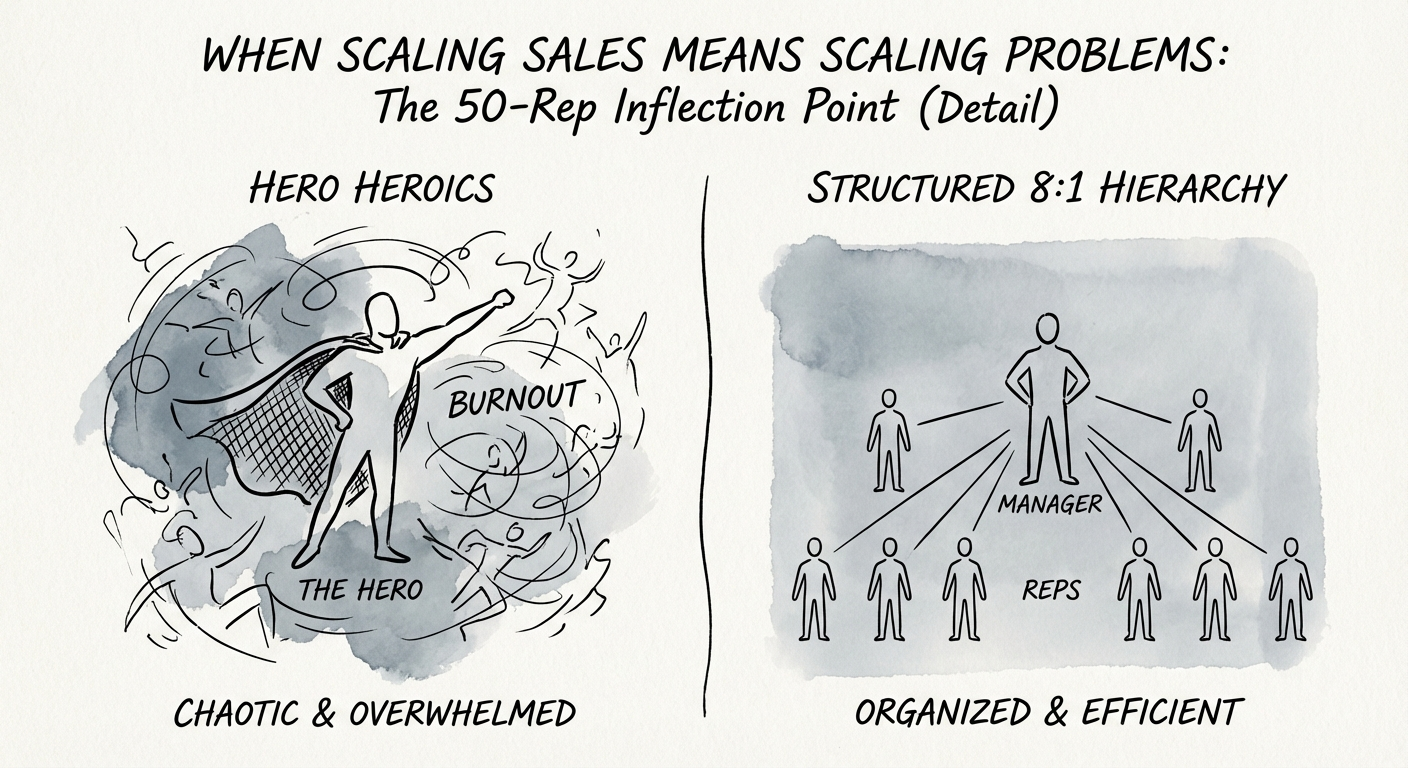
The primary culprit at the 50-rep mark isn't lead flow or product-market fit; it is the collapse of your management layer. In the early days, a "player-coach" sales leader works fine. But as you scale, span of control becomes the single biggest lever for EBITDA efficiency.
Benchmarks from the Alexander Group indicate that the average First Line Sales Manager (FLSM) can effectively manage 8.5 reps. Yet, I routinely walk into Series C companies where a single Director is trying to manage 15 or 20 AEs. This is negligent. At 15 reports, a manager spends less than 30 minutes per week coaching each rep. They become glorified scorecard keepers, not coaches. They don't have time to listen to Gong calls; they only have time to ask, "When is this closing?"
The Ramp Time Tax
This lack of coaching has a direct financial penalty: extended ramp times. 2025 data shows that the average SaaS sales ramp time has ballooned to 5.7 months—a 32% increase since 2020. In Enterprise B2B, it's closer to 9-12 months. If you are hiring 20 reps this year, and they take 6 months to become productive instead of 4, you are burning millions in payroll without revenue return. You are paying for a "phantom sales force."
This is also where the "Hero Manager" fails. Many founders solve the management gap by promoting their best AE to manager. This is often a fatal error. The skills that make a great closer (urgency, autonomy, intuition) are the opposite of what makes a great manager (patience, process, coaching). You lose your best revenue generator and gain a mediocre manager, doubling your problem.
The Fix: Moving from Art to Engineering
To survive the 50-rep inflection point, you must stop treating sales as an art form performed by artists, and start treating it as an engineering discipline run by operators. This requires three specific actions within the next 90 days.
1. Enforce the 8:1 Ratio
Do not allow span of control to exceed 8 reps per manager. If you have 50 reps, you need 6-7 competent frontline managers. If you can't afford the managers, you can't afford the reps. The ROI of a manager who reduces ramp time by 2 months is higher than the ROI of hiring two more mid-tier AEs.
2. Codify the "Tribal Knowledge"
You cannot scale what is not written down. "Watch what I do" is not a training strategy. You need a centralized playbook that covers not just what to sell, but how. This means documented exit criteria for every pipeline stage, call libraries of "perfect" discovery calls, and objection handling scripts that don't rely on Founder charisma. Companies that document their sales process see a valuation premium because the revenue is transferable, not people-dependent.
3. Split Revenue Operations from Sales Ops
At 50 reps, you need more than a Salesforce administrator. You need Revenue Operations (RevOps). Sales Ops manages the CRM; RevOps manages the end-to-end data integrity of the customer journey. They own the "Magic Number" (Sales Efficiency). They spot that your conversion rate from Demo to Proposal has dropped 5% in the Northeast region before you miss the quarter. They provide the "air traffic control" that allows the VPs to focus on flying the planes.
The 50-rep mark is where companies either become durable revenue engines or stall under their own complexity. The difference isn't the product. It's the discipline to build the machine that builds the revenue.