
The practical answer
- Short answer
- Most Series B plans break on ramp-time arithmetic, not ambition. A 4-test diagnostic for $10M-$30M SaaS: rep math, Magic Number, VP fit, forecast variance.
- Best fit
- Industry: B2B SaaS. Function: Sales
- Operating path
- GTM Execution → Commercial Performance → Performance Improvement
- Key metric
- 5.7 Months Avg. Time to Full Productivity for B2B Reps (2025)
Open your hiring plan and do the subtraction
Here is the exercise nobody runs before they raise the Series B. Take the new-ARR number your board funded. Divide it by your average ramped-rep quota. That tells you how many productive reps you need carrying a bag every single month of the year — not hired, productive. Now overlay your actual ramp time. For B2B reps in 2025, full productivity lands at an average of 5.7 months, up sharply over the last few years. So a rep you sign in January isn't pulling a full quota until roughly June.
Run that math honestly and a brutal thing happens: the plan that looked like a hiring problem turns out to be a calendar problem. If you need 12 ramped reps by Q3 and your ramp is six-plus months, every one of them had to start their offer letter in Q1. They didn't. So the number isn't aggressive — it's already missed, and you're only finding out now because the pipeline math caught up to the staffing math.
This is the $10M-to-$30M ARR chasm, and it kills more well-funded B2B SaaS companies than bad product ever will. At $5M you closed deals on founder charisma and three reps who would run through a wall. At $15M you are mathematically dependent on people you barely know selling to people they've never met, on a ramp clock you don't control. The capital didn't fix that. It just gave you the means to hire faster into the exact gap that's leaking. The four tests below tell you whether the engine can actually metabolize the money — or whether you're about to pour fuel on a fire and call it growth.
The board didn't fund a number. They funded a hiring plan that assumes reps ramp in four months. Yours take seven. Do that subtraction before you sign the offer letters.
Four tests. Fail two and you're not scaling, you're spending.
1. Ramp time you can actually prove
Pull your last hiring cohort and answer one question with data, not vibe: how many months until each rep hit full quota three months running? If the honest answer is "we don't track it that cleanly," that's already a fail — you're flying a revenue plane with the fuel gauge taped over. The danger line is six months; past it, you eat a fully loaded acquisition cost for the better part of a year before a single dollar comes back. More headcount doesn't dilute that drag, it multiplies it. The deeper benchmark breakdown lives in our sales rep ramp time benchmarks.
2. The Magic Number, read as a verdict
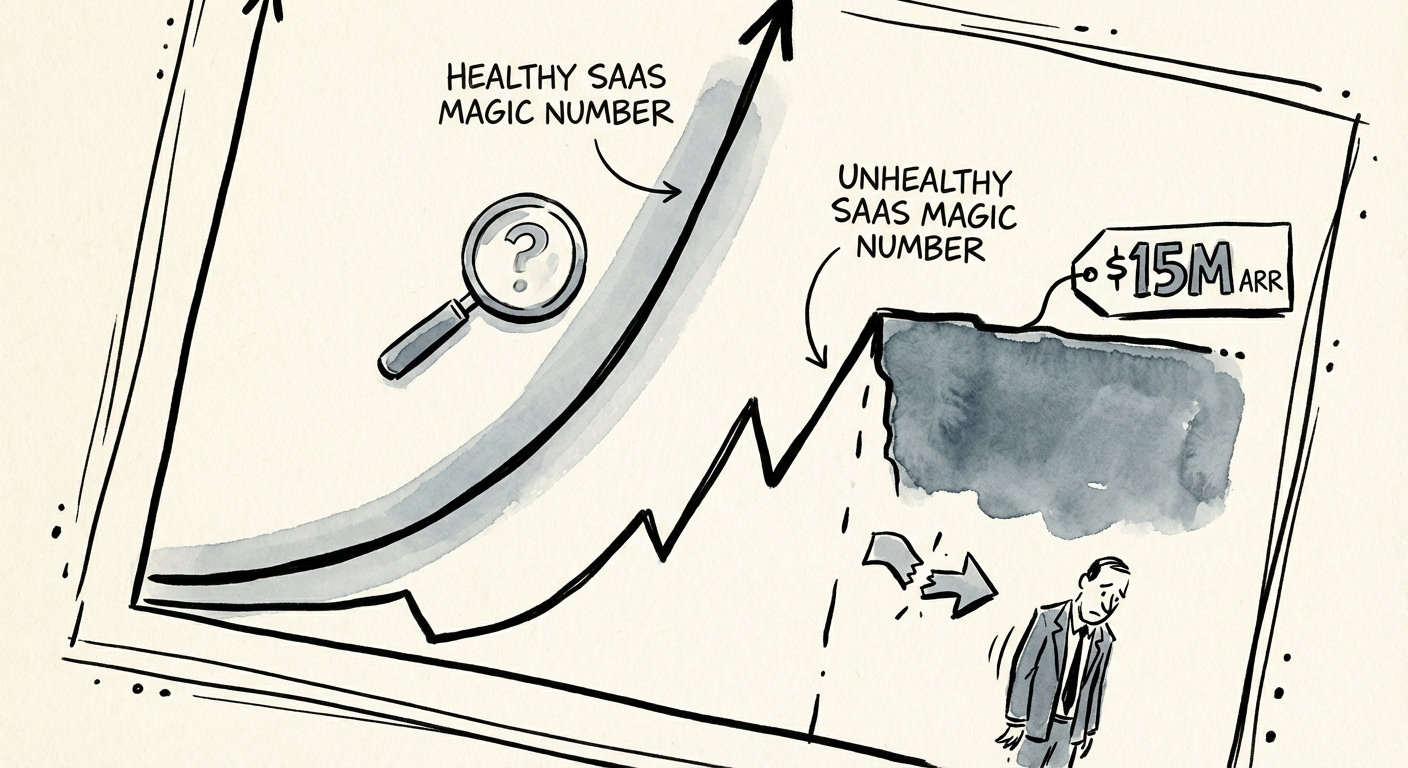
New ARR this quarter divided by last quarter's sales-and-marketing spend. Above 0.75 you're healthy; above 1.0 you're enviable. Below 0.5 is not a number to tune — it's a diagnosis. It means you're spending well over a dollar to buy a dollar of ARR, and adding reps to that motion just buys you a bigger loss faster. A weak Magic Number is almost never a sales-effort problem. It's usually a messaging or segment problem wearing a sales costume, and 2025 SaaS efficiency benchmarks make clear that investors now expect this ratio to trend up, not just exist.
3. The VP who can still demo
The most expensive Series B mistake is the resume hire — a leader from a name-brand enterprise who manages managers and expects a fully built RevOps machine, enablement team, and inbound firehose to already be humming. It isn't. They stall, and so does the quarter. It's no accident that average VP of Sales tenure has shrunk to under two years — companies keep hiring the operator the business will need at $50M to run the business it actually is at $15M. The test: has your VP personally closed a deal in the last 90 days? At this stage you need a builder who flies the plane while bolting on the wings, not a passenger who expected a finished cockpit.
4. Forecast variance, the tell that ranks them all
Look at your Day-1 commit for the last two quarters. Did the final land within 10% of it? Founder-led forecasting runs on gut, and gut is fine at $3M. At $15M, variance above 15% means you don't have a revenue engine, you have a roulette wheel — and you can't set burn or hiring against a number that swings a sixth in either direction. Note that chronic sandbagging is just as disqualifying as missing high; both mean the team can't see its own pipeline. Our guide to fixing broken sales forecasting walks through why.
Failed two? Freeze hiring and fix the engine first.
If you missed on two or more tests, the move is counterintuitive and it's the right one: stop hiring for a quarter. Adding reps to a leaking motion doesn't accelerate you, it just burns the chassis faster. Here's where the frozen quarter goes.
Codify the hero motion. Right now your best deals close because one person — often you — carries undocumented tribal knowledge into the room. Record those calls. Transcribe the discovery questions and the objection handling. Build the playbook from your actual winners, not a generic framework. You can't clone a star, but you can clone the sequence the star runs. Our breakdown of why scaling breaks heroics goes deeper on the transition from instinct to system.
Stand up a 30-minute deal desk. You don't need a department or a tool. You need a weekly half-hour where CEO, CFO, and VP Sales walk every deal above a set threshold — pricing, terms, fit. This is how you stop the discounted, mis-sold "bad revenue" that books in Q1 and churns by Q4, quietly poisoning your net retention right when the next raise needs it clean.
Compress the ramp on purpose. Re-cut onboarding so week one teaches buyer pain and discovery, not your feature menu. Certify reps on the pitch before the platform; product depth can come once they can hold a buyer's attention. Target time-to-first-deal under 45 days. Then take it to the board in their language: "We're pausing hires for one quarter to pull ramp from seven months to four, which lifts efficiency on the next cohort by 40%." That sentence is a CEO running the business. The alternative — more bodies, same ramp, same variance — is a founder hoping for a miracle the math already ruled out.