
The practical answer
- Short answer
- Tech due diligence isn't a checkbox—it's a valuation lever. Discover the 10 red flags that kill deals, from 74% high-risk vulnerabilities to the 'Hero Developer' trap.
- Best fit
- Industry: Private Equity. Function: Technology
- Operating path
- Technical Debt → Turnaround & Restructuring → Transaction Advisory Services
- Key metric
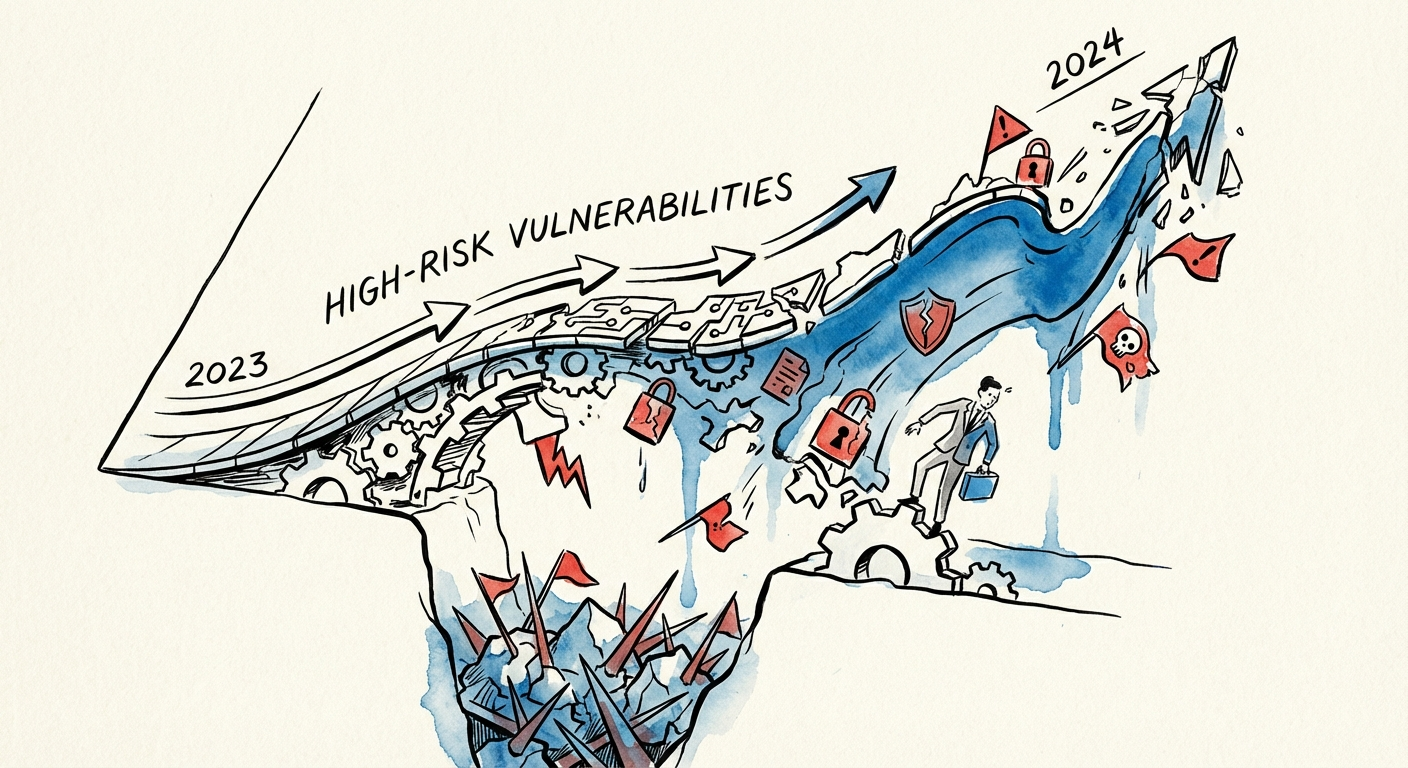
- 74% Codebases with High-Risk Vulnerabilities (2024)
The Price of Ignorance is Margin Erosion
In 2024, technology due diligence ceased to be a checkbox exercise for the IT department. It became a primary valuation lever. With interest rates stabilizing but capital still expensive, Private Equity sponsors can no longer afford to inherit "fixer-upper" tech stacks that require 18 months of remediation before value creation begins.
The data is unforgiving. According to McKinsey, up to 40% of an average organization's technology estate is consumed by technical debt. For an acquirer, this isn't just an operational nuisance; it is a direct drag on EBITDA. When you acquire a company, you acquire its debt—financial and technical.
Consider the cautionary tale of Verizon's acquisition of Yahoo. A failure to adequately assess cybersecurity posture during initial diligence led to a massive data breach discovery, ultimately slashing the deal price by $350 million. Today, the risks are even more insidious. They hide in open-source dependencies, undocumented APIs, and "hero" developers who hold the entire IP in their heads.
If you are an Operating Partner, you are not looking for code perfection. You are looking for risk quantification. You need to know if the target's technology is an asset that scales or an anchor that sinks the investment thesis. Below are the diagnostic red flags that should trigger immediate retrading or a walk-away decision.
When you acquire a company, you acquire its debt—financial AND technical. If the roadmap for the first 12 months is purely infrastructure stabilization, your value creation plan is already delayed.
The Diagnostic: 10 Red Flags That Signal Distress
1. The Open Source Minefield
Open source software is the foundation of modern development, but unmanaged dependencies are a liability. The 2024 Open Source Security and Risk Analysis report by Synopsys found that 74% of commercial codebases contain high-risk open source vulnerabilities—a 54% surge from the previous year. If your target uses components with restrictive licenses (like GPL) or unpatched CVEs, you are acquiring legal, security, and remediation exposure.
2. The 'Hero' Factor (Key Person Dependency of 1)
When the CTO says, "Ask Dave, he's the only one who knows how that works," you have a critical valuation problem. We call this the Founder Trap. If the platform's stability relies on the tribal knowledge of one or two individuals, the asset is not transferrable. Post-acquisition attrition is common; if 'Dave' leaves, the investment thesis may leave with him.
3. The Scalability Glass Ceiling
A platform that runs smoothly at $10M ARR can fail at $20M. We look for "glue code" and manual database sharding that indicates the architecture cannot handle a 2x load increase without a total rewrite. If the roadmap for the first 12 months is purely infrastructure stabilization, your value creation plan is already delayed.
4. 'Spaghetti' Monoliths
While microservices are not always the answer, a 10-year-old monolithic application with zero documentation and high coupling is a massive red flag. It implies that every new feature will take 3x longer to build than industry benchmarks. This is where technical debt becomes financial debt, directly impacting your R&D efficiency ratios.
5. The Cloud Cost Black Hole
Inefficient cloud architecture is a margin drag. We frequently see startups using cloud credits to mask poor architectural decisions. Once those credits expire, or when the user base scales, hosting costs can rise quickly, compressing gross margins below the 70%+ SaaS standard. If cloud spend is growing faster than revenue, the unit economics are broken.
6. Cybersecurity Control Gaps
Lack of SOC 2 compliance in a B2B SaaS firm is a deal-breaker for enterprise exits. But deeper than badges, we look for basic hygiene: lack of Multi-Factor Authentication (MFA), shared admin credentials, and unencrypted databases. These aren't just IT fix-its; they are indicators of immature controls.
7. The Data Swamp
Every investment thesis today includes an "AI Strategy." But you cannot run AI on poor-quality data. If the target's data is trapped in unstructured silos, inconsistent formats, or lacks unique identifiers, their "AI readiness" is zero. You will spend millions on data engineering before a single model can be trained.
8. Proprietary Frameworks
A custom-built PHP framework from 2014 is a hiring challenge. If the target technology requires skills that the market no longer produces, you will face rising talent costs and slower velocity. You want standard stacks (React, Python, Node, .NET Core) that have deep talent pools.
9. Manual Deployment (No CI/CD)
If releasing code requires a developer to manually copy files to a server on a Friday night, the operational risk is extreme. Automated Continuous Integration/Continuous Deployment (CI/CD) pipelines are the heartbeat of a modern engineering team. Lack of automation signals low maturity and high error rates.
10. Phantom IP Ownership
We have seen deals collapse because the target used contractors who never signed IP assignment agreements. Or worse, the core algorithm is a copy-paste from a Stack Overflow thread protected by a restrictive license. Ensure the target actually owns the code they are selling.
From Red Flag to Retrade
Identifying these flags is not about killing the deal—it is about pricing the risk. If you find massive technical debt, you don't necessarily walk away. You retrade. You calculate the Cost of Remediation (e.g., $2M to refactor the monolith) and you deduct it from the enterprise value or structure it as a holdback.
Smart Operating Partners use these findings to build the Value Creation Plan (VCP) before the ink is dry. Instead of vague goals like "improve tech," the VCP becomes specific: "Migrate off legacy SQL server in Q1," "Implement SOC 2 by Q3," "Hire 2 Senior Engineers to dilute key person risk."
As we detailed in The $2M Mistake, technical due diligence is your insurance policy against buying an asset with hidden operating liabilities. In a market where multiple expansion is no longer guaranteed, operational engineering is the only path to returns.
The Operator's Checklist
- Request a Software Bill of Materials (SBOM): Know exactly what open source is in the code.
- Audit Cloud Spend vs. Usage: Look for linear correlation (bad) vs. economies of scale (good).
- Interview the "Hero": Assess their willingness to document and delegate.
- Quantify the Debt: Put a dollar figure on the rewrite. If it's >10% of deal value, pause.
Don't let technical debt become avoidable fund-level drag. Dig deep, quantify the risk, and buy with your eyes wide open.