The practical answer
- Short answer
- Stop guessing your GTM strategy. New 2025 data shows Sales-Assisted PLG drives 3.5x higher ACV. Compare Top-Down vs. Bottom-Up benchmarks here.
- Best fit
- Industry: B2B SaaS. Function: Sales
- Operating path
- GTM Execution → Commercial Performance → Performance Improvement
- Key metric
- 3.5x Higher deal value for Sales-Assisted PLG vs. Self-Serve
The GTM Identity Crisis That Stalls Growth
You have hit the Series B plateau. Your revenue growth, once automatic, has flatlined at 26% year-over-year—the median for 2025, but far below the 60%+ required for a premium valuation. The problem isn't your product; it's your Go-To-Market (GTM) schizophrenia.
We see this constantly in our portfolio: A founder builds a product designed for bottom-up adoption (easy signup, single-player utility) but hires an expensive enterprise sales team to sell it top-down. The result? Account Executives (AEs) chasing $4,000 Annual Contract Value (ACV) deals, blowing out your Customer Acquisition Cost (CAC) payback period to an unsustainable 24 months. Alternatively, we see complex platforms requiring 60-day implementations trying to force a "Product-Led Growth" (PLG) motion, resulting in 95% churn during the trial phase because users can't self-onboard.
This is the GTM Identity Crisis. It usually happens when a company scales from $10M to $50M ARR. You attempt to layer on a second motion before mastering the first, or worse, you pick the wrong motion entirely based on "what worked for Slack" rather than what the math dictates for your unit economics.
To fix this, you must stop viewing Top-Down (Sales-Led) and Bottom-Up (Product-Led) as marketing choices. They are mathematical constraints dictated by your ACV and product complexity. Getting this wrong isn't just a marketing error; it is a capital efficiency material risk in the 2025 funding environment.
Product-led growth can open the account, but complex B2B revenue still needs human sales discipline layered on top of product usage data.
The Math: Benchmarking Your Motion
In 2025, the lines have blurred, but the benchmarks have hardened. Pure-play strategies are being replaced by hybrid models, but you cannot execute a hybrid model without understanding the base rates of each component. Let’s look at the data derived from Bessemer Venture Partners and OpenView.
1. The Efficiency Gap
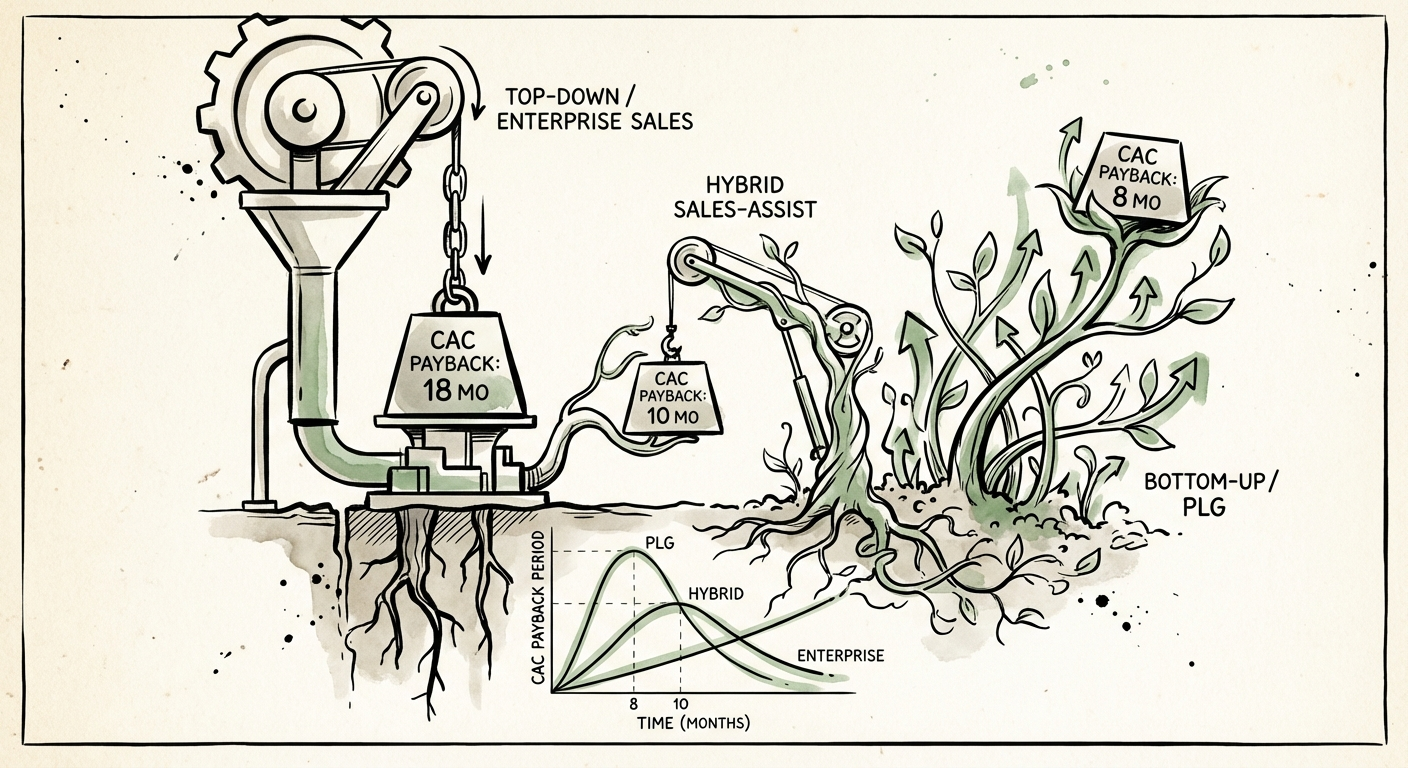
- Top-Down (Sales-Led): The standard CAC payback period is 12-18 months. You are paying for human relationships, discovery calls, and navigational prowess within buying committees. Win rates for elite teams hover around 20-30%.
- Bottom-Up (PLG): The efficiency standard is disciplined. Best-in-class PLG companies achieve CAC payback in <12 months, often closer to 6 months. Why? Because the product does the prospecting. However, conversion rates from Free-to-Paid are brutally low—typically 5-10% for pure self-serve motions.
2. The "Sales-Assist" Multiplier
Here is the critical insight for 2025: Pure PLG has a ceiling. Data shows that introducing a "Sales-Assist" motion—where sales reps engage Product Qualified Leads (PQLs) rather than cold outbound leads—is the highest leverage move a founder can make.
According to ProductLed benchmarks, adding sales assistance to a PLG motion drives 3.5x to 4.5x higher contract values compared to pure self-service transactions. Furthermore, while typical free-to-paid conversion is ~9%, PQLs handled by sales convert at 25-35%.
3. The ACV Danger Zone
The most common failure mode we diagnose is the "Dead Zone" between $5k and $15k ACV. This price point is too high for a credit card swipe (friction) but too low to support a fully loaded enterprise AE (CAC). If your ACV falls in this range, you must automate the top of the funnel or increase pricing to support a human touch. You cannot afford to have a $150k OTE rep chasing $8k deals.
For a deeper dive on fixing broken forecasting in these models, read our guide on sales forecasting accuracy. Additionally, if you are struggling to define what actually counts as a "lead" in these hybrid models, review our analysis on pipeline coverage lies.
The Diagnostic: Choosing Your Path Forward
If you are stalled, you need to realign your motion with your reality. Use this 3-point diagnostic to determine your immediate next step.
1. The Complexity Test (Time-to-Value)
Can a user get to an "Aha!" moment in under 15 minutes without talking to a human?
Yes: You have the right to attempt PLG/Bottom-Up. Focus on removing friction and gating features, not access.
No: If you require integration, data migration, or training to see value, stop forcing PLG. You are just frustrating prospects who need hand-holding. Stick to Top-Down or a "Concierge Onboarding" model.
2. The ACV Test (The Rule of $10k)
Look at your last 50 closed-won deals.
Under $10k ACV: You cannot support a traditional outbound sales team. You must move to Inbound/PLG with a low-cost "Customer Success" closing motion, or you must raise prices significantly.
Over $25k ACV: Self-serve will likely fail you. Complex purchases require procurement navigation. Build a professionalized sales motion (see our guide on professionalizing founder-led sales).
3. The Hybrid Pivot (The "Sales-Assist" Play)
If you have high volume but low ACV, implement a "Hand-Raiser" workflow. Don't hide your phone number. Allow users to self-serve up to a point, then trigger a sales alert based on usage signals (e.g., inviting the 5th user, hitting a data limit). This is how you capture that 3.5x lift in deal size without destroying your CAC efficiency.
Conclusion
Stop trying to be everything to everyone. The market punishes GTM ambiguity. If you are Top-Down, own it: high touch, high price, high service. If you are Bottom-Up, be disciplined about automation. But if you are in the messy middle, your only exit is the disciplined application of Sales-Assist logic: let the product qualify, and let the humans close.