
The practical answer
- Short answer
- Your SI's status deck is all green and your ERP is still broken. A CIO's field guide to diagnosing vendor failure, freezing T&M billing, and securing the code.
- Best fit
- Industry: Enterprise Tech. Function: IT Operations
- Operating path
- Project Recovery → Turnaround & Restructuring → Transaction Execution Services
- Key metric
- 75% ERP Failure Rate (Gartner)
The General Ledger Won't Reconcile, But the Slide Is Green
It's the Tuesday steering committee. Your systems integrator put up the same deck they've shown for eleven weeks: milestones on track, budget consumed as planned, testing 98% complete. A wall of green.
You know better, because your controller pulled you aside before the meeting. The general ledger from the new ERP doesn't tie out to the legacy system. The order-to-cash integration is still moving data on overnight flat-file dumps that someone re-keys by hand. And your VP of Supply Chain just texted: if you cut over to the new system Monday, the warehouse can't generate pick tickets and nothing ships.
That gap — between the deck and the warehouse floor — is the entire problem. The status report and operating reality have decoupled, and you're paying blended senior rates while the risk compounds quietly underneath the green.
Why the Math Works Against You
The uncomfortable truth about a time-and-materials ERP engagement is that it rewards motion, not a working close. If the SI delivers clean code that needs no rework, they bill fewer hours. If the go-live slips a quarter, that's another quarter of utilization on your account. Their delay is, structurally, their revenue.
The numbers back up the dread. Gartner finds that 55% to 75% of ERP projects fail to meet their original objectives, and the failures aren't cheap — analysis of botched implementations shows they run 189% over the initial budget. That is not scope creep you can absorb. That is a governance failure with a number on it.
For a CIO, this is the trap that keeps you frozen: you're two quarters late and millions over, and you won't fire the SI because they hold the configuration, the integrations, and the production keys. The instinct is to wait one more sprint. This is the argument for not waiting.
"Code complete, waiting on data" is the most expensive sentence in enterprise software. An integration that doesn't move data isn't 99% done. It's a promise with an invoice attached.
Three Strikes: Is This a Project Problem or a Commercial One?
Before you loop in legal, diagnose what you're actually dealing with. A late project you can manage. A misaligned vendor you have to intervene on. The difference shows up in three signals. Hit two of the three, and you no longer have a delivery hiccup — you have a vendor managing your account for margin.
Strike One: Change orders cross 15% of the original contract
Change orders are normal; ERP scope shifts as you discover how your business actually runs. But watch the cumulative ratio. When approved change orders pass 15% of the signed contract value, you've stopped paying for the system you bought and started funding a second project nobody scoped. The classic pattern: the SI underbid the RFP to win, fully expecting to recover margin later on "unforeseen complexity" in tax jurisdictions, multi-currency, or that one bolt-on you mentioned in passing. Once you're past 15% and climbing toward 25%, you're in the zone where cost becomes unrecoverable. Pull the change-order log this week and total it against the original SOW. The number is usually worse than your gut says.
Strike Two: The A-team got "rotated"
You bought the principal solution architect who ran your design workshops and made the cap-table case for the platform. Six months in, they've been moved to a fresher logo, and a configuration analyst learning your industry on your invoice is now running your build. This is endemic: 4 out of 10 organizations say they would not recommend their current systems integrator to a peer. Quantify it. If named senior staff turns over more than 30% in a quarter and throughput doesn't improve, that rotation isn't a staffing accident — it's how the SI optimizes your account.
Strike Three: "Code complete, waiting on data"
The last 1% of an integration is where the hardest 50% of the work hides. A vendor who reports an interface as "code complete but waiting on data" is reporting a non-functioning interface with extra syllables. A real integration moves records, end to end, in a test that someone other than the developer can watch. Three tells that the green is fake:
- UAT entry dates slip by exactly two weeks, repeatedly — just long enough to stay off the escalation radar.
- Severity-1 defects look stable while Severity-2 defects quietly balloon (the real blockers got reclassified down).
- They blame your team for "slow requirements," yet can't hand you the requirements document they need you to sign.
One strike is a bad month. Two strikes is a commercial crisis you have to manage as one.
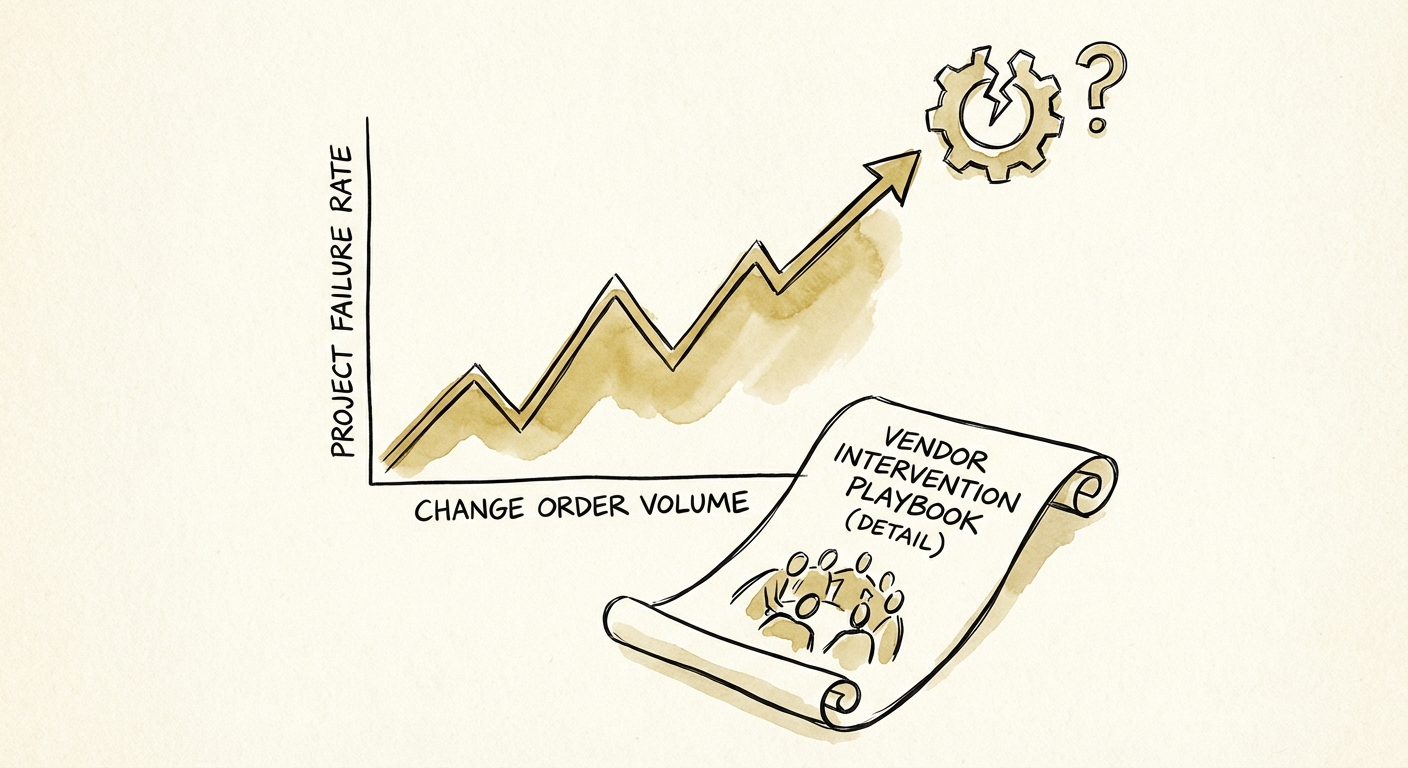
The Intervention: Reset Leverage in That Order
You've diagnosed it. Now change the dynamic — and resist the two useless moves: the angry email and the "let's re-align" meeting. Neither shifts a dollar of risk. These three do, and the sequence matters.
1. Send the Notice to Cure
Nearly every Master Services Agreement carries a material-breach clause with a cure period. Work with your GC to issue a formal Notice to Cure. This is not litigation — it's an accountability instrument. It documents the specific failures in writing, restarts the relationship around evidence instead of optimism, and, most importantly, gets the SI's partner-level leadership to actually read their own status reports for the first time.
2. Convert the rest to fixed-fee milestones
Stop buying effort. Buy outcomes. The move sounds like this: "We're freezing all T&M billing effective today. The remaining fee releases in three tranches, each tied to a named acceptance test — order-to-cash moving live data, the financial close reconciling to the penny, and the warehouse generating pick tickets in UAT." Watch the reaction closely. If they refuse, they're telling you they don't believe they can hit those tests on their own dime. If they accept, you've just realigned their economics with your go-live for the first time in the engagement. This is the heart of our project rescue approach.
3. Secure the IP before — not after — you talk termination
The order here is non-negotiable, because vendors lock the doors during disputes. Before any termination conversation: demand a code freeze for audit, mirror every repository, Jira board, and configuration workbook to an instance you control, and revoke the SI's admin access to production before — never after — the termination letter goes out. Reverse that order and you'll find yourself locked out of your own ERP mid-cutover. If it comes to parting ways, do it deliberately with a structured exit, not a slammed door.
What you do Monday
Don't ask for another status deck — they're free to produce and tell you nothing. Pull three numbers instead: the cumulative change-order ratio, the named-senior-staff turnover this quarter, and the count of integrations that actually move live data end to end. Those three tell you whether you're managing a late project or rescuing a captured one. Then reset the economics, secure the code, and move the project back under your control — in that order.