
The practical answer
- Short answer
- Sales reps spend 72% of their time on admin, not selling. Here is the diagnostic guide to fixing CRM adoption, reducing data friction, and ensuring your forecast isn't a work of fiction.
- Best fit
- Industry: B2B Tech. Function: Sales
- Operating path
- GTM Execution → Commercial Performance → Performance Improvement
- Key metric
- 72% Time reps spend on non-selling activities (admin, data entry, meetings)
The Forecast Confidence Problem
You spent six figures on Salesforce (or HubSpot). You hired a RevOps manager. You mandated that every call, email, and stage change be logged. And yet, when you pull up your dashboard for the Monday morning forecast call, you know the data is not decision-grade.
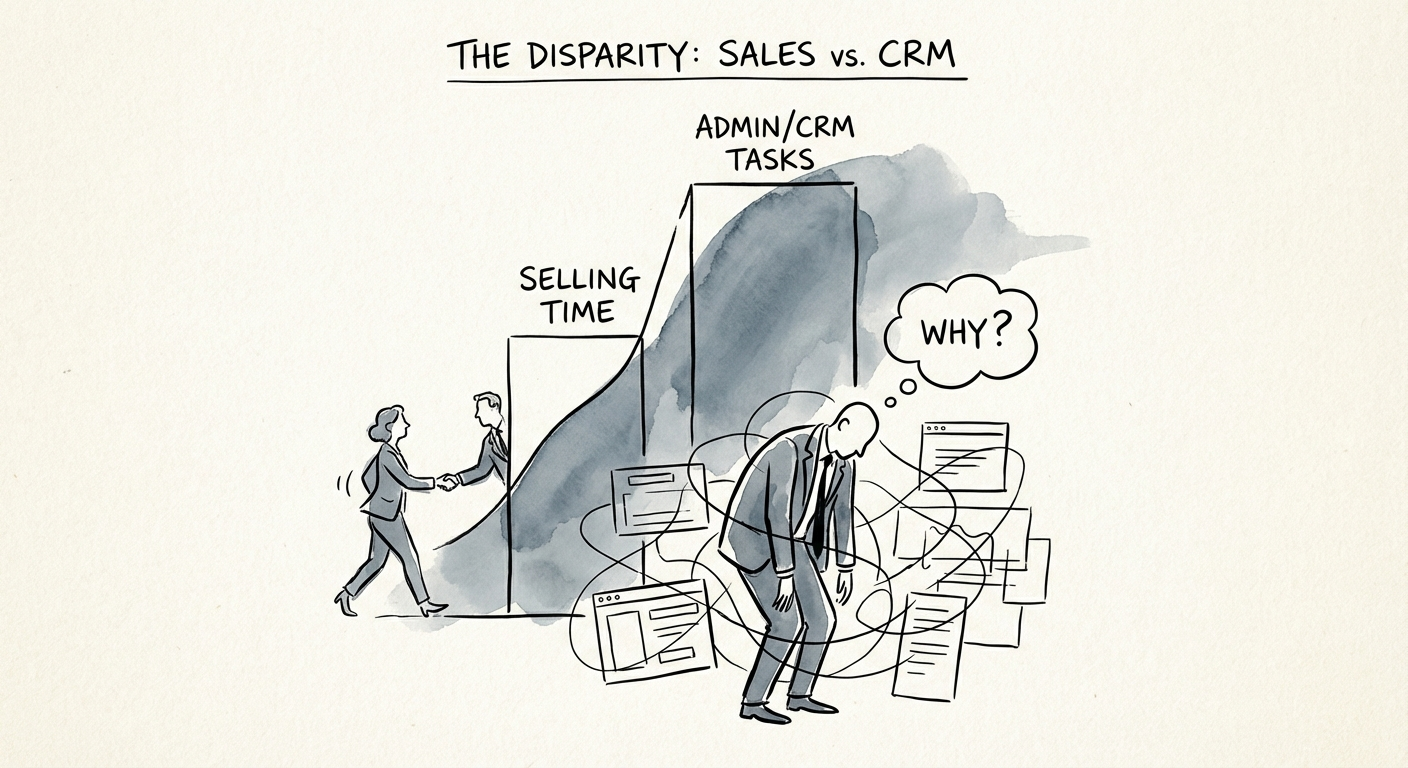
You are not alone. In 2025, despite the proliferation of AI tools and automation, sales representatives still spend only 28% to 30% of their time actually selling. The remaining 70%+ is consumed by administrative work, internal meetings, and manual data entry. Your CRM has become a compliance engine rather than a revenue engine.
The "Shadow CRM" Phenomenon
When a CRM is designed by executives for executives, it fails the end user. If your reps feel that the CRM is a tax on their time rather than a tool to help them close, they will create a "Shadow CRM." This is the spreadsheet on their desktop where the real deal status lives. They update the official CRM only 10 minutes before your pipeline meeting, usually by sandbagging dates or adding low-quality values just to satisfy required fields.
This disconnect is expensive. Gartner data estimates that poor data quality costs organizations an average of $12.9 million annually. For a Series B or C company, that cost manifests as missed forecasts, wasted marketing spend on bad contacts, and—most critically—revenue leakage because your reps are acting as data entry clerks instead of closers.
If you want to know why your team hates your CRM, look at your "Required Fields" list. Every mandatory field that does not directly help a rep close a deal is a friction point that encourages low-quality data.
If it takes 15 clicks to move a deal stage, your rep will simply wait until the end of the month to move it, destroying your ability to see real-time pipeline velocity.
The Anatomy of Adoption Failure
The problem is rarely the software itself. It is the process wrapping the software. We see three primary drivers of CRM rejection in scaling companies:
1. The "Inspection" Trap
Most founders and VPs implement CRM to inspect the sales team. They want visibility. But inspection is not value. If a rep puts data in and gets nothing out—no insights, no automation, no faster deal velocity—they will do the bare minimum. A 2025 report from Salesforce indicates that high-performing sales teams are 81% more likely to use their CRM consistently, but only because those environments have configured the tool to serve the rep, not just the manager.
2. Field Bloat
In an effort to be "data-driven," Ops teams often clutter the Opportunity object with dozens of fields: "Competitor," "Loss Reason," "Product Interest," "Marketing Source," "Next Step Date." While well-intentioned, this creates cognitive load. If it takes 15 clicks to move a deal stage, your rep will simply wait until the end of the month to move it, destroying your ability to see real-time pipeline velocity.
3. The Commission Disconnect
If you pay commissions based on signed PDFs or DocuSign envelopes, but track the deal in Salesforce, you have severed the link between the CRM and the reward. The CRM becomes optional. Adoption is not a training issue; it is an incentive issue.
When these three factors combine, you get a "inactive" instance: lots of logins, but stagnant, inaccurate data. This leads directly to the forecast accuracy crisis that plagues most Series B firms.
The Fix: From Compliance to Acceleration
You cannot nag your way to adoption. You must engineer it. Here is the 3-step playbook to turning your CRM back into a revenue engine.
1. The "Audit and Purge"
Sit down with your top sales rep (not your sales manager) and open a Deal record. For every single field, ask: "Does filling this out help you close the deal, or does it help accounting invoice the deal?" If the answer is "neither," delete it or make it optional. Your goal should be to remove 50% of the required fields. If Marketing needs attribution data, they should get it from automated tracking sources, not by forcing a sales rep to guess "Lead Source" from a dropdown menu.
2. Automate the "Drudgery"
In 2026, no human being should be manually logging emails or calls. If your tech stack doesn't automatically sync calendar invites and email threads to the Opportunity object, you are failing your team. Tools like Gong, Chorus, or simply proper HubSpot/Salesforce integration can capture this activity data passively. This frees up those 10-20 hours a week for actual selling.
3. The "No CRM, No Commission" Rule
This is the cultural hard reset. Once you have cleaned the system and automated the data entry, you must draw a line.
1. If a deal is not in the CRM, it does not exist.
2. If the forecast call relies on a spreadsheet, cancel the call.
3. If the closed-won deal isn't in the system with the correct MRR, the commission check is not cut.
This shifts the CRM from a "management tool" to the "truth source." When the CRM becomes the only path to getting paid, adoption ceases to be a problem. As you transition, keep in mind the shift from founder-led sales to a scalable system requires you to model this behavior—if you (the CEO) are still keeping deals in your head, your team will too.