
The practical answer
- Short answer
- A Vanta dashboard goes green in days. The auditor still wants six months of history. Why SOC 2 Type 2 runs 6-12 months — and how to stop bleeding deals while you wait.
- Best fit
- Industry: B2B SaaS. Function: Operations & Security
- Operating path
- Compliance & Security → Turnaround & Restructuring → Turnaround & Restructuring Services
- Key metric
- 8.4 Months Real Average Time to SOC 2 Type 2 (vs. 2 Weeks Promised)
The dashboard goes green. The deal still dies.
Picture the Tuesday this actually happens. Your biggest pipeline deal — call it a $400K ACV contract with a financial-services buyer — has cleared legal and pricing. Then it lands on the security team's desk and stops cold. The questionnaire asks for one thing: a current SOC 2 Type 2 report. You don't have one. So you do what the LinkedIn ads told you to do. You buy Vanta or Drata, connect your AWS and GitHub, and watch a satisfying number of controls flip from red to green inside a week.
Then you forward that green dashboard to the buyer's CISO, and they don't care. They want the report. The report doesn't exist yet, and it physically cannot exist for months. The deal slips to next quarter, and next quarter your champion has left.
Here is the distinction that no automation vendor puts in the ad. A Type 1 report tests whether your controls are designed correctly on a single day — you can genuinely sprint to that by adopting template policies. But enterprise procurement reads a Type 1 as a participation trophy: proof you wrote a policy, not that anyone follows it. A Type 2 report tests whether those controls actually operated over a window of time, typically six to twelve months. Vanta's own timeline guidance spells this out, and Sprinto's observation-period benchmarks say the same thing in different words: if you tell the auditor you review access logs quarterly, they need to see two consecutive quarters of evidence that you did. You cannot compress a six-month observation window into fourteen days. The software automates evidence collection — roughly 30-40% of the manual grind — but it cannot manufacture the passage of time, and it cannot make your engineers behave differently last March.
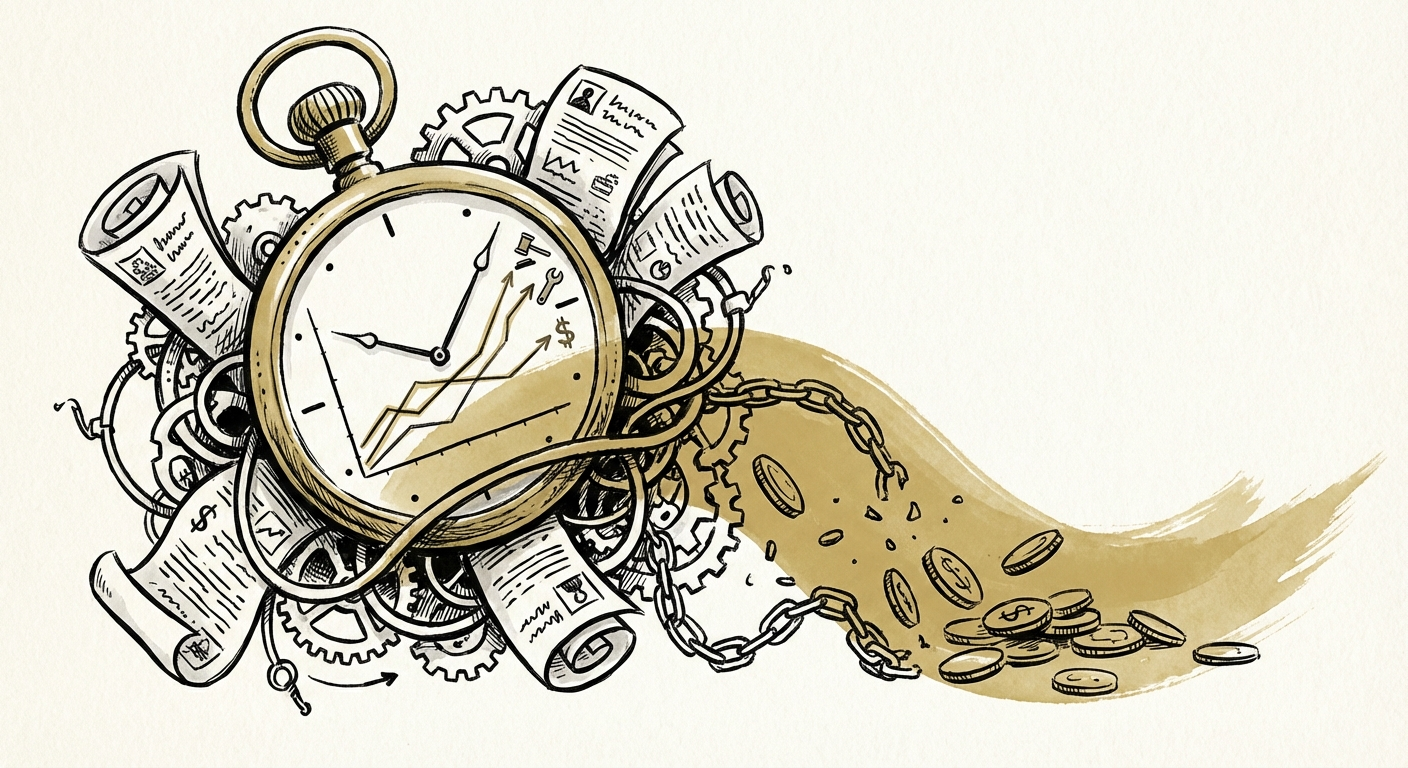
Your compliance tool is a mirror, not a janitor. It shows you the mess in high resolution and then waits for you to clean it up — and no software ever built can fast-forward six months of clean access logs the auditor hasn't seen yet.
The three places the months actually disappear
The "2 weeks vs. 9 months" gap isn't padding or auditor laziness. Across SaaS companies running their first Type 2, the real average lands around eight months, and the time vanishes into three specific sinks that have nothing to do with how fast you connect your integrations.
Sink one: the gap between "fixed today" and "true all year"
Your tool flags that fourteen people skipped security training and three offboarded engineers still hold GitHub access. You revoke everything by lunch and the control turns green. Irrelevant. The Type 2 auditor isn't asking whether it's green today — they're asking whether it was green every single day of the observation window. The engineer who shipped a hotfix straight to main "just this once" with no peer review? That's a logged exception. The contractor whose access lingered four days past their last day? Exception. The first stretch of any honest SOC 2 effort isn't audit work at all — it's retraining a team that built fast and informally to suddenly leave a clean paper trail behind every action. People fail that transition repeatedly before the habits stick. Compliance becomes a sales advantage only when it runs on muscle memory, not on a dashboard alert you action after the fact.
Sink two: the observation period you cannot negotiate away
Once the team genuinely follows the rules, the auditor starts watching — and the clock runs in calendar time, not effort. A first-timer might negotiate a three-month window, but regulated buyers in fintech and healthcare quietly distrust three-month reports the same way they distrust Type 1s. Do the arithmetic even under perfect conditions: one month of real prep, plus a three-month minimum observation window, plus a month for the auditor to write and issue the report. That's five months floor. Anyone quoting you weeks is quietly selling a Type 1 dressed up in Type 2 language.
Sink three: the evidence the software can't reach
Automation owns the machine-readable surface — cloud configs, repo settings, identity provider rules. It falls down the moment evidence lives in human judgment, which is exactly where SecureLeap documents the hidden costs piling up. "Show the board minutes where the risk assessment was reviewed." "Prove this outlier transaction got manager sign-off." "Demonstrate the vendor-risk process was actually run on the new agency you onboarded." None of that is in a dashboard, and the chase usually lands on your most expensive engineers, pulling them off the product roadmap. That's technical debt wearing a compliance badge — and it shows up as lost velocity, not a line item.
You can't cheat the clock — but you can stop wasting it
The clock is fixed. Everything around the clock is yours to manage. Three moves separate the teams that get a clean report in eight months from the ones still chasing exceptions at month fourteen.
Scope to Security only, and resist the upsell. SOC 2 has five Trust Services Criteria, and exactly one — Security — is mandatory. Founders routinely sign up for Security, Availability, and Confidentiality on the first pass and triple the workload for criteria most procurement teams never ask about. Security alone satisfies the overwhelming majority of questionnaires. Add the rest in year two, once the report has already unblocked revenue. Speed to a usable certification beats breadth of an unused one.
Run a 30-day dry run before you start the official clock. Do not declare your observation period the moment the dashboard looks tidy. Run the tool quietly for a month first and let the team break things — forgotten screen locks, skipped peer reviews, a fumbled phishing test. Every failure in the dry run is free. Every identical failure inside the real window is a documented exception that can earn you a "qualified" opinion, which is auditor language for "you failed, in writing, for your buyer to read." Only start the official clock after thirty consecutive days with no major control failure. A clean report one month late is worth far more than a qualified report on time.
Appoint a compliance owner who is not your CTO. Your CTO is too expensive and too distracted to be the person nagging about Jira tickets and uploaded evidence. Hand ownership to a director of ops or a program manager whose entire job is to chase the trail closed and pull the car over when someone isn't following the process. Drata and Vanta are worth running — they're the speedometer. They are not the driver.
So here's Monday's move: pull up your stalled deals, count how many are blocked on a SOC 2 report you don't have, and multiply by your average ACV. That number — not the ~$20K auditor fee — is the real cost of starting late. The fix is unglamorous: scope narrow, build the habits, then start the clock. For how to sequence the full timeline against revenue, see our operator's guide to SOC 2 timelines.