
The practical answer
- Short answer
- The average VP of Sales tenure has dropped to 19 months. Here is the diagnostic on why 70% of first sales leaders fail and the $2M cost of getting it wrong.
- Best fit
- Industry: SaaS / Tech Services. Function: Sales Leadership
- Operating path
- Team & Hiring → Operational Excellence → Transaction Execution Services
- Key metric
- 70% Failure rate of first-time VP Sales hires in Series B startups.
The 19-Month Revolving Door
You’ve seen this movie before. A Series B founder, flush with fresh capital and exhausted from leading sales themselves, decides it’s time to “professionalize.” They hire a VP of Sales with a sterling resume—someone from Salesforce, Oracle, or a recent unicorn exit. The board is thrilled. The team is excited. The first 90 days are a honeymoon of new dashboards and confident projections.
Then the drift begins. By month six, the forecast accuracy slips. By month nine, the “pipeline cleanup” excuse is deployed. By month twelve, the board is asking why the expensive new hires aren’t ramping. And by month 18, that “perfect” hire is gone.
This isn’t bad luck; it is a systemic failure pattern. The average tenure of a VP of Sales in B2B tech has dropped to just 19 months, down from 26 months a decade ago. For first-time VP Sales hires in startups, the failure rate hovers near 70%. This revolving door is arguably the single most expensive mistake a scaling company makes. It is not just the recruiter fees or the severance packages; it is the ‘Lost Year’ of growth that you can never buy back.
When you account for the “vacancy period” (4 months), the “ramp period” of the next hire (6 months), and the opportunity cost of missed revenue, the total impact of a failed sales leader sits between $2M and $5M for a mid-market firm. If you are reading this, you are likely either in the middle of this cycle or about to start it. Here is why it happens.
It’s not a talent problem; it’s a systems problem. 67% of VP Sales hires fail within 18 months because they are hired to scale a process that doesn’t exist yet.
The Big Logo Fallacy and Stage Mismatch
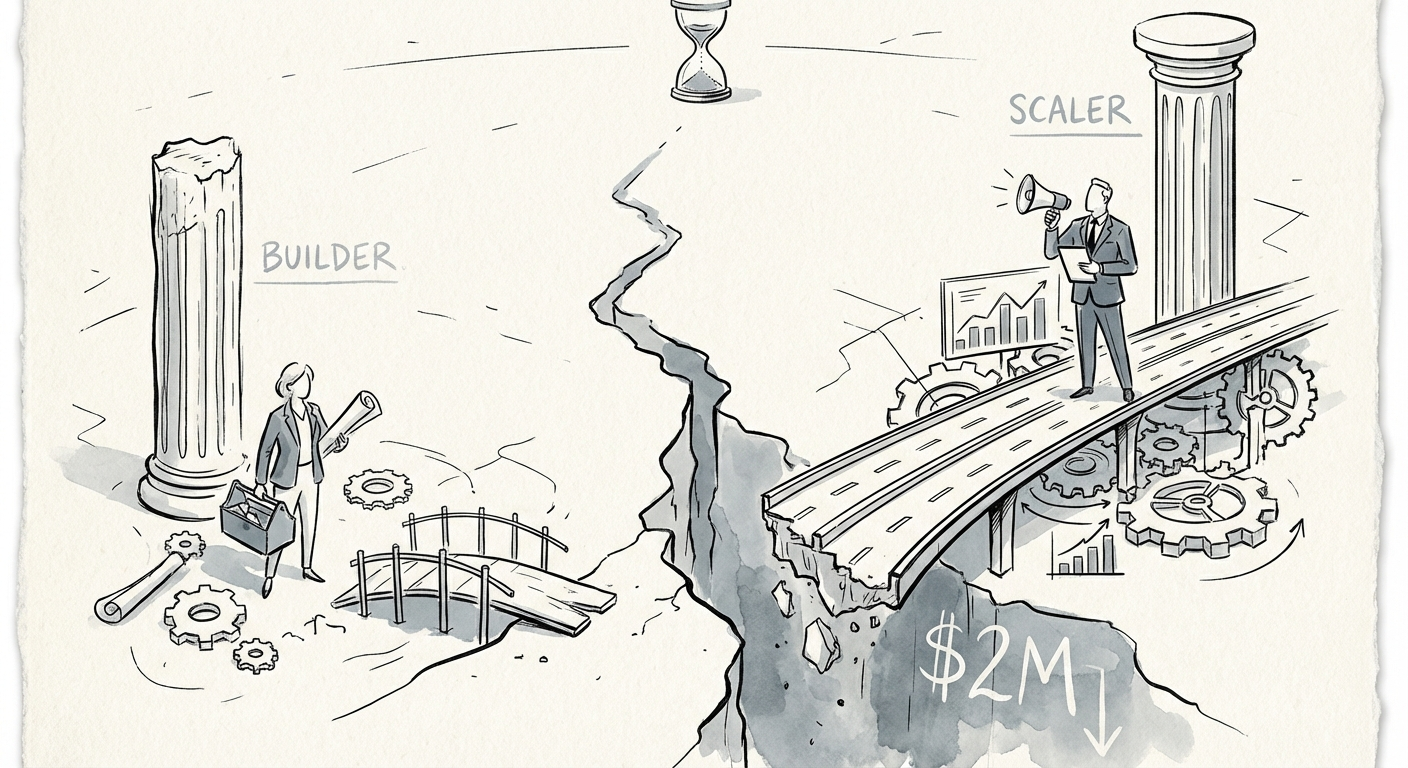
The primary driver of this failure is not incompetence; it is Stage Mismatch. Founders often hire for where they want to be (IPO track) rather than where they are (scrappy scaling). They hire a “captain” to sail the ship when they actually need a “mechanic” to build the engine.
A VP who thrived at a $100M ARR company is used to inheriting a working machine. They have brand recognition, a dedicated RevOps team, and established enablement programs. Drop that same person into a $10M ARR company with tribal knowledge and no playbook, and they will suffocate. They attempt to solve problems by hiring more bodies (the only lever they know) rather than fixing the underlying unit economics.
The Data Behind the Failure
- Process Void: Companies with a documented sales process before hiring a VP have an 83% success rate. Those who expect the VP to come in and build the process from scratch see that success rate drop to 34%. You cannot outsource the foundation.
- The Quota Gap: Industry-wide quota attainment has dropped from 63% to 50% over the last five years. This signals that “hero tactics” no longer work. If your new VP relies on hiring “rolodex reps” rather than building a scalable system, they will fail mathematically.
- The Ramping Illusion: Founders often ignore early warning signs because they believe the VP needs more time. But the data shows that sales rep ramp times are lengthening, and a leader who cannot shorten that cycle within their first two quarters is unlikely to ever do so.
We often see founders hire a “dashboard manager” when they need a “deal doctor.” The former reports the news; the latter makes the news. If your VP hasn’t personally closed a deal or sourced a lead in the last three years, they are likely the wrong hire for a Series B firm.
The Diagnostic: How to Break the Cycle
To avoid the 18-month cliff, you must change your hiring criteria from “pedigree” to “proof of building.” Stop looking for the logo on their resume and start looking for the fingerprints on their previous builds.
The 3-Step Validation Framework
- The ‘Two Hires’ Rule: Do not hire a VP unless they can prove they hired at least two reps at their previous gig who hit quota. Many “successful” VPs simply rode the wave of a product that sold itself. You need to know they can identify and coach talent, not just inherit it.
- The Playbook Audit: Ask to see their playbook. Literally. If they describe vague philosophies about “relationship building” but cannot show you a documented stage-gate process, a hiring scorecard, or a transition plan from founder-led sales, they are not a builder.
- The 30-Day Impact Test: A great VP impacts the organization immediately, well before revenue shows up. In the first 30 days, they should have diagnosed the pipeline, fired the “can’t close” reps, and simplified the CRM. If they are still “observing” at Day 60, they are failing.
Finally, recognize that the cost of inaction is worse than the cost of admission. If you have a VP currently in the “drift” phase—nice person, great resume, but flat revenue—you are bleeding enterprise value every day you wait. The real cost of mis-hires isn't the salary; it's the competitors capturing your market while your sales leader makes excuses.