The practical answer
- Short answer
- Gartner predicts 70% of ERP projects will fail by 2027. Here are the 10 root causes of failure and the operational playbook to fix them.
- Best fit
- Industry: Enterprise Tech. Function: IT Leadership
- Operating path
- Project Recovery → Turnaround & Restructuring → Transaction Execution Services
- Key metric
- 70% Of ERP initiatives fail to meet original goals by 2027 (Gartner)
The $100 Million Paperweight
You didn’t sign up for this. You signed up to modernize a legacy stack that was held together by duct tape and prayers. But eighteen months later, you are staring at a Gantt chart that hasn’t moved in six weeks, a steering committee that has stopped showing up, and a budget that is bleeding red ink.
You are not alone in this trench. According to recent data from Gartner, more than 70% of ERP initiatives are predicted to fail to fully meet their original business goals by 2027. We aren’t talking about minor glitches. We are talking about failures where the system is either abandoned or delivers zero ROI after millions in spend.
For enterprise CIOs, an ERP failure isn’t just a bad quarter; it is a career-ending event. It freezes capital, demoralizes engineering teams, and forces the business to retreat to the very spreadsheets you promised to kill. The market is littered with these cautionary tales, yet year after year, smart leaders make the same ten mistakes. Here is why your project is failing, and more importantly, how to stop the bleeding.
You can't implement SAP or Oracle as a side hustle. If your best people aren't dedicated 100% to the project, you are signaling that it's not a priority.
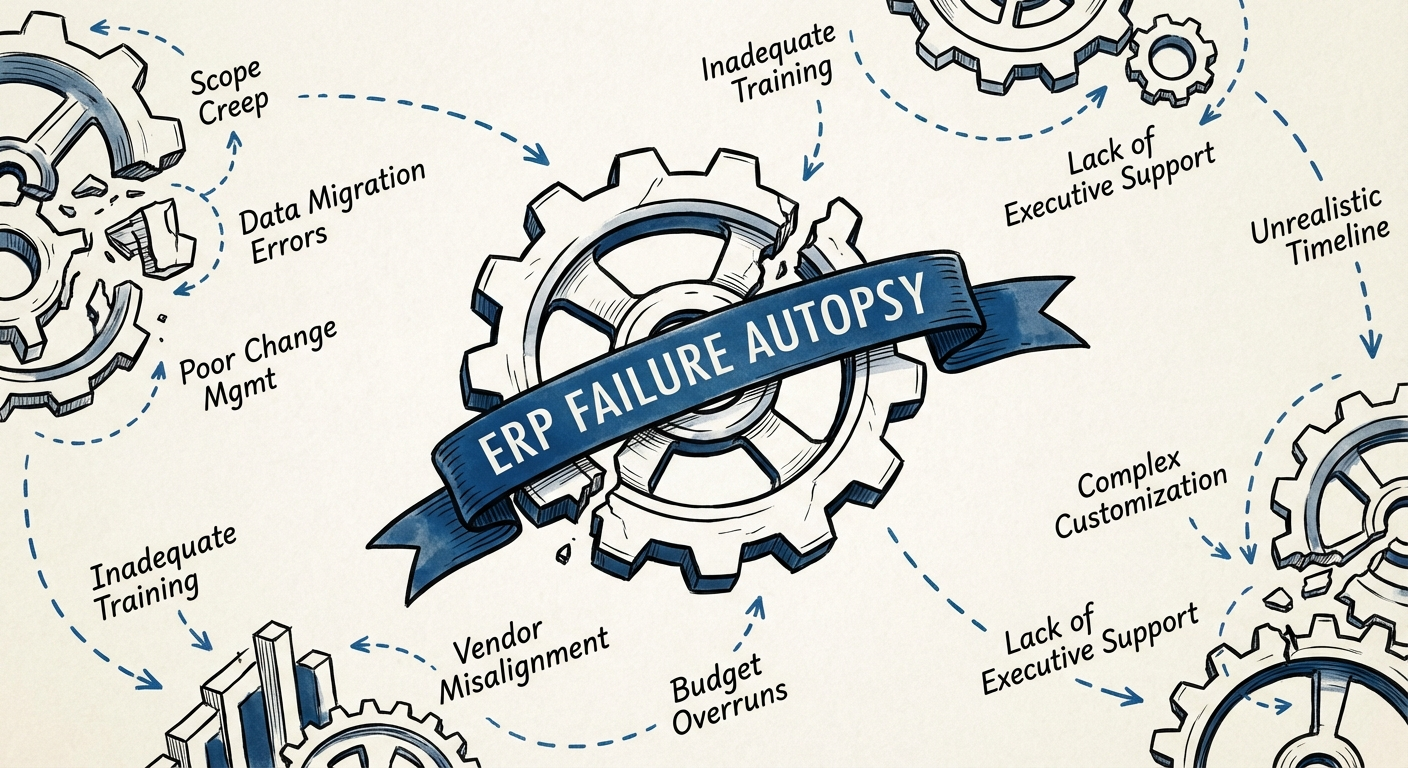
The 10 Horsemen of the ERP Apocalypse
We have audited dozens of stalled implementations. The technology is rarely the root cause. The failure is almost always operational. Here are the ten reasons your ERP is stuck, backed by 2025 market data.
1. The Customization Death Spiral
Your business is unique, but your General Ledger is not. Yet, teams consistently customize core ERP logic to match broken legacy processes. This creates immediate technical debt and breaks the upgrade path. The Fix: Adopt a "Vanilla First" policy. If a process doesn't fit the standard ERP workflow, change the process, not the code.
2. The "Part-Time" Core Team
You cannot implement SAP or Oracle as a side hustle. 38% of budget overruns are caused by underestimated staffing. If your best people are not dedicated 100% to the project, you are signaling that it is not a priority. The Fix: Backfill their day jobs. If you can't afford to backfill them, you can't afford the ERP.
3. Data Migration Denial
Data is the silent killer. Most teams underestimate the rot in their legacy data until UAT (User Acceptance Testing). By then, it is too late. Migrating dirty data into a new system is just an expensive way to confuse your users. Read our Data Migration Zero-Defect Framework for the technical specifics on cleaning this up before migration begins.
4. The Governance Vacuum
Who breaks the tie when Finance wants X and Operations wants Y? In failing projects, the answer is "nobody." The decision sits in committee for weeks, stalling the integrators. The Fix: Establish a "24-Hour Rule" for decisions. If the steering committee can't decide, the Executive Sponsor casts the tie-breaking vote immediately.
5. Scope Creep by Committee
64% of ERP projects face delays due to scope changes. Stakeholders treat the ERP like a Christmas tree, hanging every wish-list item on it. This dilutes focus and bloats the timeline. The Fix: Freeze the scope at the design sign-off. Any new request goes into a "Phase 2" parking lot, no exceptions.
6. Testing Theater
Teams under time pressure cut testing first. They run "happy path" scenarios and ignore the edge cases. Then they go live, and the system crashes when a customer tries to return a partial order. The Fix: Automate regression testing early. Force users to break the system in UAT, not just validate it.
7. Change Management Fluff
Sending a newsletter is not change management. Real resistance happens when a warehouse manager realizes he has to click five times instead of writing on a clipboard. If you don't address the workflow friction, adoption will be zero. McKinsey data shows that 70% of transformations fail due to people and culture issues.
8. The Integration Hairball
Modern ERPs must talk to CRMs, WMSs, and eCommerce platforms. Failing to map these integrations in detail leads to data silos. The Fix: Treat integrations as their own workstream with dedicated architects, not an afterthought for the functional leads.
9. Vendor Hostage Situations
Your System Integrator (SI) loves change orders. If you haven't structured the contract with clear deliverables and penalties, they have no incentive to finish on time. The Fix: Tie payments to milestones, not hours. If the milestone slips, the payment slips.
10. The "Big Bang" Delusion
Trying to go live with all modules, in all regions, on the same day is too risky. It compounds risk and overwhelms support teams. The Fix: Phase the rollout. Start with a pilot region or a single business unit. Prove the model, then scale.
The 30-Day Recovery Action Plan
If you are reading this and your project is already in the red, you don't need more slides. You need an intervention. We call this the "Project Reset."
- Week 1: The Audit. Stop all non-critical development. Audit the true status of the code, the data, and the budget. Be disciplined. If a module is 20% done but 100% over budget, cut it.
- Week 2: The Governance Reset. Dissolve the current committee. Install a small "War Room" team of 3-4 decision makers with absolute authority. Implement the protocols to unblock committee deadlock immediately.
- Week 3: The Rescope. Descope everything that is not critical for Day 1 operations. Move nice-to-haves to Phase 2. Your goal is a Minimum Viable ERP (MVE).
- Week 4: The Relaunch. Re-baseline the plan with the new scope and the new team. Communicate the new "go-live" date, and stick to it.
ERP failure is not inevitable, but recovery requires the courage to admit the current plan is broken. You can either be the leader who paused the project to save it, or the leader who drove it off a cliff while claiming everything was "green." The choice is yours.
For a detailed breakdown on salvaging a project that has gone off the rails, review our full ERP Implementation Rescue Guide.