
The practical answer
- Short answer
- Learn the Zero-Defect Framework that protects data integrity, reduces downtime risk, and prevents missing-record support issues.
- Best fit
- Industry: Enterprise Tech. Function: IT & Engineering
- Operating path
- Migration & Integration → Turnaround & Restructuring → Transaction Advisory Services
- Key metric
- 100% Critical financial and customer records that should be reconciled, not spot-checked.
The "Acceptable Loss" Fallacy
In the boardroom, the migration plan looks clean. A Gantt chart shows a tidy cutover weekend. The steering committee nods when you mention industry-standard error rates. But in data migration, small error rates can still create major business problems.
The most dangerous issue is not only delay; it is the data integrity gap. In a database of 10 million customer records, a 1% error margin can mean 100,000 corrupted profiles, lost orders, or broken billing connections. That is not a technical detail. It is a revenue and customer trust problem.
For enterprise CIOs, the nightmare is silent corruption: field mappings that drift, historical invoices that do not tally, and cost overruns caused by fixing data in production instead of staging.
If you are planning a migration based on spot checks and row counts, you need a stronger validation framework. We call it the Zero-Defect Protocol.
If you are migrating 50 million records, you run 50 million comparisons. This processing cost is rounding error compared to the cost of 28,000 users calling support.
The Zero-Defect Framework: Beyond Row Counts
Most migration teams stop at row counts. "Source has 1,000,000 rows. Target has 1,000,000 rows. We're good." This is negligence. If 5,000 rows are empty nulls and 5,000 are duplicate keys, your row count is perfect, but your business is broken. To achieve 0% data loss, you must move from counting to fingerprinting.
1. The Cryptographic Handshake (Hashing)
Do not trust the database logs. Implement a cryptographic hash (MD5 or SHA-256) of the critical value columns for every single record in the source system. When the record lands in the target system, re-hash it. If the hashes don't match, the record is rejected and flagged for automated remediation. This is binary: it is either identical, or it is wrong. There is no "close enough."
2. The 100% Automated Reconciliation
Spot-checking 50 random records is theater, not validation. Your scripts must compare 100% of financial fields (balances, lifetime value, contract dates) across systems. If you are migrating 50 million records, you run 50 million comparisons. This processing cost is rounding error compared to the cost of 28,000 users calling support because their login doesn't work.
3. The "Blue-Green" Parallel Run
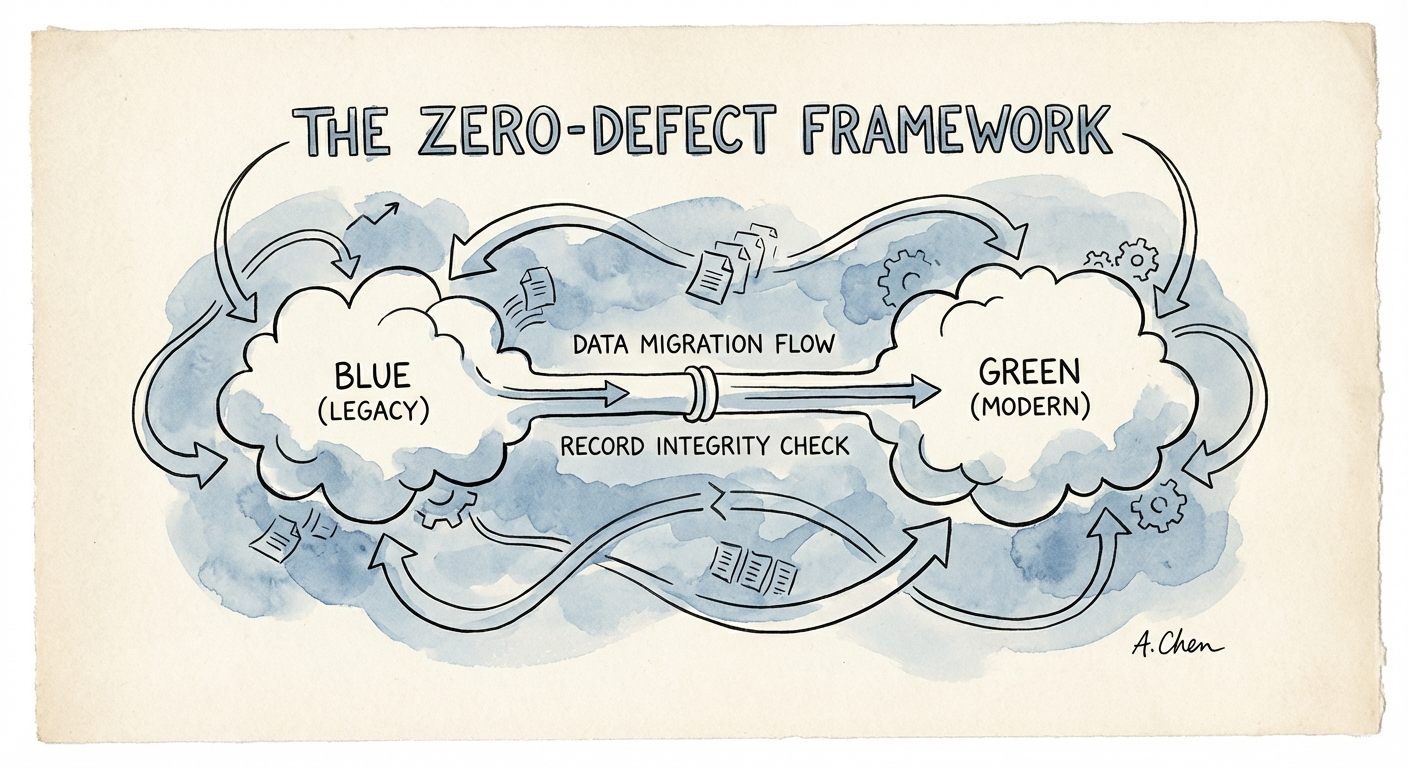
Never flip the switch blindly. Run the old system (Blue) and new system (Green) in parallel for a minimum of two billing cycles. Feed live production transactions into both. If the output—invoices generated, API calls fired—differs by even a cent or a byte, the migration halts. This is your safety net against logic errors that static data validation can't catch.
- Benchmark: Successful zero-defect migrations spend 60% of their timeline on validation scripting and only 40% on the actual move.
- Metric: Bloor Research notes that data quality issues are the #1 cause of migration delays, yet teams under-budget for validation by an average of 50%.
The Governance of "No"
The technical framework is useless without authority to enforce it. You must establish clear go/no-go governance.
Create a scorecard that is visible to the entire steering committee. This scorecard must include binary pass/fail criteria:
- Criteria 1: 0% hash mismatch on financial data.
- Criteria 2: 100% reconciliation of active customer records.
- Criteria 3: 3 consecutive dry runs with zero Sev-1 defects.
If any criterion is red, the launch pauses. You frame this not as a delay, but as risk mitigation. As we discuss in our 30-Day Governance Fix, clear criteria remove emotion from the decision.
The Result
The benchmark we use is simple: no lost records, no avoidable downtime, and no support surge caused by data integrity errors.
Migration is not about moving data. It is about proving that the business is safer in the new system than the old one.