
The practical answer
- Short answer
- Don't sign the LOI until you ask these 50 questions. 70% of deals fail in diligence—use this diagnostic to spot revenue leakage, technical debt, and key-person risk early.
- Best fit
- Industry: Private Equity. Function: M&A Operations
- Operating path
- Exit Readiness → Operational Excellence → Transaction Advisory Services
- Key metric
- 70% M&A Deals that Fail to Meet Objectives
The Winner's Curse: Why 70% of Deals Die in the Data Room
There is a specific kind of fever that takes over an investment committee when a deal book looks perfect. The EBITDA margins are 28%, the founder is charismatic, and the growth curve looks like a hockey stick. You feel the pressure to move fast, preempt the auction, and get the Letter of Intent (LOI) signed before a competitor swoops in.
Stop.
Signing the LOI is the moment you lose your leverage. Once that document is inked, the clock starts ticking against you. Exclusivity periods burn fast, and broken deal costs begin to mount—costs that funds still bear 73% of the time, regardless of whether the deal closes. More dangerously, you enter the "confirmation bias" zone, where your team unconsciously looks for reasons to keep the deal alive rather than reasons to remove it.
The statistics are brutal. Recent data indicates that between 50% and 70% of M&A transactions fail to close after the initial agreement is struck. Even worse, for technology acquisitions, 60% of acquirers later regret the deal due to missed synergy targets or hidden technical debt. The primary culprit is rarely the headline price; it is the operational and technical reality lurking beneath the spreadsheet.
As an Operating Partner, your job isn't just to validate the financials—it's to validate the engine that produces them. Financial engineering can obscure a lot of sins, but it cannot fix a codebase that requires a total rewrite or a sales team that only closes when the founder is in the room. This checklist is your shield against the Winner's Curse.
Financial engineering can obscure a lot of sins, but it cannot fix a codebase that requires a total rewrite or a sales team that only closes when the founder is in the room.
The 50-Point Diagnostic: A Framework for Decisive Diligence
You don't need generic questions about "culture." You need binary inputs that determine if this asset is a platform for growth or a money pit. We break these down into five critical diligence vectors: Financial, Commercial, Operational, Technical, and Legal/Compliance.
I. Financial Quality (The Earnings Reality)
Don't just trust the CIM. Look for the manipulation of 'Adjusted EBITDA.'
- 1. What is the bridge between Statutory EBITDA and Adjusted EBITDA, and are the add-backs truly one-time?
- 2. Has the company capitalized software development costs aggressively to inflate current earnings?
- 3. What is the exact working capital peg, and has it been manipulated by delaying payables this quarter?
- 4. Are there any "change of control" bonuses buried in G&A expenses?
- 5. What is the granular trend of Gross Margin by product line over the last 24 months?
- 6. Have pricing increases been used to mask volume declines?
- 7. What is the Revenue Recognition policy regarding implementation fees? (Are they booking one-time service revenue as ARR?)
- 8. What is the Days Sales Outstanding (DSO) trend for the top 10 customers?
- 9. Are there undisclosed liabilities related to under-accrued sales commissions?
- 10. What is the "burdened" cost of delivery when including all client-facing support staff?
II. Commercial & Revenue Architecture
Is the growth repeatable, or was it luck?
- 11. What is the Net Revenue Retention (NRR) by cohort for the last 3 years? (If it's under 100%, why?)
- 12. What is the customer concentration? Does any single client represent >10% of revenue?
- 13. If the top customer left tomorrow, would the business remain profitable?
- 14. What is the CAC Payback Period on a fully loaded basis (including S&M salaries)?
- 15. What is the win rate when the founder is not involved in the sales cycle?
- 16. Is the pipeline coverage ratio based on qualified opportunities or just "hope"?
- 17. Do contracts contain "termination for convenience" clauses?
- 18. What is the average discount rate given at the end of the quarter vs. the beginning?
- 19. Are upsells driven by product value or just price increases?
- 20. What is the churn rate in the first 90 days of a new customer relationship?
III. Operational Scalability
Can this business run without the founder?
- 21. Is there a documented Founder Extraction plan, or is the CEO the "Chief Everything Officer"?
- 22. What percentage of tribal knowledge exists solely in the heads of key employees?
- 23. Are standard operating procedures (SOPs) documented, or is delivery ad-hoc?
- 24. What is the voluntary turnover rate in the delivery/operations team?
- 25. Are there key-person dependencies in the engineering or product leadership?
- 26. How much of the current margin is sustained by underpaying staff relative to market rates?
- 27. Is the organizational chart structured for scale, or is it a flat "spoke-and-wheel" around the founder?
- 28. What is the utilization rate of the professional services team? (Is it unnaturally high, signaling burnout?)
- 29. Are there shadow IT systems running critical business processes (e.g., Excel sheets running billing)?
- 30. How long does it take to onboard a new productive employee?
IV. Technical & Product Health
The invisible deal killer. 53% of tech deals miss synergy targets because of this section.
- 31. Quantify the Technical Debt: How many man-hours are required to modernize the stack?
- 32. Is the core IP built on end-of-life languages or unsupported frameworks?
- 33. What percentage of the codebase is open source, and are the licenses compliant?
- 34. Has the product been "spaghetti-coded" to meet custom requests for single large clients?
- 35. What is the ratio of R&D spend on "keeping the lights on" (maintenance) vs. new features?
- 36. Can the architecture support 10x the current user load without a rewrite?
- 37. Are there single points of failure in the infrastructure (e.g., one database server with no failover)?
- 38. When was the last third-party penetration test, and were critical vulnerabilities remediated?
- 39. Is the deployment process automated (CI/CD), or is it manual and error-prone?
- 40. Does the roadmap actually exist, or is it just a sales wish list?
V. Legal, Compliance & Security
The latent risks.
- 41. Is the company compliant with GDPR/CCPA/SOC 2 where applicable?
- 42. Are there any past or pending lawsuits regarding IP infringement?
- 43. Have all employees and contractors signed IP assignment agreements?
- 44. Are there any "change of control" provisions in key vendor or customer contracts?
- 45. Is the company under-insured for cyber liability given its data risk profile?
- 46. Are there any open tax liabilities in nexus states where they sell but don't file?
- 47. What is the status of non-competes for the exiting management team?
- 48. Are there any environmental or regulatory skeletons in the closet?
- 49. Has the company experienced a data breach in the last 3 years?
- 50. Are there undisclosed related-party transactions (e.g., renting the office from the CEO's spouse)?
The Decision Matrix: Re-Trade, Fix, or Kill
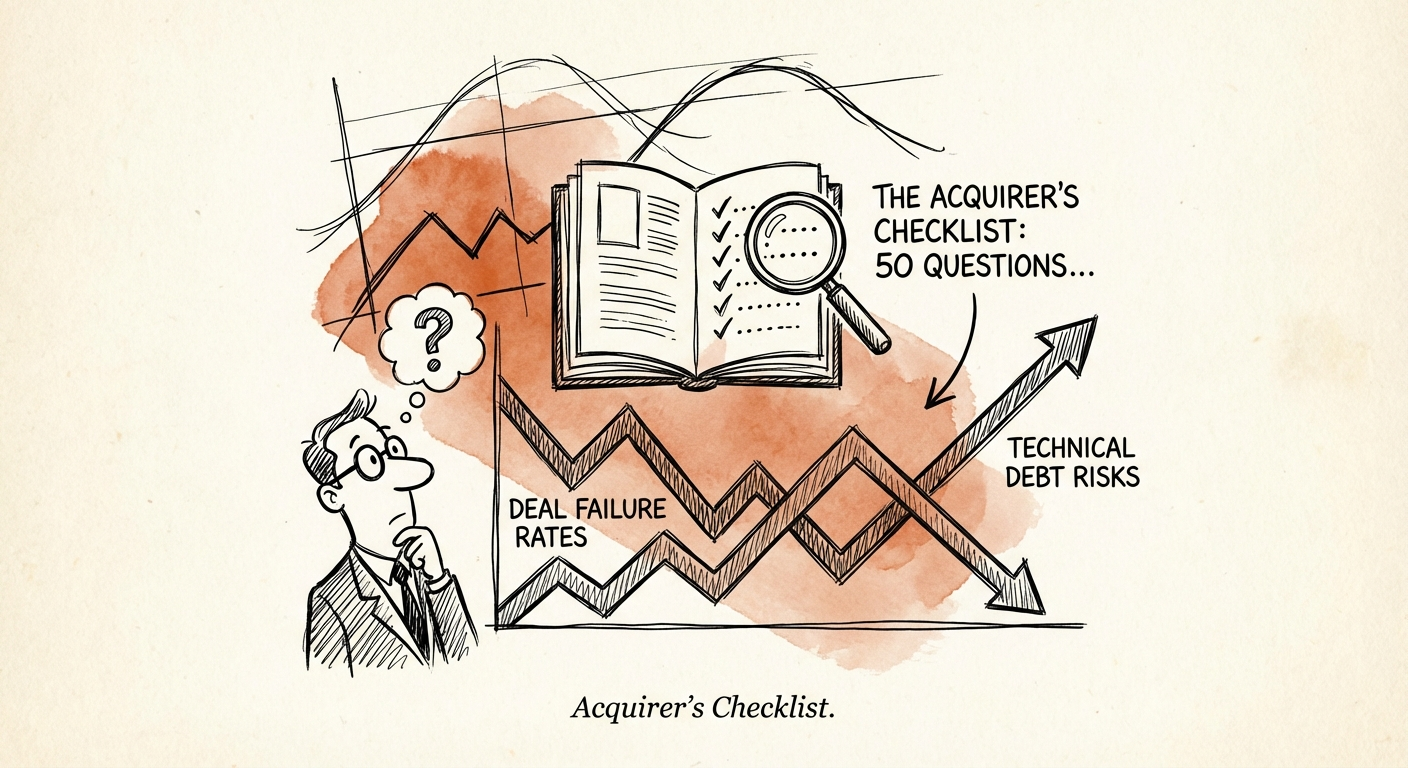
Getting answers to these 50 questions is not just an academic exercise; it is a mechanism for valuation defense. When you find that the "proprietary AI" is actually an outsourced team in a low-cost geography using open-source libraries (Question 32), or that 40% of revenue is tied to a customer with a cancellation-for-convenience clause (Question 17), you have three options:
1. The Re-Trade (Valuation Adjustment)
If the business is fundamentally sound but carries hidden debt—whether financial, technical, or operational—you re-price the risk. We recently advised a PE firm that discovered significant technical debt during diligence. Instead of walking away, they used the findings to negotiate a $4M reduction in the purchase price, earmarking those funds specifically for a "remediation capex" budget post-close. Use the data to adjust EBITDA add-backs or increase the escrow holdback.
2. The Structure Fix (Earnouts & Governance)
If the risk is behavioral (e.g., founder dependency or unproven pipeline), solve it with deal structure. Shift more of the consideration into an earnout tied to Gross Profit rather than Revenue, forcing the seller to maintain margin discipline. Mandate the hiring of a professional COO as a closing condition to solve the "spoke-and-wheel" management issue.
3. The Kill (Walking Away)
There are some bells you cannot un-ring. If the revenue recognition is fraudulent, the IP is stolen/encumbered, or the customer concentration risk is existential (e.g., 60% of revenue with one client who is currently running an RFP), change the deal. The cost of broken deal fees is a rounding error compared to the cost of a writedown. As the adage goes in private equity: "The best deal you ever do is the bad one you didn't close."
Diligence is not a box-checking exercise. It is the first step of your Value Creation Plan. If you don't ask these questions now, you will be paying for the answers later.