The Compliance Deadlock: Defense Requirements on a Commercial Budget
For the Enterprise CIO or VP of Engineering in the mid-market, the world just got significantly more expensive. If you are operating in the Defense Industrial Base (DIB), healthcare, or critical infrastructure, the mandate has shifted from "reasonable security" to "defense-grade assurance." The arrival of CMMC 2.0 (Cybersecurity Maturity Model Certification) has turned what was once a paperwork exercise into a binary survival metric: get certified or lose the contract.
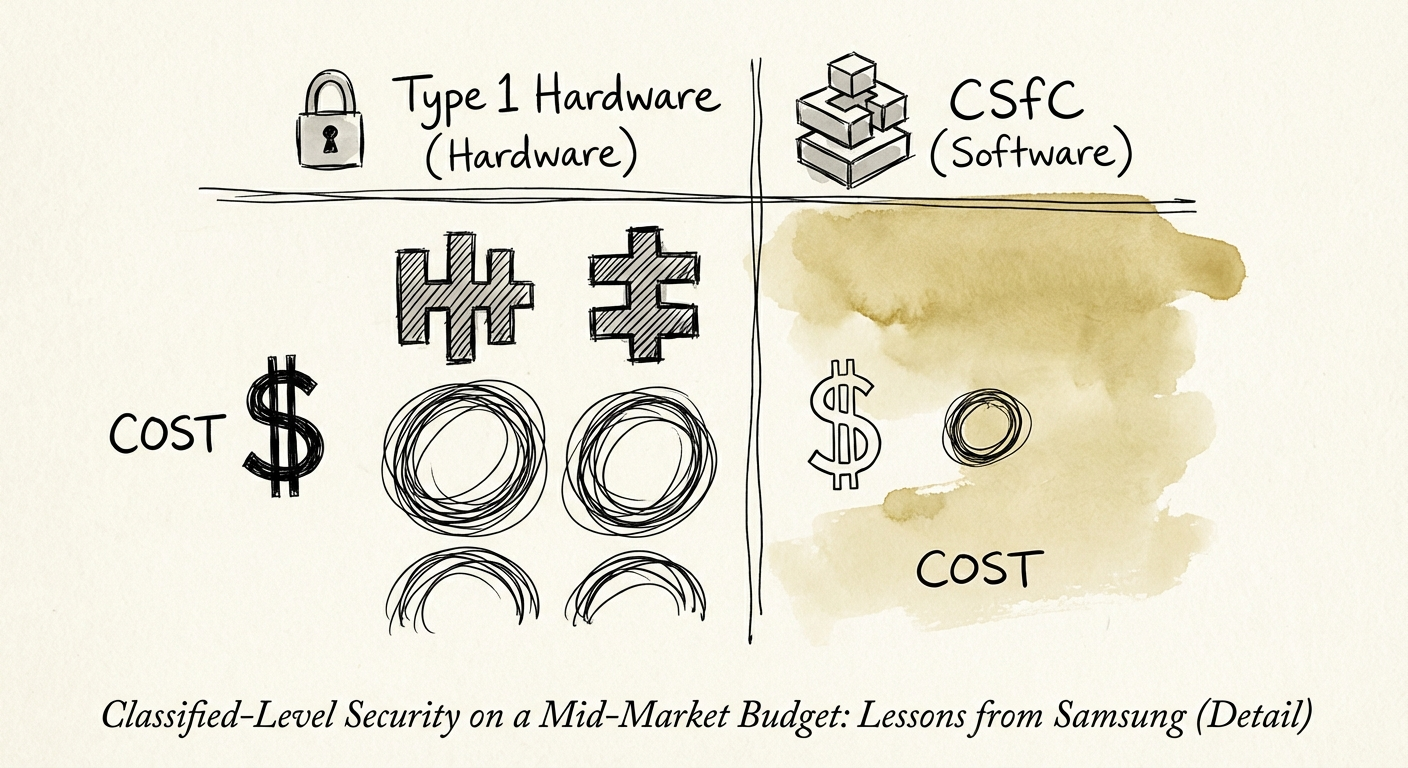
The problem is the math. Traditional "Classified" security—the kind used by the NSA and DoD—was historically built on Type 1 encryption. These are bespoke, proprietary hardware devices, physically hardened, astronomically expensive, and requiring specialized handlers. For a Fortune 100 contractor like Lockheed Martin, buying $5,000 encrypted hard drives and maintaining SCIFs (Sensitive Compartmented Information Facilities) is a rounding error. for a mid-market firm with $50M in revenue, it is EBITDA suicide.
You are likely facing a "Transition Tom" scenario: A major digital transformation or new market entry is stalled because your security architecture cannot satisfy a governance committee or a prime contractor’s flow-down requirements. You are stuck between a board that refuses to double your IT budget and a Compliance Officer who refuses to sign off on the risk.
The way out isn't to buy more expensive hardware. It's to change the architecture entirely. The precedent for this shift comes from a semiconductor fab context where commercial mobile hardware could satisfy classified-use requirements through layered controls.
The Semiconductor Fab Proof Point: Commercial Solutions for Classified (CSfC)
In 2014, a quiet revolution occurred in government security. The NSA approved commercial mobile devices for use under the Commercial Solutions for Classified (CSfC) program. This was a paradigm shift. For decades, "classified" meant "custom." Suddenly, the NSA admitted that mass-produced, commercial-off-the-shelf (COTS) hardware—if properly architected—could be trusted with the nation's secrets.
The CSfC Methodology: Layering > Hardening
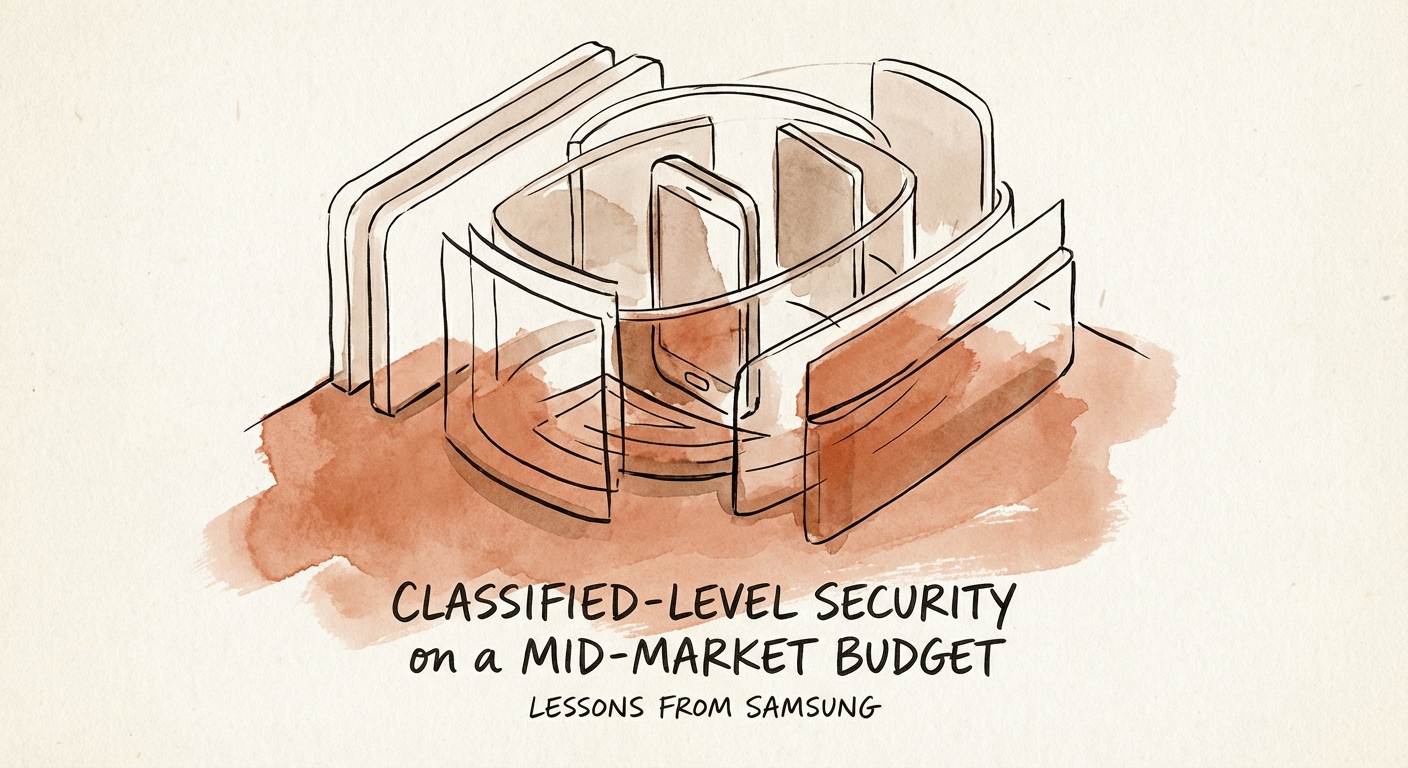
The lesson for the mid-market CIO is not to go buy a specific phone fleet. The lesson is how a semiconductor fab context satisfied the certification pattern: not by building a thicker device, but by building a smarter stack. The CSfC framework replaces the "unbreakable box" (Type 1) with the "redundant layers" principle.
To achieve classified handling on a commercial budget, you must adopt two core CSfC rules:
- The Rule of Two: You do not rely on one perfect firewall or one perfect encryption key. You use two independent layers of encryption (e.g., a VPN inside a VPN, or file-level encryption inside disk-level encryption). If one layer has a zero-day vulnerability, the second holds the line.
- Diversity of Defense: The two layers should ideally come from different vendors or use different algorithms. This exponentially increases the cost of attack for an adversary while only incrementally increasing the cost of implementation for you.
The Financial Impact: Breaking the 53% Tax
We call the cost of security deadlock the 53% Tax—the hidden operational drag of stalled projects. By adopting a CSfC-style approach (Software-Defined Security on commodity hardware), you bypass the need for proprietary hardware.
Consider the benchmarks. Achieving CMMC Level 2 compliance involves 110 controls from NIST SP 800-171. Recent data places the cost for a mid-sized firm (50-250 employees) between $175,000 and $233,000 for initial preparation and assessment. If you attempt to meet these controls using legacy "Type 1" thinking—dedicated circuits, air-gapped hardware, and proprietary encryption appliances—that cost can easily triple.
Modern cybersecurity risks aren't mitigated by spending more; they are mitigated by architecting better. The semiconductor fab example proved that a commercial device, when wrapped in the right policy and software, can be more secure than a $5,000 legacy encryptor that hasn't been patched in three years.
Action Plan: The 90-Day Architecture Pivot
If your digital transformation is stuck in committee due to security concerns, or if you are staring down a CMMC audit with a terrified wallet, execute this three-step pivot.
1. The Hardware Purge (Days 1-30)
Audit your current security spend. Identify every line item that is "proprietary security hardware." If you are paying for dedicated encryption bridges or legacy VPN concentrators, mark them for replacement. Your goal is to move to software-defined perimeters (SDP) and Zero Trust Network Access (ZTNA) that run on commodity servers or cloud infrastructure. Metric to watch: Reduction in hardware maintenance contracts.
2. Implement the "Two-Layer" Standard (Days 31-60)
For your most sensitive data (CUI or IP), implement the CSfC "tunneled" approach. Do not trust the transport. Use application-layer encryption on top of network-layer encryption. For mobile fleets, enforce the "Dual-DAR" (Dual Data-at-Rest) standard found in modern MDM profiles. This satisfies the "Defense in Depth" requirement of CMMC without requiring you to issue James Bond gadgets to your sales team.
3. Governance as Code (Days 61-90)
The semiconductor fab approval wasn't just about the chip; it was about the Protection Profile (MDFPP). You must document your configuration management. Most mid-market firms fail audits not because they lack security, but because they lack proof of security. Automate your compliance reporting. If you can't prove the configuration state of an endpoint in real-time, it is not secure.
Conclusion: Systems, Not Heroes
The days of security through obscurity are over. The days of security through infinite budget are gone. The winning strategy for the mid-market CIO is Security through Standardization. By adopting the architectural lessons of the CSfC program—layering commercial technologies to achieve classified results—you don't just pass the audit. You unlock the agility your business needs to scale.