
The practical answer
- Short answer
- If your month-end close takes 15 days, you are operating in a 50% blind zone. Benchmarks show top performers close in 4 days. Here is how to fix it.
- Best fit
- Industry: B2B SaaS. Function: Office of the CFO
- Operating path
- Financial Infrastructure → Commercial Performance → Valuations
- Key metric
- 61% CFOs cite outdated info as top agility barrier
The 20th of the Month: An Autopsy, Not a Report
If you are a founder or CEO of a mid-market company, you likely know this feeling well: It is the 18th of the month. You have a board meeting in three days. You are trying to decide whether to approve a new headcount request for engineering or if you need to pull back on marketing spend because the pipeline looks soft.
You ask your Controller or VP of Finance for last month’s numbers. The response? “We’re still finalizing the accruals. I need two more days.”
By the time you get the P&L, it is the 20th. Two-thirds of the current month is already gone. You are making decisions for June based on April’s data. You aren’t steering the ship; you are looking at the wake.
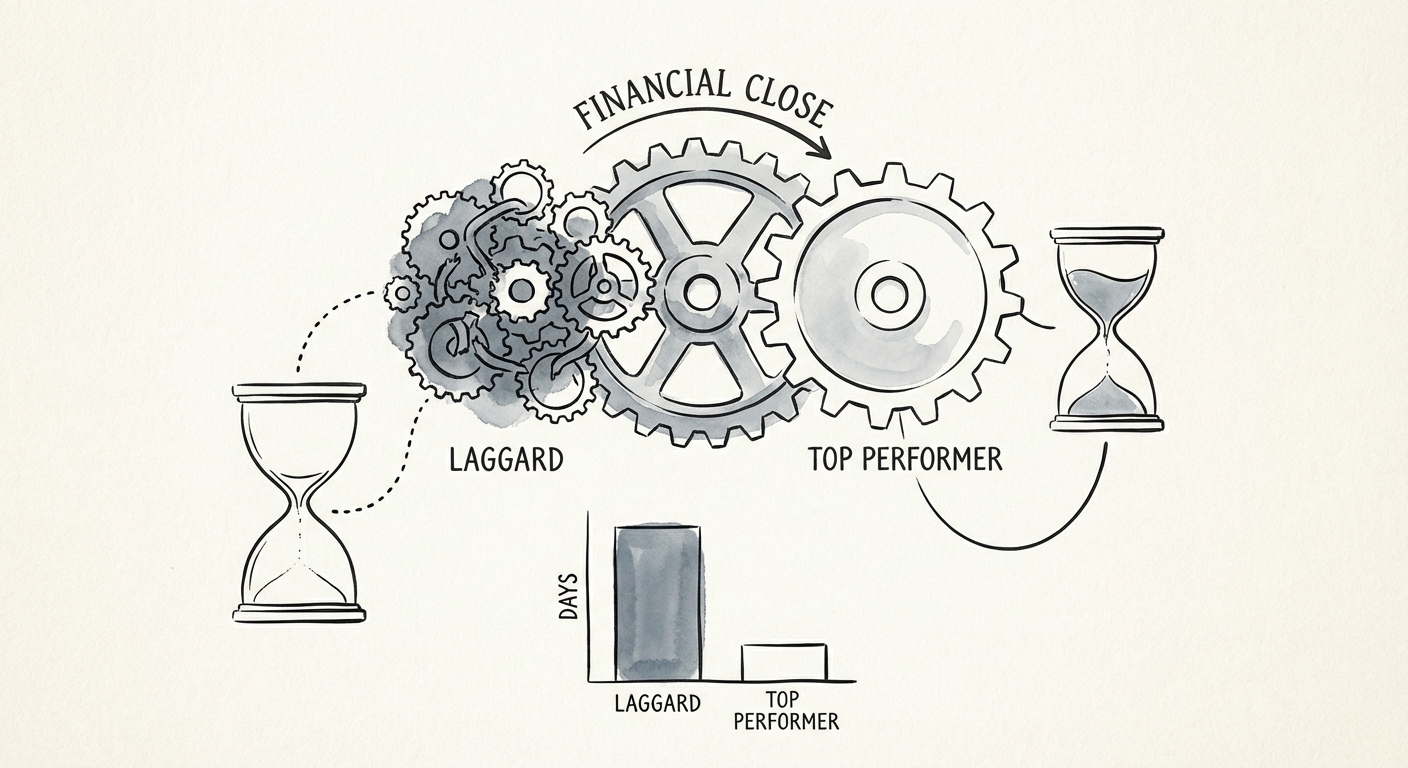
This is the Financial Blind Zone. If your close takes 15 days, you are effectively lacking operating visibility for 50% of the year. In a market where agility is the only defense against margin compression, this latency is not an annoyance—it is an existential risk.
The Cost of “Perfect” Data
The irony is that most finance teams delay the close in the pursuit of accuracy. They hold the books open to capture that late $500 vendor invoice or to reconcile a $120 credit card variance. They prioritize precision over utility.
But as we discuss in Why Your Board Doesn't Trust Your Numbers, precision without timeliness is useless. A 99% accurate report delivered on Day 4 is infinitely more valuable than a 100% accurate report delivered on Day 20. The former allows for course correction; the latter is just record-keeping.
Recent data underscores this gap. While the median close time for mid-market companies hovers around 7 days, laggards—often rapidly scaling firms relying on manual processes—are grinding through 12 to 15-day closes. This delay directly correlates with agility. A study cited by SOBI Analytics found that 61% of CFOs identify “outdated or incomplete information” as their primary barrier to decision-making agility.
A P&L delivered on the 20th isn’t a management report; it’s an autopsy. You can't fix a patient that's been dead for three weeks.
Benchmarks: Are You a Leader or a Laggard?
You cannot fix what you do not measure. To understand if your finance function is an asset or a bottleneck, you need to compare your cycle times against the market.
According to 2025 data from APQC and Ventana Research, the landscape looks like this:
- Top Performers (Top 25%): Close in 3–5 business days.
- Median Performers: Close in 6–8 business days.
- Bottom Performers: Close in 10+ business days.
If you are in the “10+ days” category, you are not just slow; you are statistically significantly behind your competitors. You are paying a “latency tax” on every strategic decision.
Why It Takes So Long (The 3 Killers)
Why do these delays happen? It is rarely because your finance team is lazy. It is usually because they are trapped in manual loops. Research from Ledge indicates that 50% of finance teams take longer than a week to close, primarily due to three factors:
1. Reconciliation Fatigue
The same study found that teams spend up to 50% of their time just reconciling accounts. If your team is manually matching bank transactions in Excel on Day 5, you have already lost the battle. This is often a symptom of disparate systems—your CRM, billing engine, and ERP aren’t talking, forcing humans to be the integration layer.
2. The “Hard Close” Obsession
Many controllers operate with an auditor’s mindset, refusing to close the sub-ledgers until every penny is accounted for. They treat the monthly management report like a statutory audit filing. This is a cultural failure. Management reporting requires materiality, not perfection. Waiting three days for a $2,000 vendor invoice in a $50M business is bad math.
3. Hero-Based Workflows
As we explore in How to Build a Finance Function That Survives Hypergrowth, early-stage companies often rely on a “hero” controller who stays up until 2 AM to brute-force the close. This works at $5M revenue. At $20M, it breaks. If your process relies on one person’s memory or stamina, you don’t have a system; you have a key-person dependency.
The Fix: From Heroics to Continuous Accounting
Getting to a 4-day close doesn’t require doubling your headcount. It requires shifting from a “batch” mindset to a “continuous” mindset.
1. Implement “Continuous Accounting”
World-class finance teams don’t wait until the 31st to start reconciling. They reconcile daily. Cash, credit cards, and key revenue accounts should be reconciled every morning. Ventana Research advocates for this shift, noting that “continuous accounting” is the only path to a sustainable sub-5-day close. By spreading the work over the month, Day 1 becomes a review day, not a creation day.
2. Establish Materiality Thresholds
Give your team permission to estimate. Set a materiality threshold (e.g., $1,000 or $5,000 depending on your size) for accruals. If an invoice is missing and it’s below the threshold, accrue the average and move on. Your Board cares about EBITDA trends, not whether the office supply expense was off by $150. This creates speed without sacrificing decision-quality accuracy.
3. The T-Minus Checklist
Professionalize the process. A close checklist should start at T-Minus 5 days. Pre-close activities (fixed assets, prepaid amortization schedules) can be done before the month even ends. If your team starts these tasks on Day 1, they are already behind.
The Executive Mandate
As a CEO or CFO, you must mandate the shift. Demand a “Flash Report” on Day 3 containing 90% of the critical data (Cash, ARR, gross margin estimates). Demand the full board package by Day 8 at the latest.
When you shorten the feedback loop, you increase the velocity of the organization. You stop driving with the rearview mirror and start looking through the windshield. As noted in The CFO's Guide to SaaS Metrics, trust is built on consistency and timeliness. Don’t let a slow close erode your credibility.