
The practical answer
- Short answer
- Most earnouts pay less than half their max — usually because the founder is the operating system. The 30 processes diligence buyers actually test, and how to document them fast.
- Best fit
- Industry: B2B Tech / Services. Function: Operations
- Operating path
- Founder Extraction → Operational Excellence → Interim Management
- Key metric
- 60% of Earnouts Missed Due to Founder Dependency
The deal closes. Then the real number shows up.
Picture a 60-person B2B services firm. $20M ARR, founder-led, sold to a mid-market PE buyer for a headline number everyone celebrated. Two-thirds of that number, though, wasn't cash at close — it was an earnout, tied to the business hitting growth targets over the next 24 months. Standard structure. Then the founder spends those 24 months discovering that the company couldn't quote a deal, escalate an incident, or close a renewal without him in the room. The targets slip. The earnout pays a fraction.
That's not a horror story. That's the base case. Across private company exits, more than 60% of earnouts pay out less than half their potential — and earnouts now show up in roughly a third of M&A deals, precisely because buyers no longer trust founder-driven numbers to repeat. The earnout exists to make you prove the business runs without you. Most founders fail the proof.
Here is the uncomfortable reframe for anyone in the $10M-$100M revenue band: in the lower-middle market, acquirers do not buy talent. They buy transferability. If revenue depends on your personal network, your code commits, or your gut feel on pricing, you don't own a company — you own a high-paying job that's structurally hard to sell. The "heroics" that carried you to $20M ARR are the exact line item a buyer flags as risk.
Key-person risk vs. the question that actually moves your multiple
Founders tend to obsess over key-person dependency in the insurance sense: what happens if I get hit by a bus? Buyers are running a colder test. If you walk out of the room — voluntarily, on a Tuesday, six months post-close — does the number drop? Diligence in this market has moved past customer concentration and churn charts. Buyers ask for your process documentation not because they enjoy reading SOPs, but because documented process is the only hard evidence that the revenue belongs to the company and not to you. No documentation, no proof. No proof, no premium.
A buyer isn't paying for what you know. They're paying for what survives the day you stop answering Slack. If the answer is "nothing," they've already discounted your check.
The 30 things diligence will actually open the drawer for
This isn't a productivity exercise. Treat it as the operating manual a buyer's diligence team will physically request — and then test by asking a mid-level employee to perform without calling you. Anything you can't hand over becomes a discount. We organize it the way buyers stress-test it: can the business sell, deliver, and account for itself without the founder. For the broader exit picture, this slots into a full exit-readiness review.
I. Can it sell without you? (Commercial transferability)
- 1. Lead qualification criteria: objective definition of a qualified opportunity — retire "I know a good lead when I see one."
- 2. Demo scripts and recordings: the winning pitch, broken out by buyer persona.
- 3. Pricing logic: a calculator or rule set that produces a quote without CEO sign-off.
- 4. Proposal templates: standardized SOWs with pre-approved legal language.
- 5. Objection battlecards: documented answers to the top 10 competitor talking points.
- 6. Pipeline review cadence: the exact agenda and metrics for the weekly sales meeting.
- 7. Client onboarding roadmap: Day 0 to Day 30, step by step.
- 8. Renewal playbook: triggers and scripts for the T-90 renewal conversation.
- 9. Case study library: proof points indexed by industry and use case.
- 10. Partner rules of engagement: how referral partners and resellers actually transact.
II. Can it deliver without the hero? (Operational continuity)
- 11. Implementation plans: standard project templates for small, medium, and large deployments.
- 12. Incident / SLA protocols: who gets the 2 AM call — and the honest answer can't be "you."
- 13. QA checklists: the go/no-go gate before code or deliverables ship.
- 14. Capacity model: the formula that signals when to hire the next CSM or engineer.
- 15. Vendor / COGS map: critical software and service vendors with ownership contacts.
- 16. Change management SOP: how product updates reach customers.
- 17. Root-cause template: the post-mortem process for failed deliveries.
- 18. Customer health scoring: the weighted formula that predicts churn.
- 19. Key-account plan: the QBR structure for your top 20% of clients.
- 20. Deployment / CI/CD docs: enough that a new engineer can ship safely on Day 1.
III. Do the numbers hold up cold? (Financial & administrative integrity)
- 21. Chart-of-accounts definitions: explicit booking rules — this is where EBITDA add-backs live or die.
- 22. Collections process: the automated sequence for overdue invoices.
- 23. Commission plans: documented OTE structures and payout triggers.
- 24. Signing-authority matrix: who can commit $500, $5,000, $50,000.
- 25. Hiring and interview guides: standardized scorecards for key roles.
- 26. New-hire ramp: the two-week onboarding plan.
- 27. Board reporting pack: the standard monthly/quarterly deck format.
- 28. Compliance log: SOC 2 / GDPR evidence-collection procedures.
- 29. IP assignment proof: every employee and contractor has signed over IP rights — buyers will check.
- 30. Disaster recovery plan: continuity for outages and cyber incidents.
Read that list again as a buyer would. Each gap isn't a missing document — it's a reason to move money from cash-at-close into an earnout you'll have to fight for.
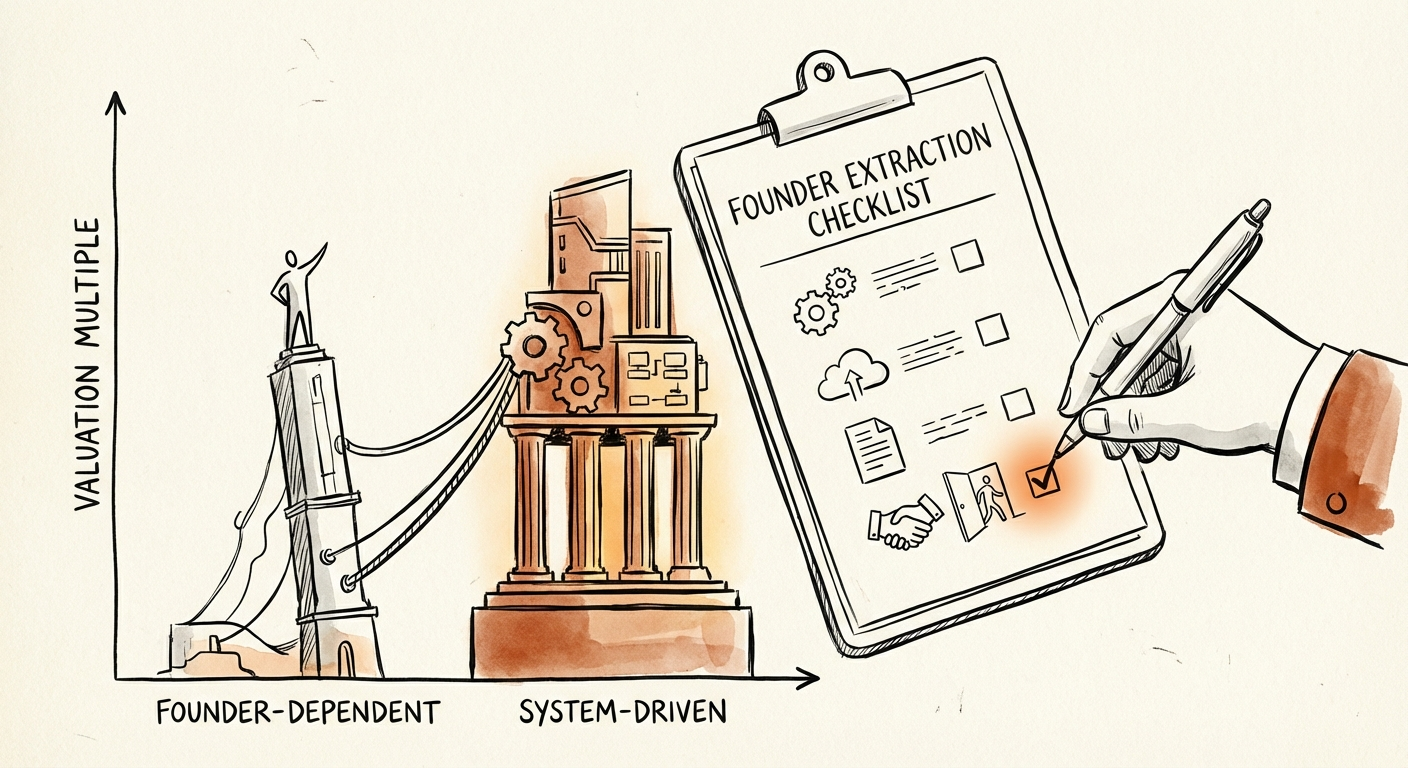
Don't write the manuals. Record them.
The universal objection: "I don't have time to write 30 SOPs." Correct — and you shouldn't. Written-from-scratch SOPs are slow, and worse, they're usually wrong, because founders document the idealized process instead of the one they actually run. Use a video-first method that captures reality:
- Record yourself doing the real thing. Next time you approve a pricing exception or run pipeline review, hit record and narrate the decision out loud — including the judgment calls you'd normally keep in your head.
- Hand off the transcription. An ops manager or EA turns your 5-minute clip into a one-page checklist. You're the source; they're the scribe.
- Test it on someone junior. Give the checklist to a newer employee and have them run the task. If they fail, the documentation is wrong, not the person. Fix it and repeat. A process that survives a junior hire is a process that survives diligence.
Why this is the highest-ROI work you'll do all year
Two firms, same $5M EBITDA. One hands over a complete operating manual; the other keeps the passwords in the founder's head. They do not trade at the same multiple — buyers pay a real premium for documented, transferable operations, and in this market that gap commonly runs 1.5x to 2x EBITDA. On $5M EBITDA, that's roughly $7.5M-$10M of enterprise value sitting inside a checklist you can finish in a quarter.
Start this Monday with the three processes a buyer would test first: how a deal gets priced, how an incident gets escalated, and how revenue gets recognized. Record one of them this week. The goal isn't to stop being valuable — it's to stop being the single point of failure that turns your full valuation into a conditional one. Sell the system, not the genius. Your earnout depends on it.