
The practical answer
- Short answer
- A $400k full-time CFO hired at $15M ARR will reconcile invoices and resent you for it. Here's the utilization math and the scorecard for the switch.
- Best fit
- Industry: B2B Tech. Function: Office of the CFO
- Operating path
- Financial Infrastructure → Commercial Performance → Valuations
- Key metric
- $280k Avg. Annual Savings (Fractional vs. Full-Time)
The CFO who reconciled invoices and quit
A $15M ARR SaaS company hired a former public-company CFO. On paper it read like a recruiting win: the board was thrilled, the cap table looked credentialed, the investor update practically wrote itself. Eleven months later he was gone, and the company had spent close to $450,000 to learn a lesson it could have bought for $90,000.
Here is what actually happened on a Tuesday. He had run a finance org of 40; he now had a team of two and a QuickBooks login. So he did what bored senior people do — he built decks. Beautiful capital-allocation decks. Meanwhile the company's billing logic was misfiring and quietly leaking roughly $50k a month in uncollected and mis-invoiced revenue, the kind of grind-it-out reconciliation work he considered beneath him. He was a racecar driver in a go-kart: enormous horsepower, nowhere to put it, and a transmission that kept stripping gears.
This is the trap that catches founders between $10M and $50M ARR. You've outgrown the bookkeeper who keeps the lights on. Investors are now asking for cohort analysis, net revenue retention, and a defensible CAC payback number — and your "finance function" is one controller. The instinct is to hire a heavyweight you can "grow into." But you don't grow into a $400k CFO. You either give them a strategy worth their weight, or you pay them half a million dollars of EBITDA to be underutilized and resentful.
The right question isn't "fractional or full-time?" It's "do I have enough genuine strategic work to keep an expensive brain at full utilization?" Below $20M ARR, for most SaaS businesses, you usually don't — and the cost of guessing wrong runs straight through your runway.
A public-company CFO at a $15M startup is a racecar driver in a go-kart. He'll spend his afternoons arguing about capital allocation while invoicing leaks $50k a month right under him.
The $280k question, with the numbers attached
Start with the cash. A fully loaded full-time CFO at the Series B/C stage isn't the base salary you see in the offer letter. For 2026, the realistic stack on a SaaS company at this scale looks like this:
- Base: $250,000–$350,000
- Bonus (20–30% of base): $50,000–$100,000
- Equity (0.5%–1.5%): $100,000–$300,000+ in carried value, depending on your last mark
- Fully loaded: roughly $400,000–$500,000 a year
A high-tier fractional operator — someone who has sat in a CFO chair at a company a notch larger than yours — runs $5,000–$12,000 a month on retainer, or $250–$450 an hour. Call it $60,000–$144,000 a year. Compensation benchmarks from Bennett Financials and pricing data from CFO Advisors both land the gap in the same place: about $280,000 a year in cash you keep. On 18 months of runway, that delta is two senior engineers or a full quarter of paid acquisition — bought, in effect, by not over-hiring your finance leader.
Why ARR is the wrong tripwire
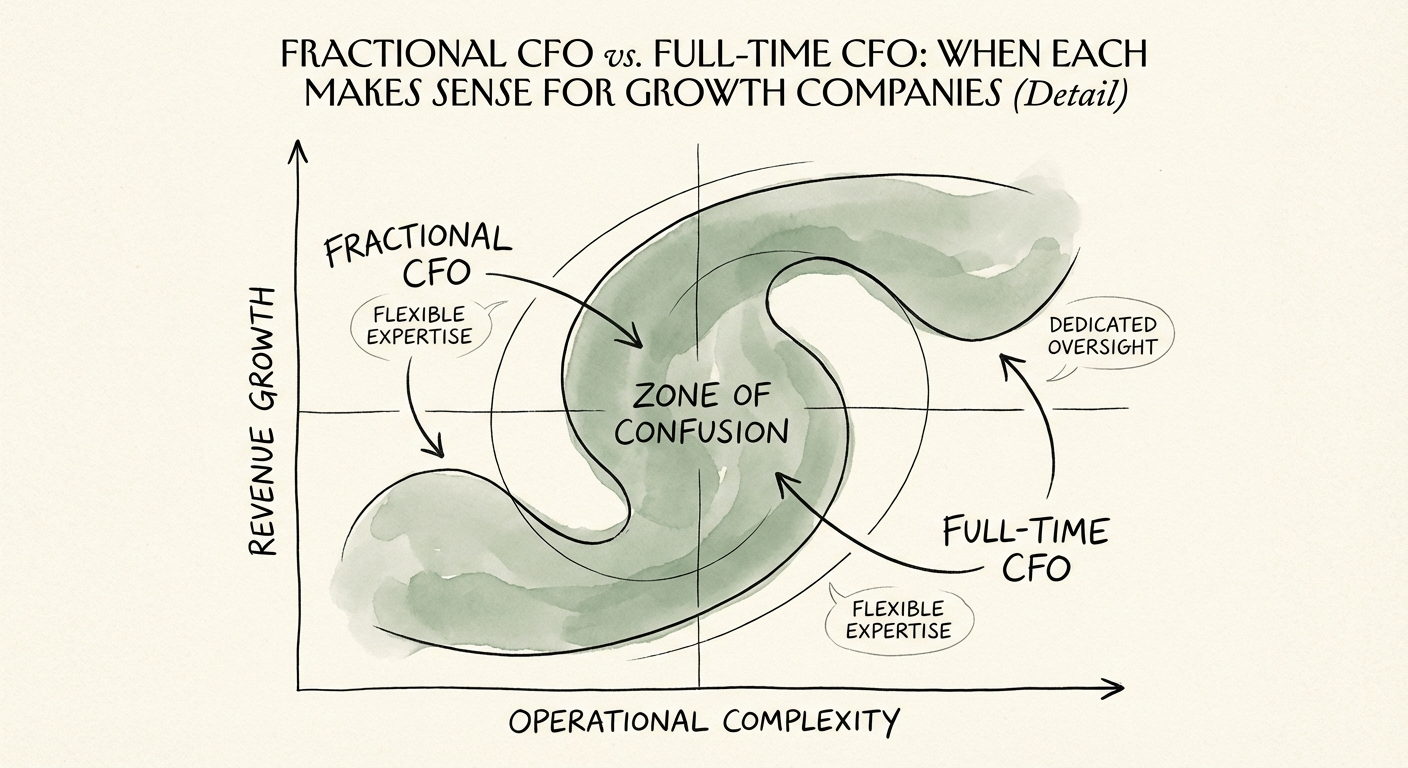
Founders love "$25M is when you hire full-time" because it's a clean number. It's also misleading, because revenue is a proxy for the thing that actually matters: how many cross-functional fires only a full-time, in-the-room executive can put out. CFO Advisors data shows seed-stage companies save up to 80% with fractional leadership — but that curve inverts the moment internal friction starts demanding political capital a part-timer can't accumulate from outside the Slack.
Score yourself honestly on four axes. Each one that leans heavy is a vote for full-time:
- Capital calendar. Prepping a raise? Fractional handles the model and the data room cleanly. Running a live roadshow with weekly investor calls? That's a full-time owner of the narrative.
- Revenue mechanics. Flat per-seat pricing in one currency is fractional-friendly. Usage-based billing, multi-currency, or high-volume transactional data pushes you toward someone watching it daily.
- Board pressure. A board that wants accurate monthly numbers — fractional. A board that wants someone to defend those numbers under live cross-examination and own the relationship between meetings — full-time.
- M&A. Buying a company is the one axis with no nuance. If you're acquiring, you need a full-time CFO. Diligence, purchase accounting, and integration don't fit in a retainer.
Three or four of those running hot? Your complexity has outrun fractional, regardless of whether you've crossed $25M. One or two? You're paying for an org chart, not an outcome. For the flip side of this same mistake — paying full-time prices for a hire who washes out — see why 'gut feel' executive hiring quietly bleeds EBITDA.
What to do before your next board meeting
Pick your zone and run the test that comes with it.
If you're at $5M–$20M ARR: rent, but rent sharply
Hire a fractional operator — not a generic outsourced-finance firm. You want someone who has been a sitting CFO at a company one size up from yours, because their value is pattern recognition, not hours logged. Give them a single 90-day mandate with a number attached: "cut days sales outstanding by 15," or "rebuild the model so the Series B data room is investor-ready," or "stop the billing leak." Then watch what happens. If they hit it, extend. If they miss, you're out three months of retainer — not a severance package, a garden leave, and a six-month recruiting gap. That asymmetry is the entire point of renting: cheap to be wrong. Their first deliverables are usually cleaning up your financial infrastructure, building a 13-week cash forecast, and pressure-testing CAC, LTV, and gross margin so your unit economics survive a partner's red pen.
If you're at $20M–$50M+ ARR: buy, and buy someone who'll get dirty
You're ready for full-time when finance stops being a reporting function and becomes a lever: building 18–24 months of audited financials toward an exit or IPO, restructuring debt, negotiating a credit facility, or being the one person willing to tell the CEO the capital plan is wrong. But the hire is risky — roughly half of executive hires don't last 18 months, per Pinnacle Search, and the all-in cost of one that fails dwarfs the salary. The single best filter in the interview costs you one question: "Tell me about the last time you personally reconciled a messy ledger." A candidate right-sized for a $20M company will have a story and maybe a war wound. One who scoffs at the question is the racecar driver from the top of this piece — too senior for your go-kart, and about to spend your runway proving it. As Pinnacle Search documents, the real cost of that mis-hire shows up months later, in the work that quietly didn't get done.
The win here isn't the most impressive title on your org chart — it's the most efficient capital structure underneath it. Rent the veteran brain for analyst money while your complexity is low. Buy the full-time owner the moment your scorecard tips, and not a quarter sooner. When that day comes, the PE playbook for installing a first-time CFO is the onboarding sequence worth stealing.