
The practical answer
- Short answer
- New 2025 data shows 33% of PE CEO replacements are now interim. Learn the critical difference between a 'caretaker' and a 'turnaround' operator before you hire.
- Best fit
- Industry: Private Equity. Function: Executive Leadership
- Operating path
- Team & Hiring → Operational Excellence → Transaction Execution Services
- Key metric
- 33% Of CEO replacements in H1 2025 were Interim appointments (up from 9% in 2024)
The Vacuum at the Top
The scenario is standard, but the panic is fresh. Your portfolio company—a $40M B2B SaaS platform or a mid-market manufacturing firm—has missed its EBITDA target for the third consecutive quarter. The founder, who was supposed to transition to a product role, has become a bottleneck. You pull the trigger. The founder is out.
Now you have a vacuum.
Your Operating Partner instincts kick in. You need a replacement yesterday. The permanent search will take six months (minimum). You need a bridge. The default move is to call your search firm and ask for an "Interim CEO." You want a "safe pair of hands" to keep the ship steady while you hunt for the unicorn permanent executive.
This is where value destruction begins.
In 2025, the market has shifted aggressively toward interim leadership. Data shows that 33% of all CEO replacements in H1 2025 were interim appointments, a massive jump from just 9% in 2024. This signals a fundamental change in how Private Equity manages talent gaps. The "Gig Economy" has reached the C-Suite.
But there is a fatal conflation happening in Board meetings across the industry. Sponsors are confusing Interim CEOs (caretakers) with Turnaround CEOs (fixers). They hire a diplomat when they need a general. They hire for continuity when the business model demands reconstruction.
If your portfolio company is wasting cash, a "steady hand" doesn't stop the bleeding—it just comforts the patient while they die. You don't need someone to keep the lights on; you need someone to rewire the building.
If you hire an Interim CEO to do a Turnaround CEO's job, they will spend their first 90 days 'assessing' and 'building consensus.' Meanwhile, you burn three more months of runway.
The Diagnostic: War Time vs. Peace Time
To avoid a multiple-crushing hiring mistake, you must diagnose the asset's condition with brutal honesty. The distinction between an Interim and a Turnaround CEO is not semantic; it is structural. It comes down to their mandate, their relationship with the Board, and their tolerance for friction.
1. The Interim CEO: The Steward
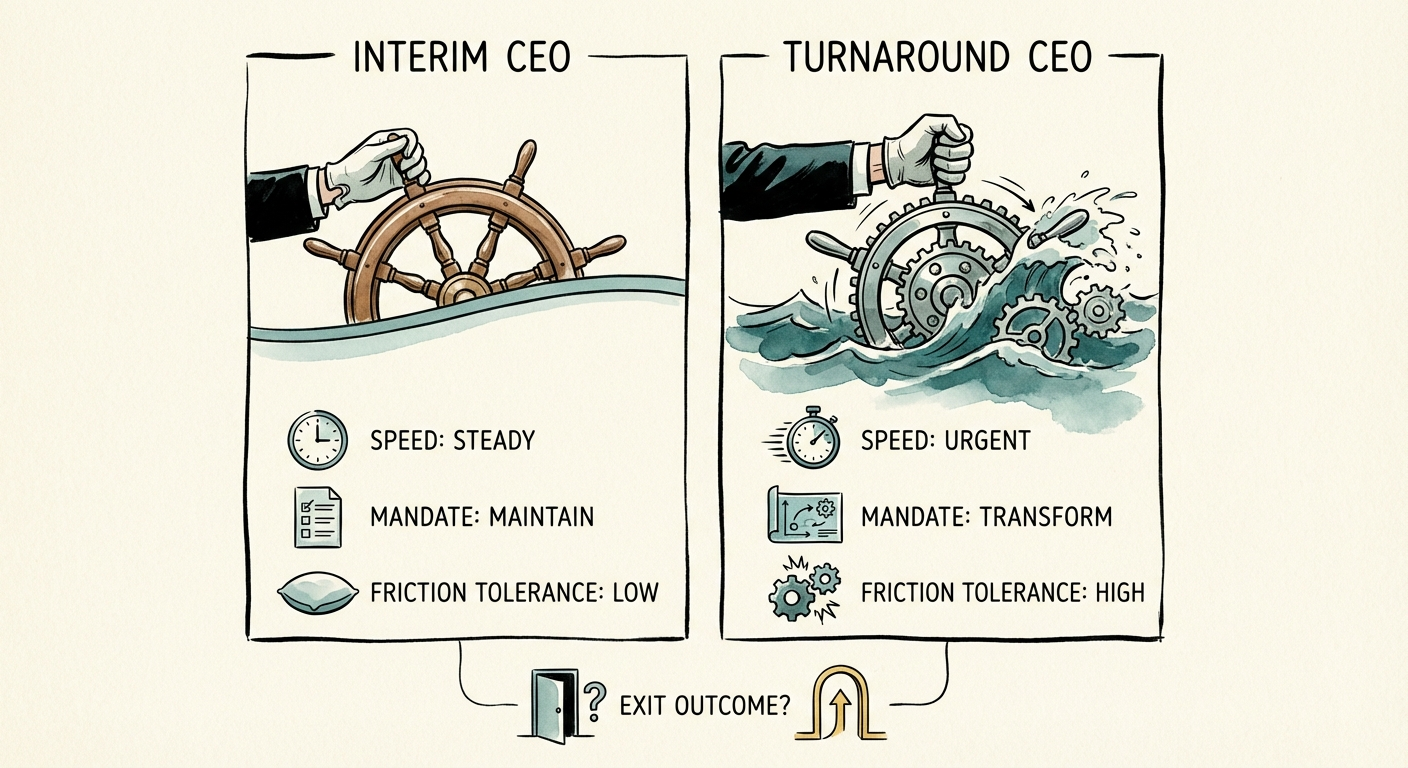
The Interim CEO is a peace-time operator. Their primary mandate is continuity. They are appropriate when the business has strong unit economics and a validated GTM motion, but lacks leadership. Perhaps the previous CEO retired unexpectedly or was managed out due to a conduct issue, but the P&L is healthy.
- Mandate: Do no harm. Maintain velocity. Stabilize the staff.
- Decision Speed: Measured. They consult the existing executive team.
- EBITDA Impact: Neutral to slight positive (cost control).
- Friction Tolerance: Low. They are there to smooth the transition for the permanent hire.
The Interim CEO is a bridge. They ensure the management team quality remains intact until the permanent successor arrives.
2. The Turnaround CEO: The Surgeon
The Turnaround CEO is a war-time operator. Their mandate is survival and restructuring. They are required when the business is facing a cash crunch, declining NRR, or a broken delivery model. They do not care about "how things have always been done" because those methods are why the company is failing.
- Mandate: Stop the bleeding. Radical cost extraction. Strategic pivot.
- Decision Speed: Rapid. They make unilateral decisions based on cash preservation.
- EBITDA Impact: High. Strategic turnarounds can drive 15% to 30% EBITDA expansion through operational efficiency alone.
- Friction Tolerance: High. They will fire popular but ineffective leaders. They will exit unprofitable customers.
If you hire an Interim CEO to do a Turnaround CEO's job, they will spend their first 90 days "assessing" and "building consensus." meanwhile, you burn three more months of runway. As noted in the PE Operator's Playbook for 100-Day Turnarounds, speed is the primary leverage point in a distressed asset.
The Cost of Misalignment
Why do PE firms get this wrong? Because Turnaround CEOs are expensive and abrasive. They charge a premium—often 25-50% higher daily rates than standard interims—and they upset the culture. But the cost of a "polite" interim in a crisis is far higher. If a $50M company with 10% margins declines to 5% margins during a 6-month interim stint, you haven't just lost cash flow; at a 12x multiple, you've erased $30M in Enterprise Value.
The Decision Matrix: 5 Questions to Ask Before You Hire
Before you sign a search retainer, ask these five questions about the portfolio company in question. If you answer "Yes" to more than two, you need a Turnaround CEO, not an Interim.
- Is cash runway less than 9 months? (Interims manage budgets; Turnarounds manage daily liquidity.)
- Is NRR (Net Revenue Retention) below 90%? (This indicates a product or service failure, not just a sales leadership gap.)
- Are you contemplating a Reduction in Force (RIF) of >15%? (Interims struggle to cut deep enough; Turnarounds view RIFs as necessary math.)
- Is the "Tribal Knowledge" problem severe? (If the founder left with the playbook, you need someone to rebuild processes from scratch.)
- Do you need to break a bad vendor or customer contract? (Turnaround CEOs relish negotiation conflict; Interims avoid it.)
The Execution: Stop Buying "Safe"
The surge in interim appointments in 2025 suggests that PE firms are becoming more agile, but agility without accuracy is just chaos faster. When you look at your stalled portfolio company, stop looking for a "safe pair of hands."
If the company is in distress, you do not need a caretaker. You need an operator with authority to act. The real cost of a mis-hire isn't the recruiter fee—it's the six months of inaction that turns a salvageable asset into a write-down.
Your move: assess the P&L. If the EBITDA is stable, hire the stabilizer. If the EBITDA is compressing, hire the operator. And pay them whatever they ask, because they are the only thing standing between the company and a write-down.