
The practical answer
- Short answer
- VP Sales tenure is down to 19 months. External hires fail 61% more than promotes — but Series B founders rarely have a promotable rep. Here's how to decide.
- Best fit
- Industry: B2B SaaS. Function: Sales Leadership
- Operating path
- Team & Hiring → Operational Excellence → Transaction Execution Services
- Key metric
- 61% Higher likelihood of external executive hires being fired vs. internal promotes.
The hire that takes your growth chart hostage
Picture the moment: you're a founder-CEO at $14M ARR, you've personally closed or coached every deal over $50K for three years, and you finally decide to hand off the number. Two folders sit on your desk. One is your best closer — knows the product cold, beloved by the team, threatens to walk if she doesn't get the title. The other is a slick VP from a name-brand platform company whose deck looks like a TED talk. You're about to make a six-figure bet, and the uncomfortable truth is that the data says both options are coin flips at best.
The average tenure of a VP of Sales in tech has fallen to roughly 19 months, down from 26 a decade ago (Gong.io). Run that math against your reality. A new VP ramps for about six months before they're truly productive, operates for nine, then spends the final stretch quietly interviewing while your pipeline drifts. By the time you accept it isn't working, fire them, and refill the seat, you've burned the better part of two years. For a company trying to climb from $10M to $50M, that's not a personnel problem — it's a missing year of compounding revenue you can't refinance with a Series C.
Here's what makes the Series B version of this decision so brutal: the failure modes are predictable, and you can usually see which one you're walking into.
- The promoted super-rep: You hand the title to your top closer because losing her feels worse than the risk. She has never written a comp plan, drawn a territory map, or made a hiring decision under quota pressure. So she does the only thing she knows — she hovers over live deals, jumps on the calls she should be coaching, and quietly resents the eight reps who aren't as good as she was. The team doesn't get a leader; it loses its best individual contributor and gains a frustrated babysitter.
- The big-logo savior: You hire the polished VP from the company everyone's heard of. In their last role they had a marketing org generating leads, a RevOps team building dashboards, and a brand that opened doors. Drop them into a $14M startup where they have to build their own pitch deck and chase their own list, and the air goes out of the room. They're solving for problems you won't have for three years while the fires burning today go unattended.
A great rep promoted to VP keeps closing deals. A great VP builds the machine that closes deals without them. At Series B, you almost never have the second person already on payroll — so stop pretending the safe choice exists.
What the numbers say — and the trap inside them
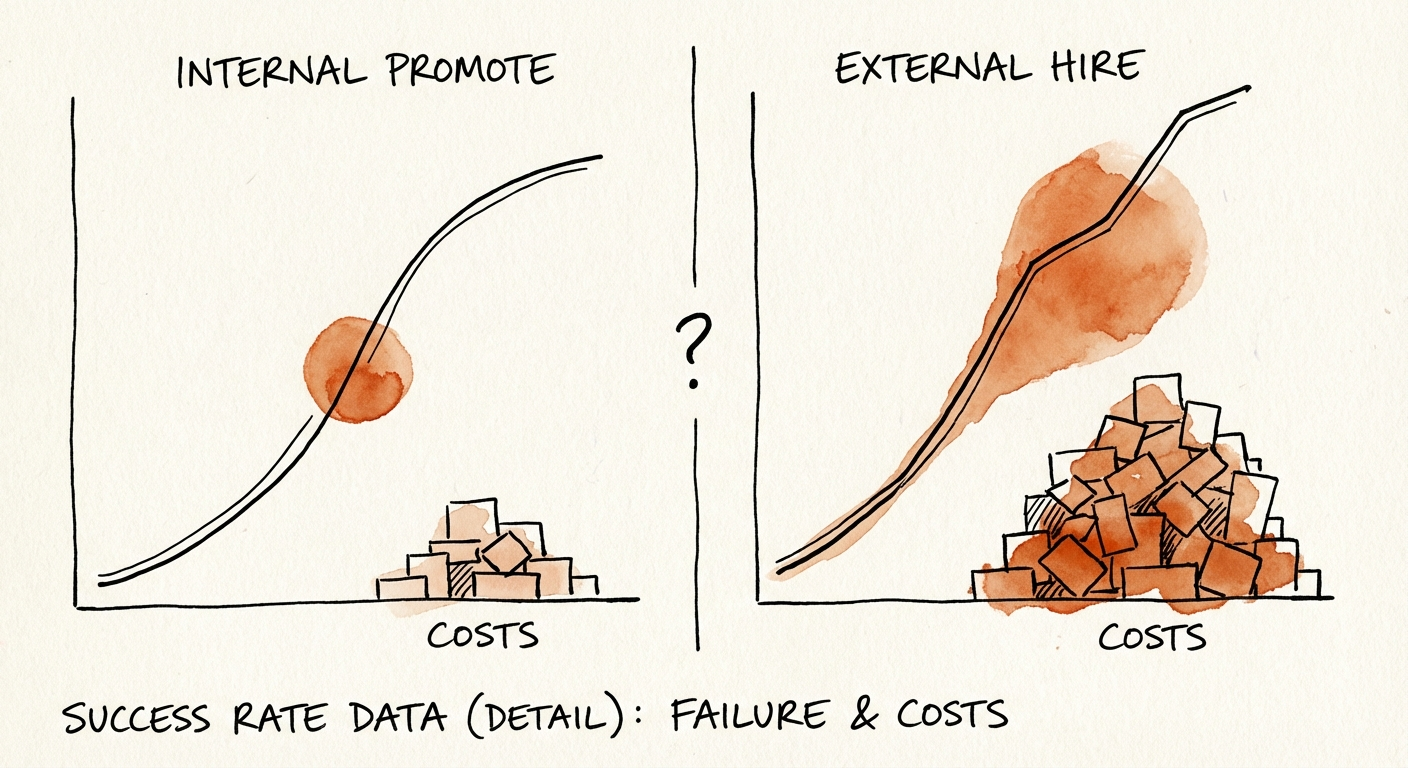
On paper, the safe answer looks obvious. Research out of the Wharton School found that external hires are about 61% more likely to be fired than people promoted from within — and they cost 18-20% more in compensation while earning lower performance ratings through their first two years. The devil you know is cheaper, sticks around longer, and already understands your customers. For a founder who's exhausted and wants continuity, the internal promote reads like the responsible choice.
The problem is what "continuity" actually buys you. An internal promote is excellent at maintaining a machine that already runs. At Series B, your machine doesn't run yet — it runs through you. The forecast is in your head. The qualification criteria are your gut. The reason deals close is that the founder shows up on the call. Promoting your best rep preserves a sales motion that was never built to scale past you. You don't need someone to protect the status quo; you need someone to construct the thing that lets you finally leave the room. That's a building job, and a great closer has rarely done it.
External hires fail more often, but they remain the realistic route to transformational change — entering a new segment, moving from founder-led selling to a repeatable rep-led motion, standing up your first real sales process. The catch is stage mismatch, and it kills more external VPs than incompetence ever does. The startup external-hire failure rate sits somewhere around 40-50% inside 18 months, and the most common reason isn't that the person was bad — it's that they were good at the wrong altitude. Someone who scaled a sales org from $50M to $200M is a Scaler. They know how to add headcount to a working engine. Ask them to build the engine from a half-finished prototype and they'll keep reaching for tools — enablement teams, ops headcount, mature data — that don't exist in your building. As Bart Fanelli, former CRO at OutSystems and Splunk, puts it: companies hire Scalers to do a Builder's job, then act surprised when it breaks.
Now price the mistake. A failed external VP of Sales costs roughly 6x to 10x their base salary once you tally lost revenue, wasted SDR cycles, and the deals that never closed (The Sales Experts). Pay someone $250K and the real bill lands between $1.5M and $2.5M. The severance is the cheap part. The expensive part is the phantom pipeline — the quarters of bookings that should have existed and simply never materialized because nobody was building the motion that would have created them. Sandler's finding that around 70% of sales leaders fail isn't a talent shortage. It's a diagnosis problem: companies hire against a title instead of against the specific structural job in front of them.
Hire for the stage you're actually in
Strip away the false comfort and here's the honest read for most Series B founders between $10M and $50M ARR: you probably don't have a promotable VP on staff. Your best people are exceptional individual contributors, not builders of teams and systems. So you go external — but you go external with the odds deliberately rigged in your favor instead of leaving it to a polished interview performance.
The profile you're hunting is a stage-appropriate Builder, and a brand-name logo on the resume is closer to a yellow flag than a green one — unless that person joined the brand early, before the machine existed. Three filters separate the Builder from the Scaler wearing a Builder's interview suit:
- The right multiple: They've personally taken a company from roughly your current revenue to about 3x it. Not from $50M to $200M. From $12M to $35M, in the trenches, with a budget that felt too small.
- Still carries a bag: They haven't stopped selling. In the interview, ask them to walk a deal or demo your product. A real Builder leans in. A Scaler who's been above the fray for five years will deflect — that deflection is your answer.
- Shows you the artifacts: They can pull up the actual playbooks they made — onboarding schedules, comp plans, qualification frameworks — not a strategy slide about "go-to-market excellence." Builders keep the receipts because they made the things themselves.
Then, whether you promote or hire out, refuse to wait 19 months to learn whether it's working. Run a structured first-quarter audit with a written verdict at each gate:
- Month 1 — Diagnose. They deliver a written assessment of your team, pipeline, and process. Vague observations mean they can't see the machine clearly enough to fix it.
- Month 2 — Prove it. They personally close a deal or unstick a stalled enterprise opportunity. A Builder will want the at-bat; a Scaler will want to "set up the team first."
- Month 3 — Build something. They ship one real structural change — a new outbound cadence, a rebuilt comp plan, a qualification standard the whole team adopts. Not a deck. A working part.
The success rate of this hire isn't a lottery you're forced to play. Name the specific structural problem you're actually solving — "move us from founder-led to rep-led selling" — and find the person who has solved that exact equation at your stage before. If you hire against a logo and a gut feeling instead, the data has already told you how this ends: back in the market in 19 months, two years of growth gone, and a few million dollars lighter. If you've already lived through one of these failures, our VP Sales recovery guide and the hiring accuracy framework are where to go next; if you're still in the founder's chair, start with the founder-led to scalable sales transition.