
The practical answer
- Short answer
- Your deal model promised $4M in synergies by Month 12. It's Month 18 and the ERPs still don't talk. Here's where PE integrations actually stall — and the 90-day reset.
- Best fit
- Industry: Private Equity. Function: Operations
- Operating path
- Migration & Integration → Turnaround & Restructuring → Transaction Advisory Services
- Key metric
- 70% Deals Failing Synergy Targets
The number that was true in the data room is a lie by Month 18
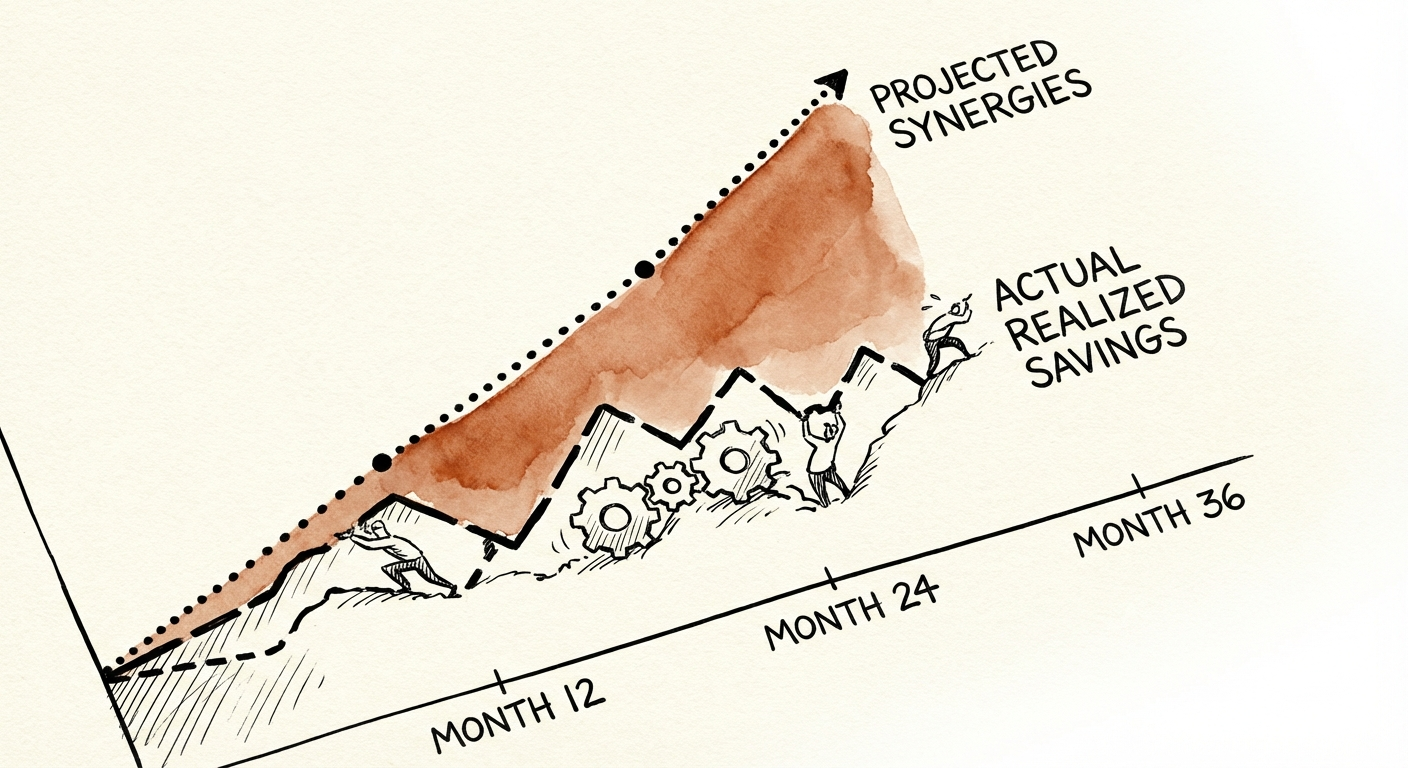
The model was clean. Buy the competitor, fold in the back office, point both sales teams at one pipeline, and book $4M in annualized EBITDA synergies by Month 12. The committee approved it on a single slide. You are now in Month 18, and that slide is fiction: two CRMs, two ERP instances running in parallel because the data migration failed validation twice, and roughly $500k actually realized — almost all of it the duplicate SaaS licenses and the headcount you'd have trimmed anyway.
This is the gap nobody underwrites. Deal partners price synergies on financial logic — "we don't need two CFOs" — but the synergy doesn't show up until someone answers a technical question: "can we merge two general ledgers without breaking month-end close?" The first sentence takes a meeting. The second takes a year. McKinsey's read on why mergers go wrong keeps landing on the same fault line: the value was real, the integration capability wasn't.
And the delay is not free. Every month two general ledgers stay separate is a month you are paying the cost structure of two companies while carrying the debt of one combined entity. That's contra-synergy — it eats the very EBITDA your hold-period IRR was built on. It is no accident that the median PE hold period has climbed to a record 5.6 years. A meaningful slice of that drag is integrations that were modeled for 12 months and are still grinding at 36. You did not buy a slow exit on purpose. You bought a server-room problem you mistook for a spreadsheet line.
Nobody gets credit for the synergy until the old server is literally unplugged. Forecast the unplugging, not the quarter.
Where the timeline actually breaks — and why diligence misses it
Roughly 70% of deals fall short of their synergy targets, and in the stalled mid-market integrations I've been pulled into, the cause is almost never strategic. The two companies still belong together. The execution just hit friction nobody priced. Three failure modes, in the order they typically surface.
IT was treated as a "workstream," not the business. In a B2B software or tech-services firm, the systems are the operating model. Deloitte's integration teams find that IT drives the majority of synergy capture in data-heavy sectors — and that it's consistently the longest pole in the tent. When you defer stack consolidation, you hand both teams "swivel-chair integration": humans retyping records from one system into another. That's not just slow — it hardens resistance, because the acquired team keeps their legacy tool as a security blanket and quietly never adopts the new one.
The data was dirtier than the diligence. Your team graded the codebase. Nobody graded the customer table. Say you inherit a database where a third of the records are duplicates or half-blank — you now cannot run the cross-sell that was supposed to be your headline revenue synergy, because you don't trust the list you'd be selling into. De-duping that isn't a sprint; it's a quarter-plus of cleanup that freezes the GTM motion you bought the company to accelerate.
Governance evaporates around Day 100. The first 100 days run hot. Then integration fatigue sets in: the steering committee meets monthly instead of weekly, the PMs get yanked back to their day jobs, and the genuinely hard items — ERP cutover, platform unification — get deferred "to next quarter." Those quarters compound. The parallel-run workaround that was supposed to last six weeks becomes the institutionalized way the combined company runs. That's technical debt with a financing cost, and it's sitting directly on the EBITDA line a future buyer will discount.
If you're 12 months post-close and still running parallel: the reset
You will not status-meeting your way out of this. A company stuck in parallel operations needs an intervention, and it fits in about 90 days. Three moves, in order.
Re-underwrite the tech roadmap in ten days. Stop defending the original date — it's gone. Run a hard ten-day audit on the true state of each integration thread. For every legacy system still alive, ask one question: is the blocker technical or political? If it's political (a sponsor protecting "their" platform), you remove the blocker — that's the operating partner's job, not the PM's. If it's technical, you resource it properly instead of starving it.
Kill "best of both worlds." The longest delays come from building a franken-system to keep everyone happy. Name the winning platform — usually the acquirer's — and migrate to it. The goal is not the perfect CRM; the goal is one CRM, so you can finally see a single global pipeline. Standardization beats optimization every time at this stage, because you can optimize a unified system but you can never report on a split one.
Tie synergies to triggering events, not calendar quarters. Don't forecast "$1M in Q3." Forecast "$1M upon decommission of the legacy ERP." That reframes the whole org around the migration that unlocks the money rather than the date on a Gantt chart — and it aligns incentives honestly: nobody books the synergy until the old box is physically off. Fund the work to do it; the playbook for budgeting integration against deal value is where most plans under-resource by half. Because here's how it ends: your exit multiple rests on showing the next buyer one scalable platform. Sell them two firms duct-taped together and their diligence will find it — the same way yours should have — and the discount lands on your IRR. Do the hard migration now, on your clock, or finance it later at the buyer's price.