
The practical answer
- Short answer
- A founder-led target moves in 2 days; your platform takes 2 weeks. That gap, not "values," is what kills synergies. How operating partners measure and bridge it.
- Best fit
- Industry: Private Equity. Function: Human Capital
- Operating path
- Team & Hiring → Operational Excellence → Transaction Execution Services
- Key metric
- 70% Of M&A deals fail to achieve anticipated synergies due to cultural clashes (McKinsey)
The week the deals stopped getting signed
Picture a clean platform play: a PE-backed services group acquires a 60-person founder-led firm to bolt on a capability the platform couldn't build fast enough. The synergy model is tidy. Cross-sell, shared back office, one ERP. Then month five arrives and the lead architect at the acquired firm quits, two engineers follow her out, and the founder who agreed to stay through the earn-out goes quiet in every standup.
The operating partner's first instinct is to blame the integration manager. Wrong instinct. What actually happened is mechanical and predictable: at the target, a senior engineer could greenlight a vendor swap or a hotfix in an afternoon. Inside the platform, that same call now routes through a procurement queue, a security review, and a delegated-authority matrix that caps her sign-off at $2,500. She didn't leave because she disliked the new logo. She left because she could no longer do her job at the speed that made her good at it.
This is the part the model never priced. McKinsey puts the share of M&A deals that miss their synergy targets because of cultural clashes at 70% — and in add-on platforms the "clash" almost always has the same shape. It is not values. It is the collision between a founder-led firm where authority is centralized but informal, and a platform where authority is decentralized but governed. Both can be high-functioning alone. Bolt them together without a translation layer and decisions simply stop clearing.
The cost shows up in two places at once. Mercer's read on the same problem is that 67% of acquirers see synergies arrive late, dragged down by mismatched governance and ways of working — and the people best positioned to capture those synergies are the first to walk when the friction sets in.
Culture clash in an add-on is rarely a values problem. It is two incompatible approval chains trying to share a P&L. Diligence the decision logs, not the mission statement.
Three numbers that tell you the integration is choking
"Culture fit" is unmeasurable, which is why most diligence skips it. But the friction that kills add-ons is measurable, because it lives in process metadata you already have. Before signing, and again at day 30, pull these three.
1. Time-to-decision, side by side
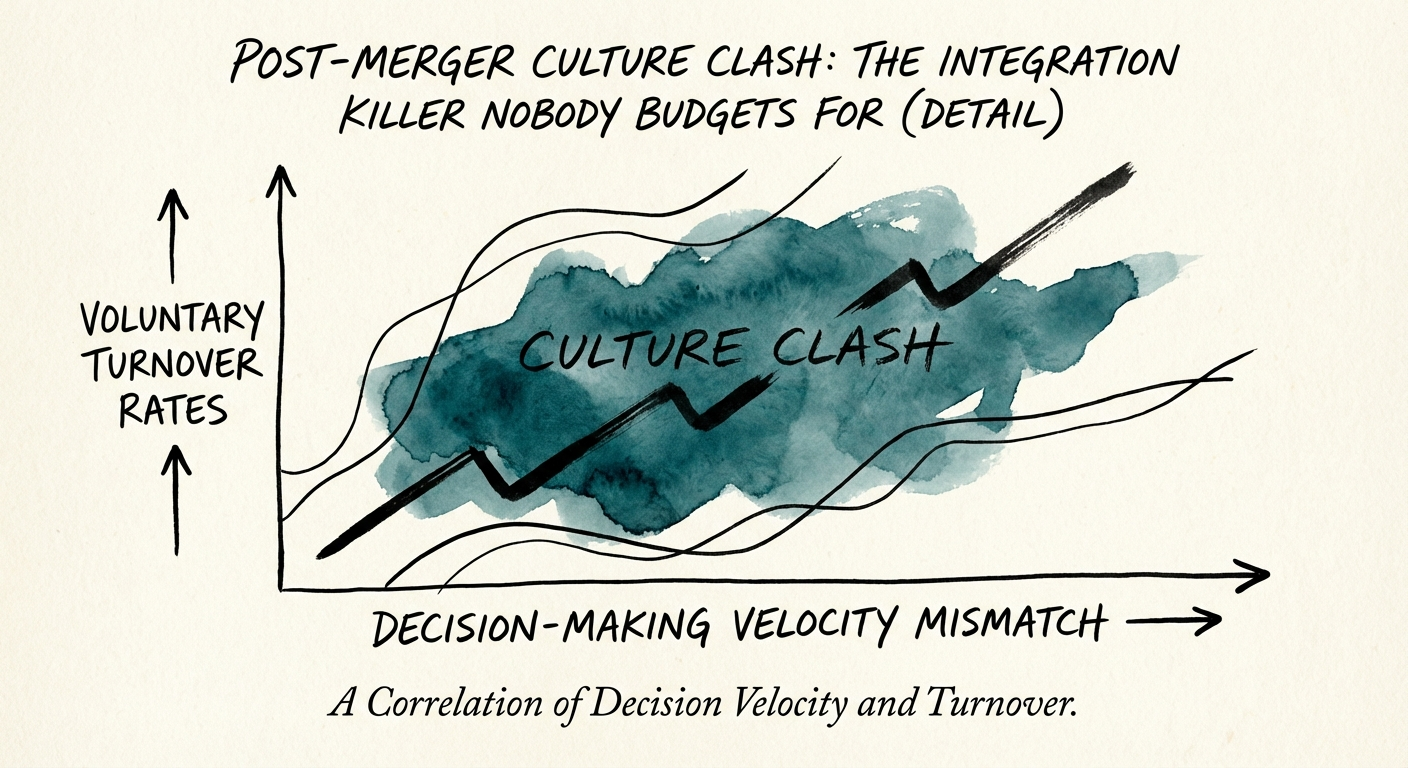
Take one routine operational request that both firms handle constantly — a hiring approval, a sub-$5K spend, a production deploy — and clock the median calendar time from request to "yes" at each company. A founder-led target might run two days. A platform with three sign-off tiers might run two weeks. That delta is the single most predictive number you can collect: when decision speed differs by more than half, voluntary turnover at the slower-feeling side roughly doubles in the first year. The acquired team experiences the platform not as more resourced, but as a place where their work goes to wait.
2. The authority gap on the org chart
Map what each role can actually approve in dollars and in decisions, not what the title implies. The recurring trap in add-ons: a founder's VP gets a grander title and a smaller spending limit on the same day. They figure that out within a fortnight, and it reads as a demotion dressed as a promotion. This is the governance mismatch Mercer ties to delayed synergies — the acquired side waits for permission, the platform side waits for results, and the quarter slides by with neither.
3. The "fight the system" pulse
At day 30, ask one question of the acquired team: To get my job done, do I have to fight the system? If more than 40% say yes, you are not integrating the asset — you are degrading it. Track it against the retention data: roughly a third of key employees leave inside the first year when the operating rhythm clashes hard enough (Instill/PwC). The people answering "yes" are the same people your talent-retention plan was built to keep, and they are usually gone between months four and nine — once the announcement glow fades and the workflow reality lands.
Build an operating interface, don't blend cultures
The mistake is trying to merge two operating systems into one harmonious culture by the end of year one. You can't, and chasing it is what stalls the deal. Build a deliberate interface between the two instead — a thin layer of agreed process that lets both sides keep functioning while the deeper integration happens on a slower clock.
In diligence, audit friction, not just financials. Ask to see decision logs. Interview middle managers, not only the C-suite. Have someone walk you through how a single feature or engagement goes from idea to delivered. Count the steps on each side. If the target clears it in three and your platform needs twelve, you've found your integration risk before you've wired the funds — and you can size the integration scorecard around it instead of discovering it in month five.
For the first 90 days, ring-fence the value engine. If you bought the firm for its R&D or delivery speed, wall that team's existing approval rhythm off from platform procurement and IT for one quarter. Let their norms stand while you build the bridge. This is what prevents the early productivity collapse that comes from dropping a fast team into a slow approval chain on day one.
After 90 days, integrate around shared goals, not shared tooling. Don't force the acquired team onto your ERP first. Find the influential operators on both sides — the ones people actually listen to, regardless of title — and put them on mixed squads aimed at a concrete, low-stakes win. Standardize the destination before you standardize the delivery model. Bain's M&A research found that most integrations address culture early yet still struggle — because they argue about values instead of fixing the ways of working. Fix the work.
What to do Monday: put a real number in the integration budget for this. High-performing sponsors carve out 2–5% of integration cost for the bridge roles, the offsites, and the temporary process translation that keeps decisions moving. Allocate zero, and you will still pay it — in turnover, missed earn-outs, and the synergy line you promised the LPs. The friction is a line item whether you budget for it or not.