The practical answer
- Short answer
- Two SaaS sales teams, overlapping accounts, mismatched comp plans. Here's how PE operating partners keep the top reps who carry the revenue thesis through close.
- Best fit
- Industry: B2B Tech / SaaS. Function: Sales Operations
- Operating path
- Team & Hiring → Operational Excellence → Transaction Execution Services
- Key metric
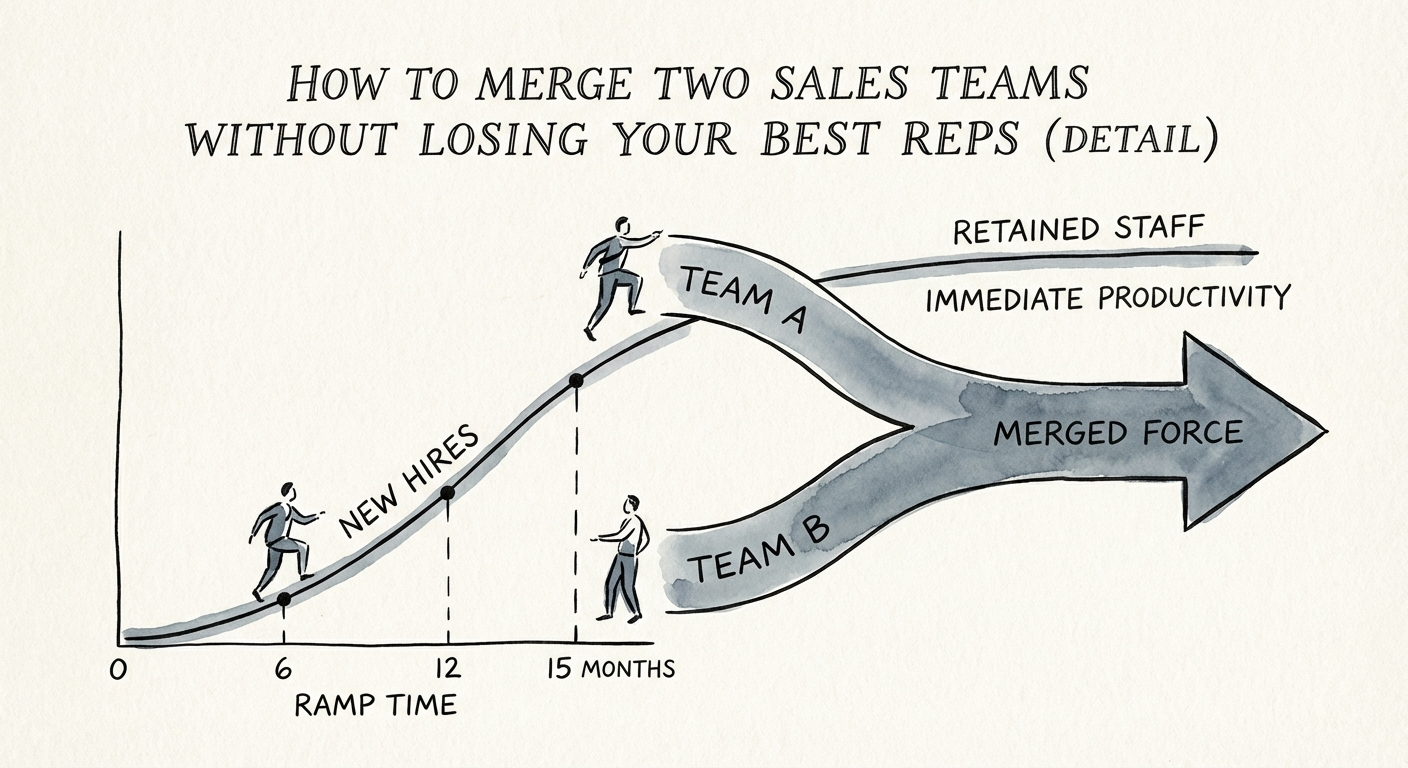
- 15 Months Time for a new sales hire to reach top performance levels (Rain Group)
The deal closed Friday. By Monday, your best closer has already done the math.
Picture the combined sales roster the morning after a SaaS bolt-on closes. Two teams, two CRMs, two comp plans, and a list of enterprise accounts where — surprise — both companies have an active opportunity in the same logo. The acquirer's senior account executive has a $1.2M renewal sitting in stage four. The acquired company's rep has been working the same account's new business team for eight months. Neither of them has been told who keeps it. So both of them quietly assume they're about to lose it, and one of them updates their resume before lunch.
This is the failure mode that quietly torpedoes the revenue thesis. You underwrote the deal on cross-sell and an expanded install base, but the integration itself attacks the people who have to deliver that number. Marsh McLennan's work on people risk in M&A puts retention at the top of the deal-risk list while a large share of acquirers admit they walk in unprepared for it. In a software business that gap lands squarely on the sales floor, because in SaaS the relationship and the renewal history live in one person's head and one person's pipeline.
What a defected rep actually costs you in a leveraged hold
The replacement check is the small number. Performio's retention data puts the fully loaded cost to replace a B2B sales rep north of $150,000 — recruiting, vacancy, lost pipeline. The number that actually breaks the model is ramp. Rain Group's onboarding research shows a new hire needs roughly 15 months to reach the production of a tenured top performer. Run that against a five-year hold financed with debt: lose three of your top quartile in the first quarter and you've created a dead zone in bookings that lands exactly when Year 1 EBITDA has to clear its covenants. You didn't lose headcount. You lost the specific dollars the lender is counting on.
A rep doesn't quit over the org chart. They quit the morning they open their comp statement and can't tell whether the named account they've worked for two years still pays them. Remove that one ambiguity and most of your attrition risk evaporates.
The two moves that buy you breathing room: name the account, freeze the comp
Retention in the first weeks isn't a culture program. It's the removal of two specific ambiguities — who owns the account, and what the next commission check looks like — fast enough that nobody has time to spiral. Get those two answered inside the first week and you've defused most of the regrettable departures before they form.
1. Resolve account ownership in a clean room — before the teams ever meet
Territory overlap is the live wire in any SaaS merger, and it's worse than in most industries because of named-account selling and multi-year contracts. The instinct is to sort it in a room full of sales leaders, which guarantees a turf war decided by tenure and volume. Don't. Have a neutral party — the integration office or an outside resource — pull both pipelines into a clean room and map every contested logo before the combined team huddles. The decision rule is documented relationship depth in the CRM: who has the active multi-thread, the renewal history, the champion relationship. Not who has the bigger title. When a rep sees a contested account assigned by evidence rather than politics, the protest dies quietly; when it's assigned by seniority, you've just taught your acquired reps the rules favor the home team. The discipline behind that — scoring overlap objectively before emotions enter — is the same logic we lay out in measuring M&A integration success.
2. Bridge the comp plan — do not harmonize it on day one
The single most common self-inflicted wound is rushing to a unified compensation plan. The Alexander Group finds the majority of companies struggle to align sales comp post-deal, and the reason is mechanical: if one company pays on booking and the other pays on collected cash, forcing everyone onto the stricter model on day one is an exit memo for your acquired reps. They will read it — correctly — as a pay cut delivered by an owner who doesn't know their book.
Run a bridge instead:
- Leave both plans untouched for two quarters. Whatever the acquired team was earning on, they keep earning on through the integration. You are buying stability, not optimizing a spreadsheet.
- Layer in a cross-sell kicker, uncapped. Pay specifically and richly for selling the newly acquired product line into existing books. This is the only thing on the comp plan that should change immediately, and it changes in the rep's favor — it signals upside without any downside.
- Guarantee on-target earnings for the top quartile. For the reps you cannot afford to lose, put a floor under them at their trailing-twelve earnings for the bridge period. A guarantee against last year's number is cheap insurance against a rainmaker walking while you're still redrawing territory maps.
The week-one promise that matters most is small and concrete: every rep knows their accounts and their pay mechanics for the next 90 days. You don't need the permanent plan figured out. You need the silence filled, because in an information vacuum the worst rumor always becomes the working assumption.
The 90-day arc: stabilize, then remove the daily friction, then unify
Once the bridge has stopped the bleeding, the job shifts from retention to productivity — and it runs on a tight clock.
Weeks 1–4: the regrettable-loss conversation, in person
Build the short list of reps who carry a disproportionate share of the number — in most SaaS books it's the top fifth driving the majority of new ARR — and meet each one face to face. Not HR, not a town hall. The operating partner or the new revenue leader walks them through their personal economics under the new ownership: the protected accounts, the guarantee, the cross-sell upside. People stay for a number they can see and a person who looked them in the eye. The specific language for those conversations is in our post-acquisition talent retention playbook.
Weeks 5–8: kill the daily friction before it compounds
Nothing erodes a retained rep faster than being made to do their job in two systems. Toggling between two CRMs, re-keying deals, fighting a CPQ tool they've never seen, learning a third expense policy — that grind makes the recruiter's call sound like relief. Move aggressively on consolidating onto one CRM and one quoting motion. A single source of truth on the customer is not an IT cleanup item; it's a condition of hitting the forecast.
Weeks 9–12: roll out the real plan and watch leading indicators
By day 90 the bridge has done its work and the permanent comp plan goes live, now built around the combined value proposition you actually bought the company for. Don't grade yourself on retention headcount alone — that's a lagging number. Watch pipeline velocity, cross-sell attach rate on the new product line, and whether your protected accounts are still showing forward motion in the CRM. If those hold through the quarter, the engine survived the surgery.
Do this Monday
Pull both pipelines into one view and flag every account where the two teams overlap. That single artifact tells you exactly where your retention risk is concentrated — because the reps most likely to leave are the ones sitting on a contested logo with no answer. In a leveraged hold, the sales team isn't a cost center you can trim alongside the back office. It's the asset the entire multiple-expansion case rests on. Protect it with the same rigor you'd protect the balance sheet, starting with the one map that shows you where the fights will be.