
The practical answer
- Short answer
- Only 7% of sales orgs forecast above 90% accuracy. A 90-day plan for venture- and PE-backed SaaS founders to rebuild board trust after a missed quarter.
- Best fit
- Industry: B2B SaaS. Function: Office of the CFO
- Operating path
- Financial Infrastructure → Commercial Performance → Valuations
- Key metric
- 7% Sales Orgs with >90% Forecast Accuracy
The 9 p.m. email you don't want to send
It's the night before the board call. You're staring at a deck that says you closed at 88% of plan, and you're rehearsing the sentence that explains why. Here's the thing no one tells you about your first real miss as a venture- or PE-backed SaaS founder: the board has already stopped listening to the explanation. They're doing arithmetic. They're asking whether the next four quarters are guessable, and whether the multiple they underwrote still holds.
That's the actual stakes of a bad quarter. Not the lost ARR — the lost predictability. According to Gartner, only 7% of sales organizations forecast with greater than 90% accuracy. So the moment your number slips, your investors don't just see one soft quarter; they see a company that may not be able to see itself. And a SaaS business that can't forecast trades at a discount no product roadmap can buy back.
Concretely, here's how the repricing works. A SaaS company carrying clean, predictable net retention gets underwritten on a forward multiple — investors paid up because they trusted the next eight quarters. Miss once with a clean story and a tight recovery, and you're a rounding error. Miss without a credible read on why, and the conversation quietly shifts from "growth multiple" to "show me the floor." Same product. Same team. The only variable that changed is whether your numbers are believable. Spend the morning after the board meeting deciding which of those two companies you are.
Bad news has to travel faster than good news. Warn the board four weeks early and it reads as management. Tell them four days late and it reads as negligence — and they reprice you for both.
Headwinds don't churn customers. Three specific things do.
The reflex is to blame the macro: longer cycles, frozen budgets, "everyone's missing." Maybe. But you cannot walk into the next board call with a weather report. You walk in with a forensic read of three places where a SaaS revenue engine actually breaks — and you name which one broke yours.
1. Your pipeline is lying, and 3x coverage is the alibi
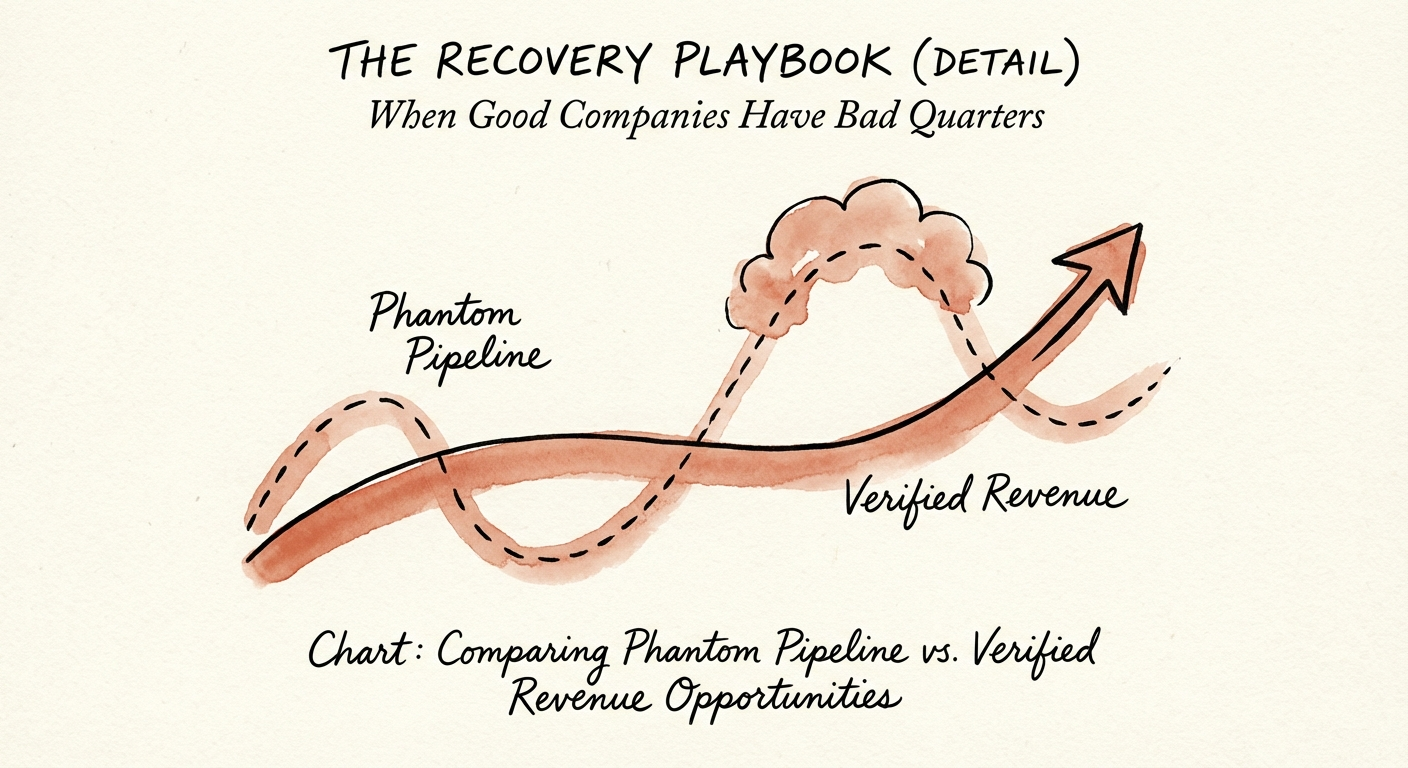
Founders get coached that 3x coverage means safety. It doesn't, and the math is unforgiving. If your win rate quietly slid from 25% to 18% — which happens the instant buyers add a second approver — then 3x coverage mathematically guarantees a miss before the quarter even starts. The problem isn't lead volume; it's that a large chunk of any "healthy" funnel is phantom: deals that stalled weeks ago but stayed open because no rep wants to walk into the forecast meeting with a thin column. Pull the report yourself. Filter for deals with no stage movement and no logged buyer activity in 45 days. That number is your real coverage gap.
2. The leaky bucket the board sees before you admit it
While you're counting new logos, the installed base may be quietly bleeding the equity. Vena Solutions' 2025 benchmarks put average monthly B2B SaaS churn around 3.5%, while best-in-class operators hold under 1%. That gap is not cosmetic. Grow new bookings 20% while losing roughly 15% of revenue a year and you are sprinting on a treadmill — burning CAC to stand still. Worse, your investors can see net retention in the cohort data long before it shows up in your narrative, so when you don't lead with it, they assume you either don't know or won't say. Both are worse than the churn itself.
3. The forecast was top-down, so the surprise was inevitable
Ask why the board got blindsided and the answer is almost always the same: the number was built from what you needed to hit, not what the data said you would. Demand Gen Report finds median forecast accuracy sitting between 70% and 79% — meaning roughly a quarter of projected revenue is fiction in the typical company. The tell is simple: if your CFO's number and your VP of Sales's number don't reconcile to within a few points, you don't have a forecast. You have two people guessing in different directions and calling the average a plan.
The 90-day plan: stop being a black box
You will not out-work a systemic miss. Sixty hours becoming eighty does nothing to a broken forecast model — it just delays the next one. The job is to rebuild the financial infrastructure that lets investors see the business clearly, so the story stops depending on your charisma. Three moves, in order.
Days 1–7: report the weather, not the vision
Switch the board update from lagging results to leading indicators they can verify between meetings. Stand up a weekly flash report tracking meetings set, stage-2 conversion, and at-risk renewals — the inputs that move two quarters out, not the bookings that already happened. The point is to make bad news arrive early and on a schedule. A board that learns about risk in week three of the quarter is being managed; a board that learns after close is being handled, and they know the difference.
Days 8–14: flush the phantom pipeline
Run a hard scrub: any deal with no stage movement in 45 days is dead until a rep proves otherwise with a logged next step. Expect total pipeline value to drop 30–50%. That hurts, and it's the point — you're resetting the baseline to something real so every future forecast inherits truth instead of hope. As covered in our guide to fixing broken sales forecasting, you cannot optimize a number you can't trust.
Days 15–90: re-architect for predictability over speed
If net revenue retention is under 100%, freeze net-new sales hiring and redeploy into customer success — because you cannot scale a base that loses 15% of itself a year, full stop. Then rebuild the board deck around unit economics and the quality of the business, not the slope of the growth line; the supporting logic is in why your board doesn't trust your numbers. The goal of the quarter is to prove that growth slowed but the engine got more honest.
Treat the miss as tuition. The lesson it buys is that systems beat heroics, and the payoff is a company your investors can forecast without you in the room. Recover the number and you've patched a quarter. Recover the predictability and you've re-earned the multiple — which, in a board meeting, is the only thing being priced.