
The practical answer
- Short answer
- Stop relying on 20-day-old board packs. Implement the Weekly Flash Report to fix cash visibility and drive operational turnarounds. Benchmarks included.
- Best fit
- Industry: PE-Backed Services. Function: Office of the CFO
- Operating path
- Financial Infrastructure → Commercial Performance → Valuations
- Key metric
- 19% Companies effectively using rolling forecasts
The Autopsy of a Failed Quarter
You know the feeling. It’s the 18th of the month. You finally open the board pack for your troubled portfolio company. You scan the P&L, and your stomach drops. EBITDA missed by 12%. Cash burn is accelerating. Again.
You call the CEO. "What happened?"
He gives you a narrative about a delayed deal, a surprise vendor payment, or a bad hiring cohort. But the reality is simpler: He didn't know until the books closed, either.
This is the "Lag Trap." In a stable asset, monthly reporting is governance. In a turnaround, monthly reporting is an autopsy. You are managing a patient in critical condition by checking their vital signs once every 30 days. By the time you see the red ink, the cash is gone, the customer has churned, and the quarter is unrecoverable.
Most Operating Partners inherit a financial infrastructure designed for peace, not war. The CFO produces GAAP-compliant, perfectly reconciled statements that arrive three weeks too late to influence decision-making. In a distressed scenario, precision is the enemy of speed. You don't need to know exactly how much you lost last month down to the penny; you need to know if you're going to make payroll next Friday.
The Data Gap
Recent analysis by McKinsey & Company highlights that while dealmaking has slowed, the pressure on operational performance has intensified. In fact, operational improvements now account for approximately 54% of value creation in private equity, far outstripping multiple expansion or leverage. Yet, remarkably, industry data suggests that fewer than 20% of firms effectively utilize rolling forecasts to manage this volatility.
If you are relying on the standard monthly board pack to save a sinking ship, you have already lost.
In a turnaround, EBITDA is an opinion; Cash is a fact. You need a direct-method 13-week cash flow forecast. This is the single most critical tool for survival.
The 13-Week Directive
The antidote to the Lag Trap is not more reporting; it is faster, leading-indicator reporting. We call this the Weekly Flash Report.
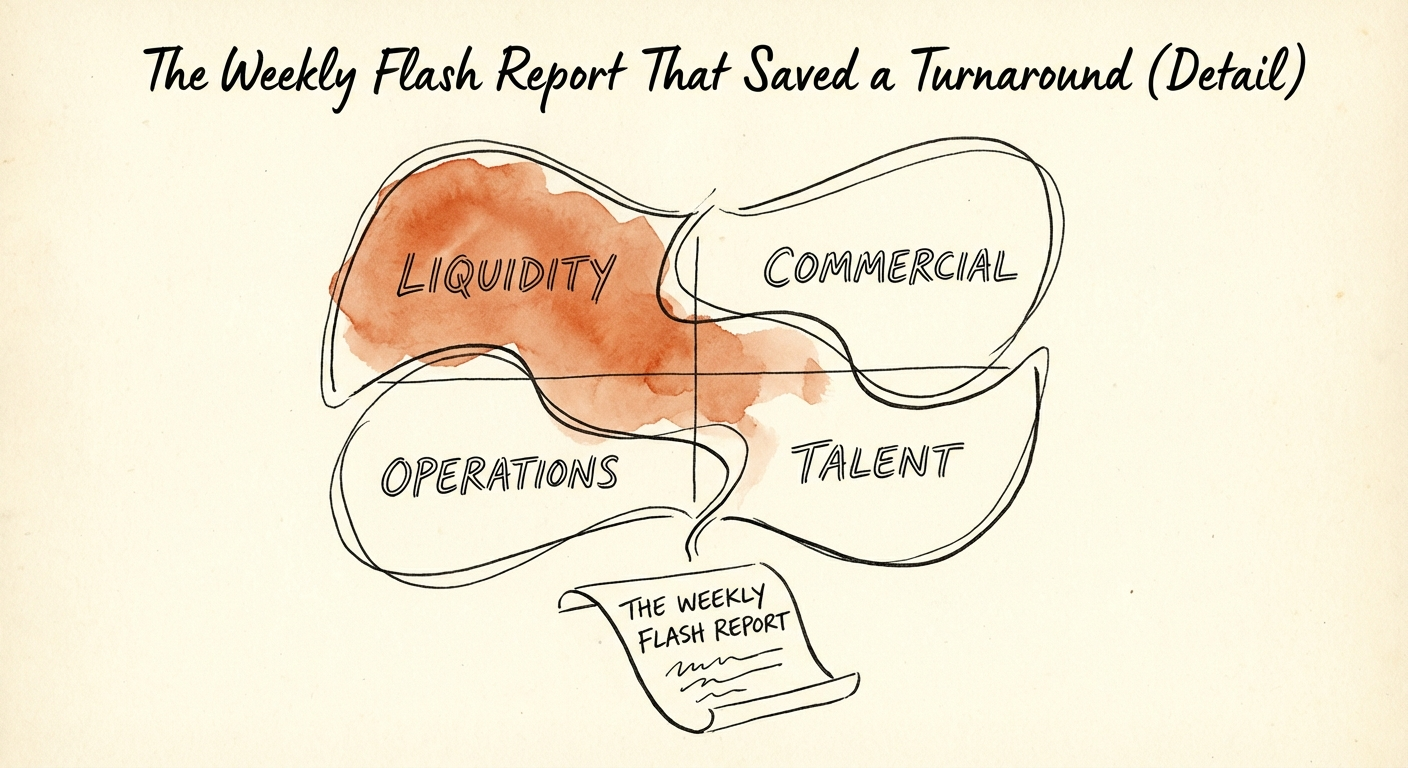
This is not a dump of the General Ledger. It is a single-page dashboard, delivered every Monday by 10:00 AM, containing only the four metrics that predict the future solvency and viability of the company. If your CEO cannot produce this, they are lacking operating visibility.
Quadrant 1: Liquidity (The 13-Week Cash Flow)
In a turnaround, EBITDA is an opinion; Cash is a fact. You need a direct-method 13-week cash flow forecast. This is the single most critical tool for survival.
- The Metric: Ending Cash Balance vs. Forecast Variance.
- The Benchmark: Variance must be <5% week-over-week.
- The Insight: If the variance is consistently negative, your CFO doesn't understand the business's working capital cycle.
Quadrant 2: Commercial Velocity
Stop looking at "Total Pipeline Value." It is a vanity metric bloated with stale deals. You need to measure movement.
- The Metric: Stage-Weighted Pipeline Velocity (Net New + Stage Advances - Stalled/Lost).
- The Benchmark: For a turnaround, you need pipeline coverage that is 3.5x to 4x your booking target, but only if 20% of that pipe is moving stages weekly.
Quadrant 3: Operational Efficiency
For services and tech firms, labor is your COGS. If utilization drops, margin vanishes instantly. You cannot wait for the month-end accruals to see this.
- The Metric: Billable Utilization (Last Week Actuals vs. This Week Forecast).
- The Benchmark: 75%+ for delivery staff. Any dip below 70% in a distressed firm is an immediate EBITDA leak.
Quadrant 4: Talent Pulse
Turnarounds burn people out. Your best engineers and salespeople will leave first. You need an early-warning smoke detector.
- The Metric: Resignation Risk Index (Subjective Red/Yellow/Green from department heads) & Key Role Vacancies.
According to Gartner’s 2025 Leadership Vision, only 3% of companies have fully aligned strategic, operational, and financial planning processes. This fragmentation is why the Board sees one set of numbers while Operations sees another. The Flash Report forces alignment every single Monday.
Execution: The Monday Morning Ritual
Implementing the Weekly Flash Report will cause friction. Your CFO will complain about data hygiene. Your VP of Sales will complain about "micromanagement."
Ignore them. This is the price of survival.
The "Rough is Right" Principle
Tell your team: "I would rather have a report that is 90% accurate on Monday morning than one that is 100% accurate on Friday afternoon." Speed allows for course correction. If labor utilization was 65% last week, you can cut contractor spend this week. If you wait for the monthly P&L, you will have paid for four weeks of idle time.
From Reporting to Action
The Flash Report is useless if it doesn't trigger a conversation. Schedule a 30-minute "Flash Review" every Monday at 11:00 AM.
- Agenda Item 1: Cash variance explanation.
- Agenda Item 2: Pipeline movement (specifically, what deals are stalling?).
- Agenda Item 3: Utilization fix (who is on the bench and why?).
We recently deployed this cadence at a $40M distressed SaaS portfolio company. Within six weeks, we identified a persistent $200k/month operational leak caused by unbilled change orders and scope creep—a detail buried in the monthly aggregate data but glaringly obvious in the weekly flash. That insight alone saved the quarter.
The Verdict
You cannot financial-engineer your way out of an operational crisis. You must operate your way out. And you cannot operate without vision. The Weekly Flash Report gives you the headlights you need to drive the car away from the cliff.
Stop waiting for the autopsy. Start checking the pulse.