
The practical answer
- Short answer
- Median SaaS growth plunged from 60% to 8.4% in 18 months. Here is the operator's playbook for surviving a revenue collapse, extending runway, and avoiding the 'death spiral' of down rounds.
- Best fit
- Industry: B2B SaaS. Function: Office of the CFO
- Operating path
- Financial Infrastructure → Commercial Performance → Valuations
- Key metric
- 20% Percentage of VC deals that were 'Down Rounds' in 2023 (vs 8% in 2022)
The Floor Is Lower Than You Think
If you felt like the ground fell out from under you in late 2023, you weren't hallucinating. The data is now conclusive: the median revenue growth rate for B2B SaaS companies collapsed from a high of 60% in Q1 2022 to just 8.4% by September 2023. This wasn't a “softening”; it was a crash.
For founders like you who built companies on the premise of 50%+ YoY growth—this shift broke the fundamental physics of your business model. You hired for a $30M future while revenue stalled at $15M. You signed multi-year cloud commit contracts based on utilization forecasts that never materialized. And, most dangerously, you likely hesitated to cut costs because you believed the dip was temporary.
It wasn't. The number of VC-backed startups filing for bankruptcy doubled in 2023 compared to the previous year. Down rounds, once a rare stigma, surged to account for 20% of all venture deals (up from just 8% in 2022). The market didn't just pause; it repriced the value of revenue itself.
The Lag Indicator Trap
The most dangerous phase of a revenue drop isn't the initial missed quarter; it's the lag. Revenue often looks stable for 3-6 months after leading indicators (pipeline coverage, NRR, usage) fall off a cliff. By the time your recognized revenue drops 40%, your actual business activity might be down 60% or more.
If you are reading this because you've missed your numbers for three consecutive quarters, you are already in the danger zone. The “wait and see” approach is what kills companies in this cycle. The median burn rate for private B2B SaaS companies went from 20% of revenue in 2022 to near 0% (breakeven) by Q3 2023. Your competitors didn't just survive; they aggressively operationalized their survival. If you haven't, you are at real solvency risk.
The market didn't just pause; it repriced the value of revenue itself. You cannot simply 'grow your way out' of a hole this deep.
The Turnaround Protocol: Operational Engineering
Surviving a 40% drop requires shifting from Financial Engineering (raising more debt, restating projections) to Operational Engineering (changing how the work gets done). You cannot simply “grow your way out” of a hole this deep.
1. The 24-Month Directive
Your first move is to secure a survival runway. In 2021, a 12-month runway was acceptable. In the current climate, where fund deployments have slowed to their lowest levels since 2014, you need 24 months of runway to survive a potential “funding winter.”
This is not about localized trimming; it is about structural resizing. The 24-Month Directive requires you to build a cash flow model that assumes zero new net revenue for the next two quarters. If you cannot survive that scenario, you are not default alive.
2. The Breakeven Mandate
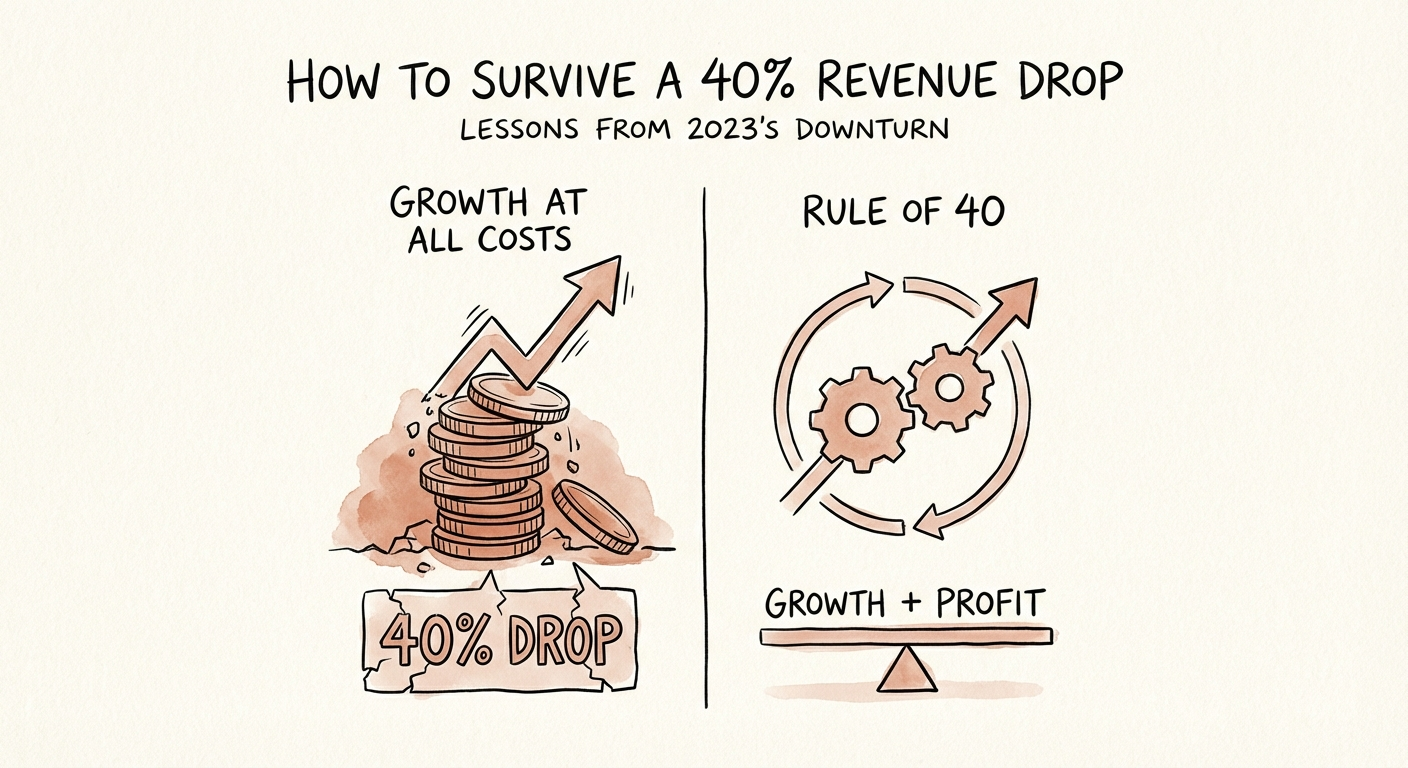
The median SaaS company dramatically improved its efficiency profile in 2023, with operating margins for unprofitable companies improving from -28% to -9%. The market no longer rewards growth at all costs; it rewards the Rule of 40 (Growth % + Profit Margin %).
- Stop Buying Revenue: If your Burn Rate vs. Growth Rate ratio is upside down (burning $2 to generate $1 of ARR), you must cut Sales & Marketing spend immediately. Data shows that rigid payment options and long sales cycles (up 3.8 weeks in 2023) are reducing efficiency.
- Audit Indirect Spend: Indirect spend often accounts for up to 20% of revenue. Benchmarks suggest that a rigorous audit here can improve bottom-line margins by 2 full percentage points without touching headcount. This is “free” EBITDA.
3. The “One Cut” Rule
The worst mistake distressed CEOs make is “death by a thousand cuts”—cutting 10% today, 5% next month, and 10% the month after. This destroys culture and paralyzes productivity. You must measure the drop, forecast the worst-case scenario, and cut once and deep. Data shows that 82% of companies fell short of their cost reduction targets in 2024 because they were too optimistic. Do not join them.
Action Plan: Stabilize, Then Rebuild
You have taken the hit. The valuation has compressed. Now, you must operate your way to a new baseline. Here is your 90-day stabilization plan.
Days 1-30: The Triage
Implement a 13-week cash flow forecast immediately. This is not a board slide; it is your daily bible. Review every single outgoing wire. If an expense does not directly contribute to retaining existing revenue (Customer Success) or closing immediate pipeline (bottom-of-funnel Sales), pause it.
Look specifically at your tech stack. The Black Box of IT Spend is often filled with shelfware from the hyper-growth era. We routinely find 15-20% of SaaS licenses are unallocated or unused in distressed firms.
Days 31-60: The Efficiency Reset
Re-evaluate your pricing and packaging. In a downturn, customers consolidate vendors. Ensure your product is “sticky” by locking in multi-year deals, even if it means offering a discount for upfront cash. Cash today is worth significantly more than booked revenue tomorrow. Recall that companies with rigid payment terms saw higher churn in 2023.
Days 61-90: The New Normal
Once you have stabilized cash, communicate the new reality to your team. The goal is no longer “unicorn status”; it is “sovereignty.” A company that controls its own destiny (breakeven or profitable) cannot be killed by a VC withdrawing a term sheet.
The drop was painful, but the data shows that the companies left standing in 2025 are leaner, more efficient, and fundamentally stronger. The “growth tourists” are gone. This is the era of the operator.