
The practical answer
- Short answer
- Post-merger churn often spikes in Month 6, not Month 1. Discover why the 'Integration Reality Check' costs PE firms 17% of acquired revenue and how to stop it.
- Best fit
- Industry: B2B Tech / Services. Function: Customer Success
- Operating path
- Migration & Integration → Turnaround & Restructuring → Transaction Advisory Services
- Key metric
- 17% Customers who reduce/cease business post-acquisition (PWC)
The Deceptive Calm of the First 90 Days
There is a dangerous misconception in Private Equity integration playbooks: the belief that if customers don't leave immediately after the deal announcement, they are safe. You close the deal, send the "business as usual" email, and watch the retention dashboard for 90 days. Nothing moves. The numbers look stable. You report to the Investment Committee that the transition is "green."
Then, Month 6 hits.
Suddenly, three key accounts downgrade. A flurry of support tickets goes unanswered. Your Net Revenue Retention (NRR) dips below 100% for the first time in two years. You aren't facing a crisis of loyalty; you are facing the Integration Reality Check.
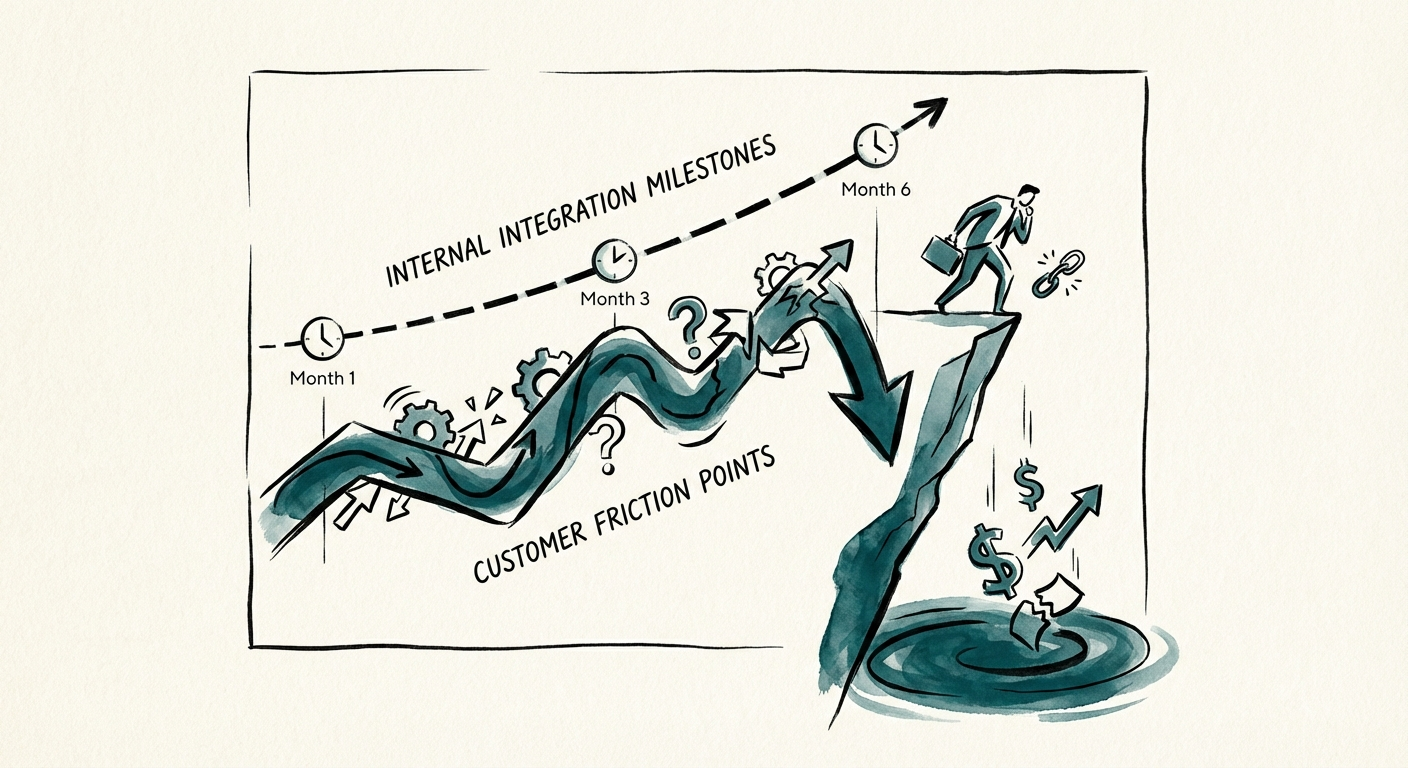
The Month 6 Churn Spike is a structural phenomenon, not a coincidence. During Months 1–3 (the "Honeymoon Phase"), two things protect you: long-term contracts that haven't expired yet, and a deliberate "Do No Harm" operating posture. But by Month 6, the protective layer dissolves. You begin executing the value creation plan—consolidating billing systems, swapping out "redundant" account managers, and rationalizing product roadmaps. This is exactly when the customer feels the friction of your synergy targets.
You can have the best M&A strategy in the world, but if customers start walking away in Month 6 because you fired their account manager, the deal model is dead.
The Anatomy of Integration Friction
Data from PWC reveals a stark reality: approximately 17% of customers reduce or cease business with a company following an acquisition. This attrition doesn't happen on Day 1; it happens when the operational changes actually touch the customer experience.
Why Month 6?
By the sixth month, the operational gears of the merger are grinding against each other. We consistently see three specific triggers that align to cause this spike:
- The Account Manager Swap: In pursuit of SG&A "synergies," you consolidate sales teams. For the customer, this means the trusted advisor who knew their business for five years is replaced by a generalist who doesn't know their name.
- The "Platform Migration" Ultimatum: This is often when the first notices go out regarding legacy platform sunsets or forced migrations. Surviving the M&A Death Valley requires handling this specific conversation with surgical precision, yet most firms handle it with a bulk email.
- Billing & Support Chaos: You merged the ERPs or CRMs in Month 4 or 5. By Month 6, the invoices are wrong, and support tickets are getting lost in a botched Salesforce consolidation.
The Financial Impact of the Leak
The cost of this churn is mathematically catastrophic to the investment thesis. It is widely accepted that acquiring a new customer costs 5 to 7 times more than retaining an existing one. But in a post-merger environment, that CAC (Customer Acquisition Cost) is essentially infinite because your sales team is distracted by integration and not hunting effectively. If you lose 10% of ARR in Month 6, you will not replace it in Year 1. Your EBITDA bridge just collapsed.
The 9-Month 'Safe Harbor' Protocol
To avoid the Month 6 Cliff, you must decouple your internal integration timeline from the customer's experience timeline. We recommend a strategy we call the 9-Month Safe Harbor.
1. Freeze the Front Line
Do not change Account Managers or Customer Success Managers (CSMs) for the top 20% of revenue until Month 9. Even if you are reducing headcount elsewhere, the relationship equity these individuals hold is the only thing bridging the trust gap. Culture clashes are internal problems; don't let them become customer problems.
2. The 'White Glove' Migration Squad
Instead of forcing a standard migration path, deploy a dedicated 'Bridge Team' whose only KPI is retention during the transition. They don't have quotas for upsells; their quota is 100% renewal of the acquired base. They manually handle the billing glitches and navigate the new support org on behalf of the client.
3. Monitor Leading Indicators, Not Lagging Ones
Stop looking at Churn Rate; it's a lagging indicator. By the time it shows up, the customer is gone. In Months 4–6, you must obsessively monitor Integration Friction Metrics:
- Ticket Resolution Time (TRT): Is it creeping up?
- Invoice Dispute Rate: Are customers rejecting bills due to errors?
- QBR Attendance: Are clients declining quarterly business reviews? (A silent leading indicator of churn).
The integration will happen. The synergies will be captured. But if you rush the customer-facing elements to meet an arbitrary 100-day plan, you will capture the efficiencies but lose the revenue.