
The practical answer
- Short answer
- Combining two Salesforce instances after an acquisition can erase 20-30% of pipeline visibility. Here's how to handle account survivorship and stage blending so Day 1 numbers are real.
- Best fit
- Industry: B2B SaaS. Function: Revenue Operations
- Operating path
- Migration & Integration → Turnaround & Restructuring → Transaction Advisory Services
- Key metric
- 20-30% Average drop in combined pipeline visibility within the first 60 days of a poorly executed CRM merger.
The dashboard the board wants doesn't exist yet
A PE-backed platform acquires a competitor. Both run Salesforce. The operating partner does the math in the deal room: two CRMs, one schema, one consolidated pipeline by the next board meeting. The work gets handed to an IT manager or a systems integrator with a date attached. Eight weeks later, the "single source of truth" is a combined org where the same customer appears three times, win rates have mysteriously improved, and the sales VP quietly keeps forecasting out of a spreadsheet because nobody trusts the dashboard.
The reason is that moving Opportunities from Org A to Org B looks like a field-mapping job and is actually a reconciliation of two businesses that defined reality differently. Before a single record loads, you have to settle territory rules, stage definitions, product eligibility, and account ownership — because each org encoded its own answers into custom fields, picklist values, and validation rules that will silently fight each other the moment they share a database.
The stakes aren't abstract. Between 70% and 90% of acquisitions fail to deliver their expected value, with botched integration a primary culprit, per the Harvard Business Review. In a B2B SaaS roll-up, that failure usually shows up first in the CRM — because that's where the synergy story is supposed to become a number.
The first wall is account survivorship, and Salesforce's native duplicate rules will not save you. They match on fuzzy name and email; they have no opinion about who owns the customer. In the parent org, your enterprise rep owns "Acme Corp." In the acquired org, a mid-market rep owns "Acme, Inc. (Subsidiary)." Same logo, two Account IDs, two reps, two comp plans pointing at it. Merge without a survivorship rule that says which record wins and who keeps the relationship, and you don't get a clean account — you get an ownership dispute that lands on the CRO's desk in week one. Settle that order of operations first; our 120-day IT integration roadmap sequences it.
A Salesforce org merger is not a field-mapping exercise. It's two revenue architectures with conflicting definitions of "won," and whichever one you let win decides whether your Day 1 forecast is true.
The blended pipeline that's mostly fiction
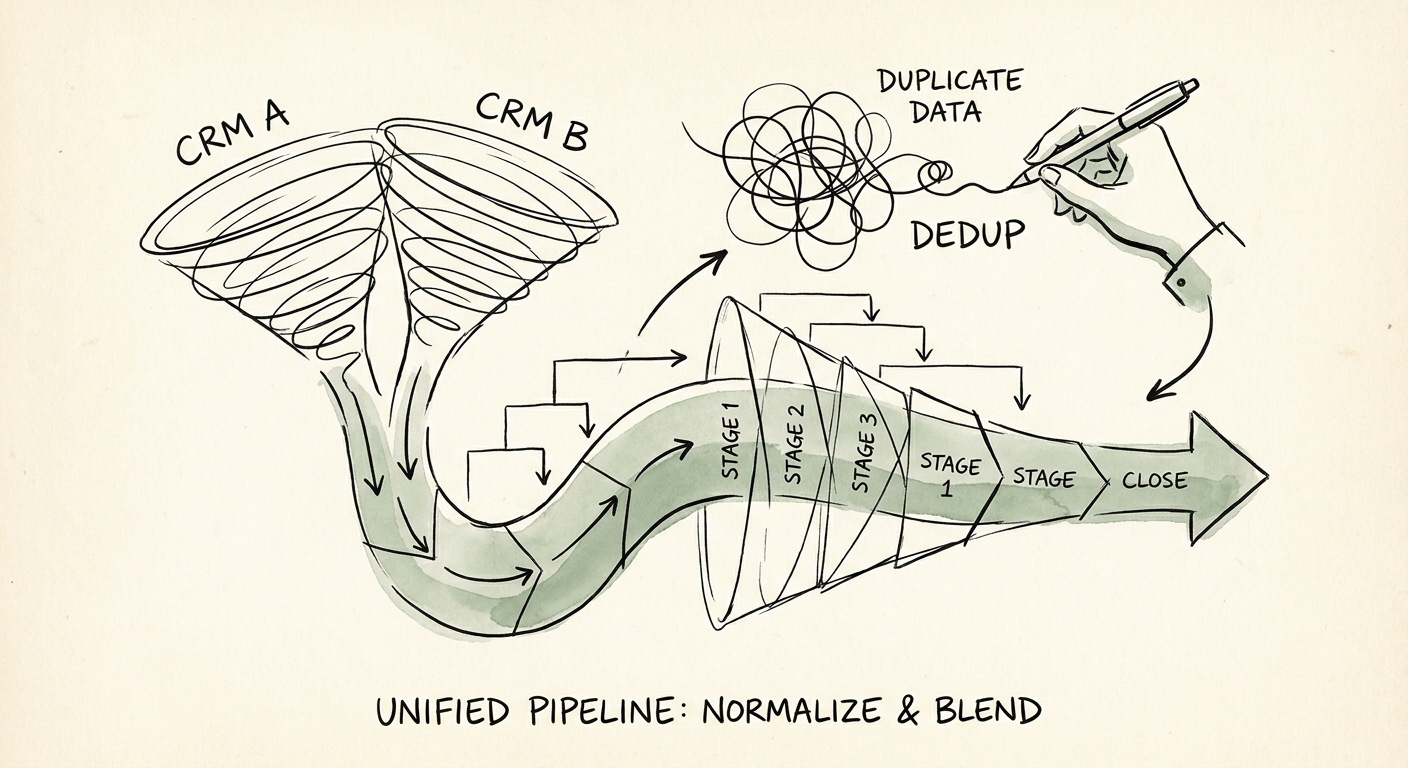
Survive dedup and you hit the harder problem: you cannot add two pipelines together when the two orgs don't mean the same thing by a stage. The parent runs a disciplined five-stage process where "Stage 3 – Proposal" historically closes at 50%. The acquired org runs a loose seven-stage process where "Stage 3 – Discovery" is tagged 30% because someone set that default in 2022 and never revisited it. Map stage-3 to stage-3 by name and you've just imported a pile of optimism as committed pipeline. The forecast looks great. It is not real.
Dirty data is expensive even before a merger amplifies it. Gartner puts the cost of poor data quality at $12.9 million a year for the average enterprise. In an M&A context that figure isn't just operational drag — it's a haircut on the multiple you'll defend at your own exit, because a buyer's diligence team will reprice a pipeline they can't trust. And the baseline is already bad: roughly 70% of revenue leaders lack confidence in their CRM data, with as much as 80% of records inaccurate before you add the structural chaos of blending two orgs.
Here's the trap that's specific to Salesforce mergers. Stage probability lives in the Opportunity stage picklist as a default, but reps and CPQ override it per-deal. So when you migrate, you can faithfully carry over every Amount, every CloseDate, every Forecast Category — and still be wrong, because the product behind the number changed the day you closed the deal. Picture a $150M SaaS platform doing a blind org merge: 40% of the acquired company's "committed" pipeline is attached to legacy CPQ bundles the parent sunsetted the prior week. The data mapped perfectly. The deals were dead on arrival. That's why every acquired rep has to defend their pipeline against the acquirer's exit criteria and current product catalog before anything leaves a sandbox — the discipline we lay out in the CRM data consolidation playbook. Skip the re-qualification and your Day 1 combined number is a press release, not a forecast.
What to do before a single CSV leaves the sandbox
Three moves separate a clean Salesforce merger from a swamp. None of them are technical — they're decisions you make on paper first, then enforce in the schema.
1. Write the Golden Record rules before you export anything. Decide field-by-field which org wins when values conflict, and document it. Usually the parent's billing and ERP systems dictate the taxonomy because that's what finance reports against. If the acquired org tracks Industry on a free-text picklist and the parent uses NAICS codes, the acquired values get transformed into NAICS before insertion — not "cleaned up later," which means never. Survivorship is a policy, not a Salesforce setting; write it down and have the CRO sign it.
2. Freeze the pipeline and remap stages by exit criteria, not by name. Build the stage mapping from the verifiable gate each stage requires, ignoring what the stages are called. If the parent's Stage 4 demands a signed mutual NDA and a completed security review, every acquired deal claiming equivalent maturity has to clear those exact hurdles to keep its probability weight. Deals that fail the stress test get demoted to an earlier stage or purged. You will lose pipeline on paper in week one. That's the point — you're trading a fake number for a defensible one.
3. Keep the acquired org read-only for 30 to 60 days. Don't decommission the legacy instance on cutover night. Leave it queryable while reps start working from the unified org. When an account-ownership dispute flares — and it will — you'll need the historical activity timeline, the old email threads, the prior proposals, to adjudicate it and save an at-risk deal. The read-only holdout is your rollback insurance and your tiebreaker.
Treat a two-org Salesforce merger as the go-to-market restructuring it actually is, not the data-migration ticket it's filed as. Get survivorship and stage blending wrong and you'll spend four quarters explaining to the board why the synergies modeled in diligence evaporated by Day 1. Get them right and the combined dashboard becomes the asset the deal thesis assumed it already was. Start by reading which post-merger integration mistakes destroy deal value — then lead with process.