
The practical answer
- Short answer
- 70-90% of M&A deals miss their model. In tech deals the value leaks in the first 100 days — through code, CRMs, and the frozen middle. Here's where, and the fix.
- Best fit
- Industry: Private Equity / Tech. Function: Operations
- Operating path
- Migration & Integration → Turnaround & Restructuring → Transaction Advisory Services
- Key metric
- 70-90% Failure rate of M&A deals to deliver expected value (Mergewise 2025)
The wire cleared. The model started leaking that afternoon.
The closing dinner went fine. The press release is out. Somewhere in the deal model, an IRR is sitting on a synergy curve that assumes two engineering orgs become one by Q2 and a combined pipeline lights up by Q3. None of that happens on a calendar. It happens in a codebase, in two Salesforce instances that don't reconcile, and in the inbox of a staff engineer who just updated her resume.
The uncomfortable part is how routine the miss is. Per 2025 data from Mergewise, 70-90% of M&A deals fail to deliver their expected value, and the cause is almost never the thesis or the price. It's the execution between Day 1 and Day 100. For an operating partner, that window is the whole game — it's where you either earn the multiple you underwrote or quietly start managing a turnaround you didn't budget for.
What follows isn't a culture-clash sermon. These are twelve specific, mostly technical failure modes that bleed EBITDA out of a software-services or SaaS acquisition while the board is still admiring a green dashboard. The first three all happen before anyone notices, because they're handoff failures — value lost in the seams between teams who never speak to each other.
1. Treating IT integration as a Day-2 problem
Financial diligence is exhaustive. Technical diligence too often stops at a "red flag" memo. So you close, look under the hood, and find the target's billing logic is a four-year-old monolith with one person who understands it. That's not a migration — it's a rewrite, and you priced a migration.
The fix is to start architectural diligence during the deal, not after it. Teams that begin technical integration planning before close realize synergies meaningfully faster. If you don't have a validated architecture map by Day 1, you are already a quarter behind a curve you put in the model yourself.
2. The "merger of equals" that paralyzes every decision
Announcing a merger of equals feels diplomatic. Operationally it installs two heads on one body, and now every tool choice, SOP, and territory line gets negotiated instead of decided. Deadlock doesn't announce itself; it just turns a 90-day plan into a 270-day plan. Name one accountable owner per function on Day 1. The status quo is precisely the thing you paid to change — ambiguity protects it.
3. The diligence-to-ops handoff that nobody runs
The deal team knows churn spiked last quarter because of a bad release. They also leave. The integration team walks in blind and rediscovers that landmine in month three, which is exactly when the first forecast misses. Run a formal diligence download before the deal team disbands. The risk register from the model should become the integration office's first task list — not a document that gets archived with the data room.
The model dies on Day 1 and nobody sends the obituary. You find out 90 days later when the forecast you bought turns out to live inside a system nobody can read.
Where tech deals bleed: the technical and financial black holes
Generic integration advice assumes the asset is a factory or a regional services book. A software company is neither. Its value lives in code, customer data, and a few dozen people who can leave on a Tuesday. That changes the math, and it changes which mistakes are fatal.
4. Budgeting 3% for integration when the work costs 7%
Models love a tidy 1-3% of deal value for integration. In Technology, Media and Telecom, that number is a fiction. EY's work on integration cost puts the spend frequently above 5.6% of target revenue for tech-heavy deals. Underfund it and the corners you cut are always the same ones: data migration and training. Those are exactly the corners that produce revenue leakage larger than the synergies you were chasing.
5. Counting revenue synergies you have no plan to capture
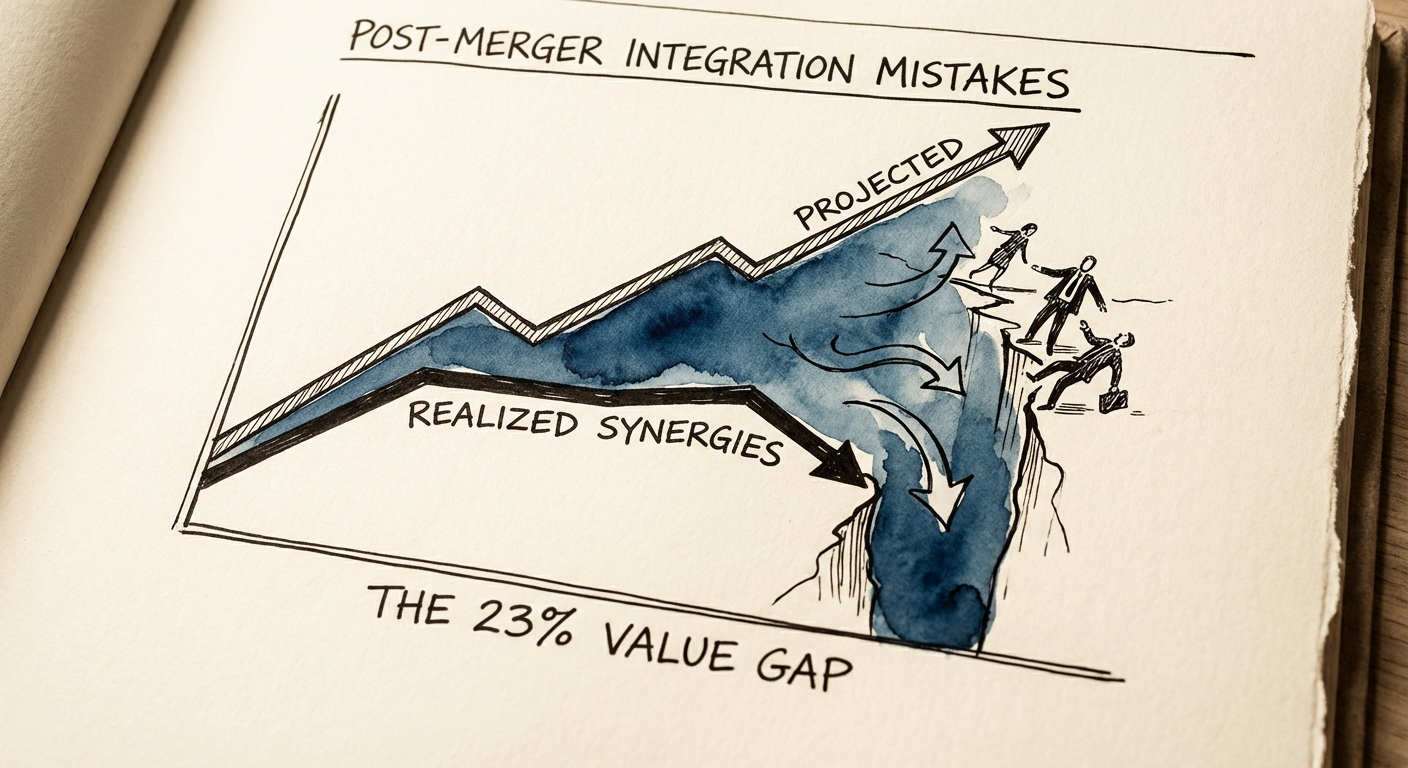
Cost synergies are easy — the duplicate CFO, the redundant office. Revenue synergies are where deals go to lie to themselves. McKinsey's work on the topic documents an average 23% gap between projected and realized revenue synergies. The mechanism is mundane: while leadership is modeling cross-sell, the reps are fighting over territory and decoding a new comp plan, so they miss the base number — never mind the cross-sell on top of it.
6. Two Salesforce instances "for the transition period"
Letting both CRMs run for "18 months" is how you end up with two versions of the truth and a pipeline you can only report in a hand-built spreadsheet. Forecast accuracy goes to noise. You cannot run a combined company you cannot see. Run a 120-day CRM consolidation and accept the short-term pain — the alternative is a year of flying blind on the exact metric your model depends on.
7. The talent drain that doubles your replacement bill
An acquisition is the single loudest signal to update a resume. Broad voluntary turnover sat near 13% in 2024; post-acquisition it routinely spikes past 30%. You're not losing headcount — you're losing the only people who know why the system is built the way it is. Replacing a senior engineer runs roughly 200% of salary, and that ignores the cost of the projects that stall while the seat is empty.
8. Bridging your network to a security shack
In the rush to connect environments, you wire your fortress to whatever posture the target actually has. If theirs is weak, you just handed an attacker a lateral path into your house — you acquired a breach. Keep the networks air-gapped until a real security audit and remediation is done. Treat connection as a quarantine decision, not an IT convenience.
The last four are where execution actually wins or loses
The first eight mistakes are about money and machines. These are about people and measurement — the part operating partners under-resource because it doesn't show up cleanly in a model.
9. Losing the frozen middle
Your C-suite is aligned and the ICs are heads-down. The resistance lives in the layer between — the directors and VPs watching their headcount, budget, and authority get redrawn. They don't rebel in meetings. They pocket-veto. They let a rollout slip "for sequencing reasons." Win the middle layer explicitly, with new scope and a stake in the combined outcome, or the integration dies of a thousand quiet delays.
10. Standardizing the secret sauce to death
You bought the target for its speed. Then you drop your procurement process, your compliance stack, and your release cadence on top of it, and within two quarters it moves like everything else you own. Identify the one capability you actually paid for and ring-fence it. Standardize the back office; protect the engine.
11. Measuring activity instead of P&L
A weak integration office reports "systems migrated" and "offices closed." A good one reports cross-sell conversion and margin expansion. You can finish 100% of an integration checklist and still miss the quarter, because the checklist measured motion, not outcome. Tie every workstream to a specific P&L line, or you're just busy.
12. Outsourcing culture to a town hall
Culture isn't a poster — it's how decisions get made under pressure. Roughly 30% of failed integrations name culture as the primary cause, and it's not because the mixers were bad. It's because one company decides by consensus and the other decides by command, and nobody wrote down which one wins now. Define the operating model for decisions explicitly. That's the culture work that matters.
What to do Monday
The integration office should behave less like a PMO and more like a small team with a mandate and a clock:
- Days 1-30 — Stabilize. Lock down the people you can't lose with retention that's real (cash, not just refreshed equity). Freeze changes to the customer experience. Stand up one decision-maker per function.
- Days 31-90 — Integrate the spine. Combine finance and sales reporting, kill the second CRM, and fund integration at the rate the work actually costs, not the rate the model assumed.
- Days 91+ — Optimize. Only now do you hunt the efficiencies, because now you can see the whole board.
For the broader pattern across deals — including the seven missteps that still trip up firms whose success rates are otherwise climbing — treat integration as a re-founding of the company, with the same architectural rigor you'd demand of the product itself.