
The practical answer
- Short answer
- The board wants financial visibility, so sponsors migrate the GL first. That sequence corrupts the data feeding it. Here is the order that actually protects deal value.
- Best fit
- Industry: B2B Software & IT Services. Function: Information Technology
- Operating path
- Migration & Integration → Turnaround & Restructuring → Transaction Advisory Services
- Key metric
- 50% of realized business synergies depend exclusively on successful systems and process integration.
The board asks for one number, and that number breaks everything
Ninety days after a roll-up closes, the operating partner wants one thing from the new portfolio company: a consolidated P&L the board can actually trust. So the instruction comes down to IT and finance — get everyone onto the platform's General Ledger, fast. It feels like the obvious first move. The GL is where the visibility lives. It is also the move that detonates the integration.
I watched a roughly $250M manufacturing roll-up try exactly this: three acquired entities jammed into one NetSuite instance inside a 90-day window, financial core first. Because the GL went first, nobody had reconciled what a "customer" was across the three targets, or which vendor hierarchies and units of measure were the survivors. The new system inherited three contradictory versions of reality and dutifully recorded all of them. The cleanup ran 14 months, and the board-ready visibility the sponsor bought the deal partly to get arrived a year and a half late.
The pattern is not unique to that deal. Gartner's analysis of ERP implementation failure puts the failure-to-meet-objectives rate at 55% to 75%, with migration of dirty data sitting at the center of the wreckage. McKinsey's work on ERP transformations reaches the same place from a different angle: roughly 70% of programs fall short of their potential because they are run as system-installation projects — "get everyone on SAP by Q3" — instead of data-architecture projects. When you cut the GL over before the operational data feeding it is standardized, you are not creating financial truth. You are automating three companies' worth of unresolved disagreements at machine speed.
The General Ledger is the scoreboard, not the game. Migrate it first and you just automate every disagreement your acquired companies never resolved about who a customer is.
The first system you migrate is not an ERP at all
The thing you migrate first is the definition layer underneath all the ERPs: master data. Before a single journal entry moves, somebody has to decide, on paper, what makes a customer record unique, what the surviving chart of accounts looks like, and how each legacy system's product and vendor models map onto that standard. That is unglamorous work. It is also the only work that determines whether the rest of the integration is possible.
Here is the concrete trap. Target 1 carries an account as "Acme Industries" on net-60 terms with tiered volume pricing. Target 2 carries the same buyer as "Acme Ind." on net-30 with a flat rate, under a different sales rep, in a different region code. Map both straight into the new ERP without resolving that conflict and you do not get one customer — you get two, with two credit profiles and two pricing engines, and a salesperson who books the same order twice. No reporting layer on earth fixes that after the fact. You decide it before the migration, or you live with it for years.
This is why I treat the choice between an ERP migration versus a consolidation as downstream of the master-data decision, not upstream of it. The financial stakes are not abstract. Bain's M&A integration research finds that around half of the synergies a deal is underwritten on depend on systems and process integration actually working — and corrupted master data quietly cancels those synergies one duplicate at a time. Panorama Consulting's ERP report shows roughly 30% of projects blow their budgets outright by underestimating exactly this integration complexity. The first-100-days deliverable is not a go-live date. It is a governed definition of who a customer is, what the chart of accounts is, and how legacy records translate to it — feeding clean data back into the old systems so you can retire them one at a time without the business going dark.
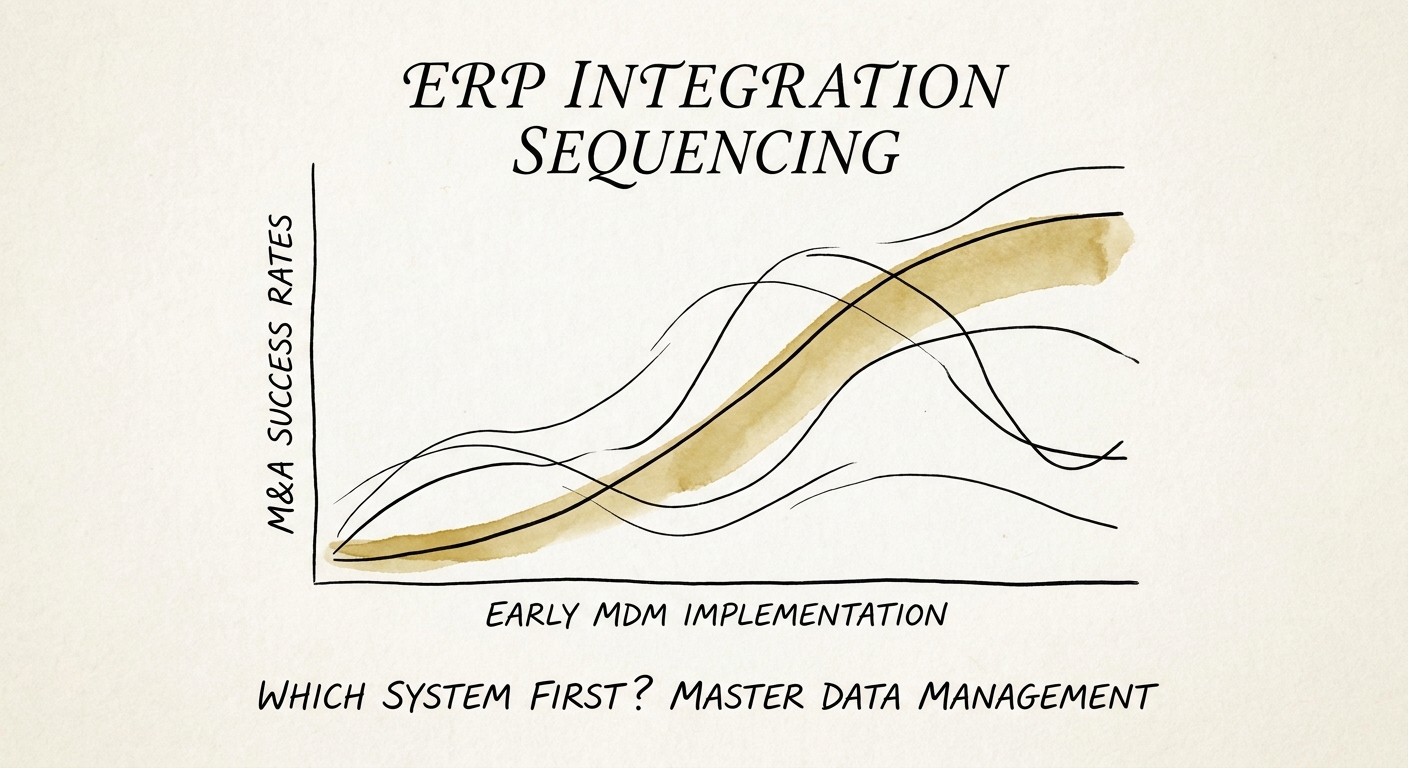
Sequence from the perimeter in, and let the GL go last
Once the master-data layer is governed, the system cutovers run from the customer-facing edge inward, not from the financial core out. Four phases, in order: CRM, then quote-to-cash (CPQ and billing), then supply chain and inventory, and only then the General Ledger.
CRM goes first because a botched sales-team merge is the fastest way to lose the revenue the deal was priced on — align the pipeline and account ownership before anything else moves. Quote-to-cash goes second so that pricing logic and the path from quote to invoice are reconciled before you touch fulfillment; otherwise you ship product the billing system cannot correctly invoice. Supply chain and inventory go third, where the heavy operational lifting lives — and because master data is already governed, a mismatch here surfaces as a caught discrepancy instead of a phantom number that quietly lands in the financials. The GL goes last, by design, so it becomes a clean repository receiving reconciled data from systems that already agree with each other.
The cost of doing this in reverse is documented. PwC's M&A integration survey reports that 78% of dealmakers concede incompatible post-deal systems eroded the value they expected. The way you stay out of that 78% is to refuse the accelerated GL timeline a CFO under board pressure — or a vendor with a quarter to close — will push you toward. Rushing the core does not buy speed; it buys two years of remediation that drags on the valuation and forces awkward EBITDA adjustments for one-time technology spend. Bake the perimeter-in order into the 120-day technology integration roadmap before close. Govern the data, sequence from the edge inward, and the scoreboard takes care of itself.