The practical answer
- Short answer
- Budgeting 3% of deal value for IT integration is how mid-market PE deals stall at day 100. Here's how to build the number bottom-up instead.
- Best fit
- Industry: Private Equity & Technology M&A. Function: Information Technology Integration
- Operating path
- Migration & Integration → Turnaround & Restructuring → Transaction Advisory Services
- Key metric
- 35% of the average first-year IT integration budget consumed by technical debt paydown in mid-market deals
The number that looks responsible and isn't
Here is a scene I have watched play out more times than I can count. A sponsor signs a $150M software platform. The deal model carries a tidy IT integration line: 3% of enterprise value, $4.5M, rounded for comfort. Everyone in the room nods. It feels disciplined. Then day 100 arrives and the operating partner is staring at a $1.9M cloud bill nobody modeled, two identity systems that won't talk, and a Salesforce instance that turns out to be three Salesforce instances. The 3% wasn't a budget. It was a guess dressed in the costume of rigor.
The reason the rule fails is almost philosophical: enterprise value measures what the seller convinced you the asset is worth. It says nothing about the condition of what you actually bought. A $400M company with one clean codebase and a single cloud tenant can integrate for less than a $90M company carrying four acquisitions' worth of unreconciled infrastructure underneath it. Pricing IT off the headline number assumes complexity scales with valuation. It doesn't. Complexity scales with how many times the target said "we'll clean that up later" and never did.
The benchmarks have moved out from under the old heuristic, too. McKinsey's work on the tech M&A integration imperative traces how cybersecurity remediation and cloud modernization — line items that barely existed when the 3% folklore was coined — now dominate the first-year spend. And the cost of getting the number wrong shows up exactly where sponsors feel it: Bain's M&A value-creation research ties delayed integrations to roughly 12% of projected synergies evaporating inside year one. Underfund the integration and you are not saving money. You are financing it with deferred EBITDA, at a terrible interest rate.
A percentage of enterprise value tells you what you paid. It tells you nothing about how broken the thing you bought actually is.
Where the money actually hides
If you want to see why the percentage rule collapses, decompose a real mid-market integration into its load-bearing pieces. Two of them eat budget in ways a top-down number never anticipates.
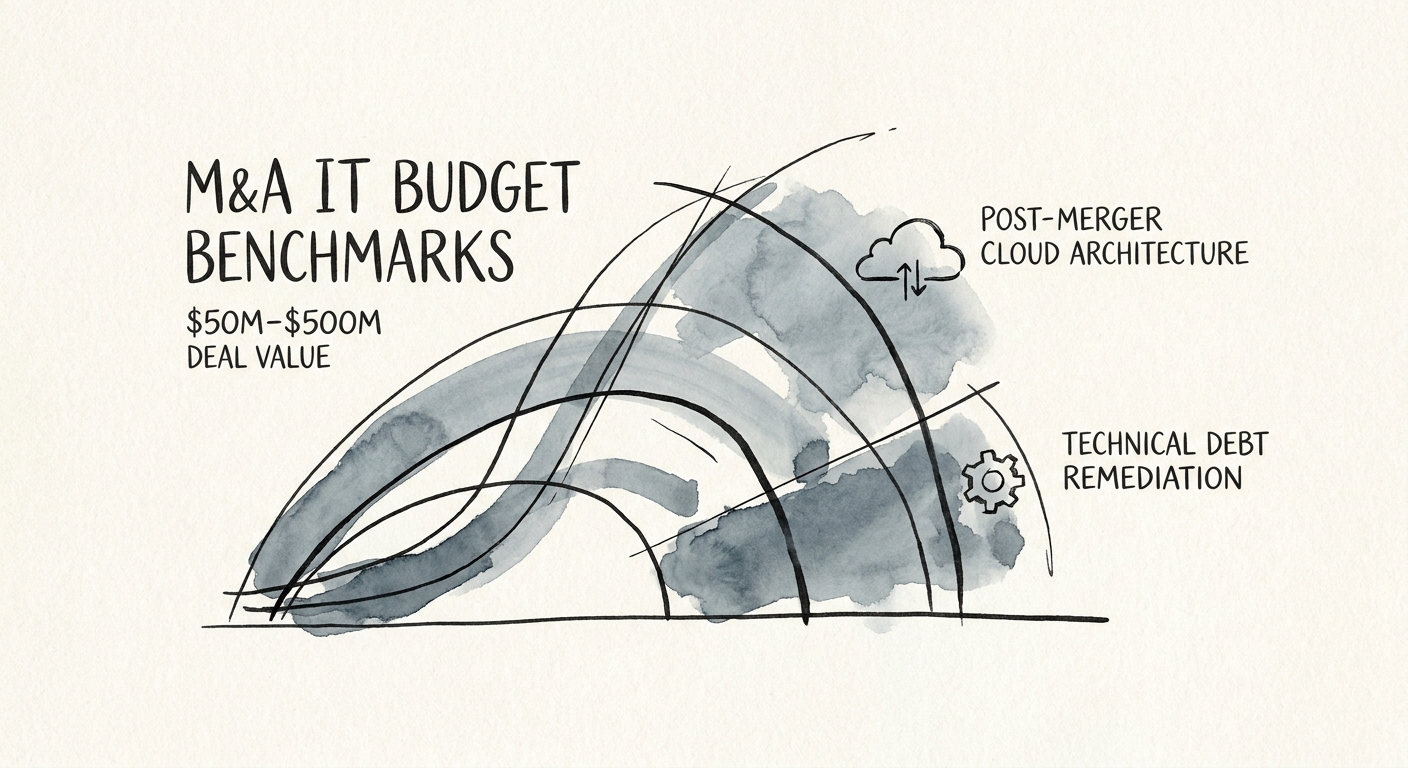
The first is cloud consolidation. When you fold two SaaS platforms together, the brutal cost isn't the new infrastructure — it's the data leaving the old one. Egress fees, cross-tenant database federation, the months you run both environments in parallel because you can't risk a churn event by cutting over fast. PwC's post-merger integration analysis puts cloud federation alone near $1.8M for deals in the $100M-$250M band. That single line can be 40% of a 3% allocation before you've touched anything else. I've sat in post-close budget reviews where the cloud line had to triple, not because anyone planned poorly, but because the diligence team priced the destination and forgot the cost of the move itself.
The second is technical debt, and the timing is what trips sponsors up. The old model treated debt paydown as a year-three problem you'd fund out of cash flow once the platform was humming. That sequencing no longer survives contact with the investment thesis — you cannot 3x ARR on a foundation that buckles at 1.5x load. Gartner's post-acquisition tech spend research finds debt remediation absorbing about 35% of the first-year IT integration budget in middle-market deals. That is not a maintenance footnote; it is a third of your number, and it is due in month one. When an operating partner asks me why infrastructure spend is spiking right after close, the answer is almost always the same: the runtime and egress costs that the CIM never put on the page, plus debt that was always going to come due — just on the buyer's clock now, not the seller's.
Build the number from the bottom up
The fix isn't a smarter percentage. It's refusing to start from a percentage at all. Build the IT integration budget zero-based, before the LOI hardens, by pricing the actual path to the target-state architecture: identity and access consolidation, ERP migration, data-warehouse federation, security baselining. Each workstream gets a name, an owner, and a validated dollar figure — not a slice of a number you backed into from the deal price.
Cybersecurity is the line most often shortchanged, and it's the one that detonates on a schedule. Deloitte's M&A diligence research finds a majority of mid-market integrations underfund day-one security and compliance alignment — which is why the "surprise" remediation project always seems to land in month three, right when cash flow has no slack for it. Make those costs explicit during diligence, or you'll fund them at emergency prices after.
Make it concrete. Say you acquire a 90-person platform running three separate CRMs from its own acquisition history. The budget can't say "CRM integration: 0.5% of EV." It has to say: extract and dedupe roughly 40,000 records, retire two instances, stand up one governed Salesforce deployment — a scope that realistically runs $400K to $850K in this deal tier. Stack the workstreams that way and you'll often land at 6-8% of deal value, not 3%. That delta isn't a budget overrun. It's the real cost of the asset, and it belongs in the purchase-price allocation, not in a year-two surprise. The discipline I push every portfolio company toward is a workstream-by-workstream 120-day IT integration roadmap with a dollar value attached to every line — the same logic we lay out in our M&A integration budget benchmarks. Do that, and your operators spend the hold period executing the thesis instead of fighting fires they paid full price to inherit.