The practical answer
- Short answer
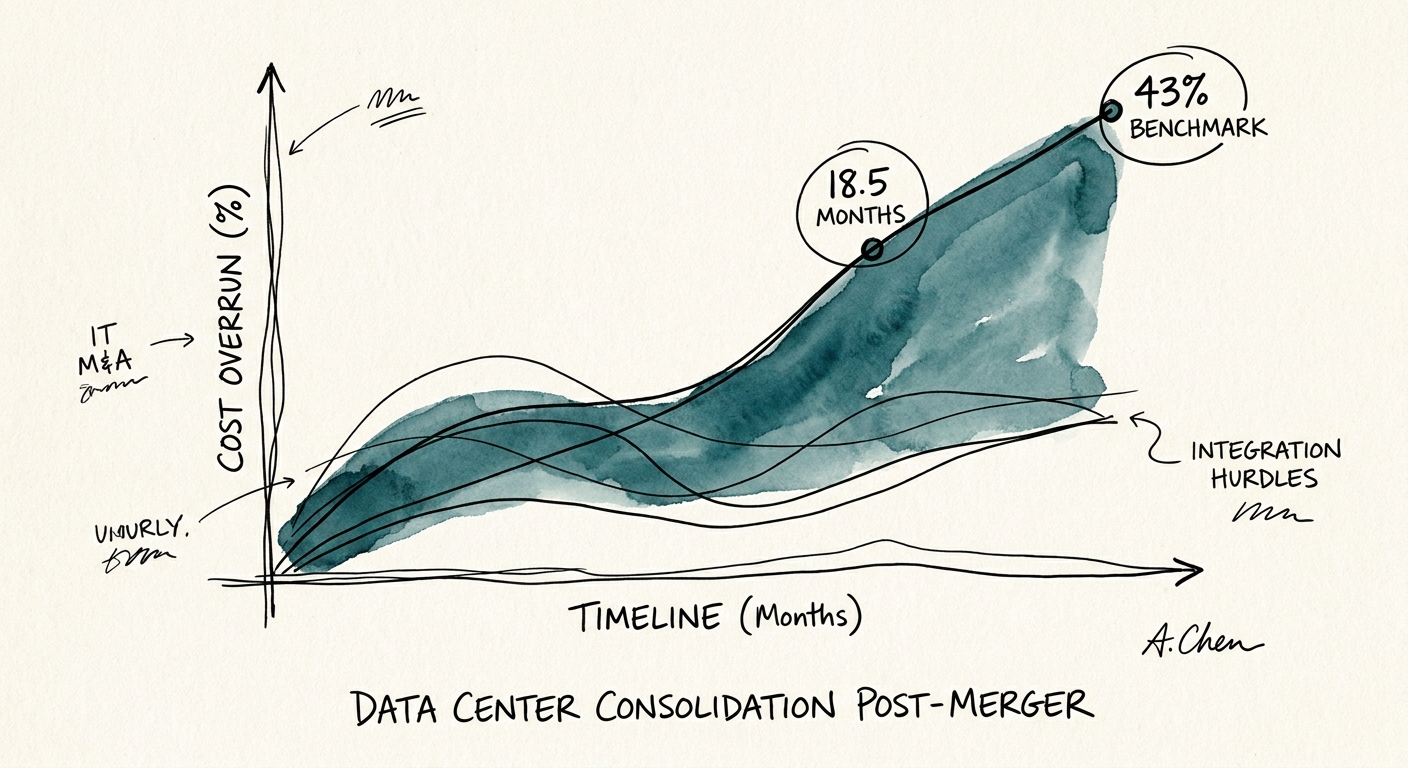
- The deal model says collapse three data centers in 9 months. The average is 18.5, with 43% overruns. Here is where the time and money actually go.
- Best fit
- Industry: Technology M&A. Function: IT Infrastructure
- Operating path
- Migration & Integration → Turnaround & Restructuring → Transaction Advisory Services
- Key metric
- 18.5 Months required to complete an average enterprise data center consolidation.
The synergy tracker says nine months. The cage says otherwise.
Somewhere in the deal model for the managed services provider you just bought, there is a line that reads "data center rationalization complete: Day 270." It was typed by someone who has never stood inside a colocation cage at 2 a.m. trying to figure out why a "decommissioned" server is still answering production traffic. That nine-month number is not a forecast. It is a wish that got promoted to a budget.
Here is the gap, in plain figures. The average enterprise data center consolidation runs 18.5 months from close, per Gartner's 2025 IT Infrastructure and Cloud Strategies — roughly double the window most integration plans assume. And the projects don't just run long, they run over: PwC's 2025 M&A Integration Report puts the average cost overrun at 43%, driven by discovery gaps and undocumented legacy dependencies. Two years of synergy, gone before the first server is unracked.
The reason isn't incompetence. It's that a data center migration is the one integration workstream where the map is wrong before you start. When you acquire a 15-year-old software business, you don't inherit a tidy rack diagram. You inherit a decade and a half of "temporary" cross-connects, a firewall rule nobody will touch because the last person who understood it left in 2019, and an application that fails silently if its NTP server moves more than two hops away. None of that shows up in a virtual data room. All of it shows up in week six, when you try to move the first workload and three unrelated things break.
A data center consolidation never dies on the network. It dies on the loading dock, in the egress bill, and in the resignation letter from the one engineer who remembered why that VLAN existed.
Where the 43% actually hides
Operating partners model the destination — the target-state cloud footprint, the consolidated tenancy, the per-unit compute savings. The overrun lives in the three line items they don't model, and they're specific to physical infrastructure consolidation in a way a software integration never is.
Dual-running is not a phase, it's a tax with no end date you control. The moment you announce a migration, you are paying for everything at once: the acquired company's legacy colocation contracts (often locked into 24- to 36-month terms with brutal early-termination clauses), the new destination environment, and the migration vendors moving data between them. You cannot turn off the old cage until the last application is verified in the new one — and "verified" is decided by the business, not the migration team. Picture a 200-rack legacy footprint where a single batch-processing job, run once a quarter for a regulator, keeps an entire row alive for an extra five months. That's not a hypothetical edge case; it's the median.
Egress turns your own data into a meter that runs against you. Pulling workloads out of the target's environment and into the platform infrastructure means moving petabytes, and the transfer fees compound fast. McKinsey's Cloud Value Report 2025 attributes up to 34% of unplanned migration cost to egress and dual-running environments combined. The leverage point is the diligence window, not the migration window: egress waivers and contract-break terms are negotiable before you sign and nearly impossible to claw back after. If your CFO is asking in Q3 why the acquired entity's gross margin fell off a cliff, the answer is usually a transfer-cost invoice that nobody put in the model.
Hardware recovery is mostly a fiction on the loading dock. Deal models love to book capital recovery from selling off the acquired hardware. Bain & Company's Tech M&A Insights 2026 finds 28% of legacy hardware value is lost to premature deprecation rather than realized in any secondary market. The servers don't get sold; they sit on a dock depreciating to zero because nobody budgeted the certified data wiping, the chain-of-custody documentation a compliance audit demands, or the freight. You wrote down an asset to fund the deal, then paid to make it disappear.
The constraint is the three people who never wrote anything down
Bandwidth is buyable. Migration vendors are buyable. The thing you cannot purchase on demand is the institutional memory of the handful of engineers who built and maintained the legacy environment. They are the only people alive who know that the storage array can't be moved during the 3 a.m. backup window, or which "unused" subnet is quietly load-bearing. And they are precisely the people who read a consolidation announcement as their own layoff notice and start interviewing the same week.
The data is unforgiving. BCG's Post-Merger Talent Retention Study 2025 reports that 33% of critical infrastructure engineers exit within six months of a consolidation announcement. When that tribal knowledge walks out, an 18.5-month plan drifts toward 24, and every extra month is a full month of dual-running cost stacked on top. I have watched a portfolio company delete an Active Directory forest without mapping the cross-domain trusts, then hire its own former engineers back as contractors at a punishing premium — paying twice for knowledge it had already let walk out the door.
So treat the people problem as the schedule, not a side note. Three moves change the outcome:
- Ring-fence a dedicated migration squad in the first 30 days — separate headcount from the team keeping the legacy product alive. You cannot ask the same engineers to run the old system and architect its destruction at once; one of those jobs always loses, and it's usually yours.
- Tie retention bonuses to decommissioning milestones, not to a calendar date. Pay on "legacy DC-2 powered down and verified," so the incentive survives only as long as the knowledge is still needed.
- Spend the first 30 days on dependency discovery before you touch a single workload — physical cross-connects, undocumented firewall rules, application affinities. Then model dual-running for a minimum of 18 months in the synergy plan, not nine.
Do this and the consolidation becomes a managed, expensive project. Skip it and it becomes the quiet line item that erodes your exit multiple before the symptoms ever reach the investment committee. The number that matters here isn't the cloud bill — it's how long the legacy cage stays lit, and which person can turn it off.