The practical answer
- Short answer
- A monthly close tells you synergies slipped 30 days ago. Here are the 12 weekly leading indicators that let PE operating partners intervene on Monday, not the 15th.
- Best fit
- Industry: B2B SaaS & Tech Services. Function: Post-Merger Integration
- Operating path
- Migration & Integration → Turnaround & Restructuring → Transaction Advisory Services
- Key metric
- 40% More synergy value captured by utilizing weekly operational telemetry.
The deal model said $15 million in EBITDA expansion. The CIM had it laid out cleanly, a tidy stack of cost takeout and cross-sell. Eight months post-close, the integration was tracked in a 40-tab Excel workbook that one analyst updated the night before each monthly steering committee. By the time that committee saw a problem, the problem was five weeks old. We rebuilt the whole thing into a weekly dashboard and, in the first month, found a $2.4 million annualized AWS compute overlap — two teams paying for the same reserved instances — that the monthly close had been quietly absorbing into "cloud costs" since day one.
That is the core defect in how most private equity buyers run an integration: they steer a 100-day plan using a 30-day instrument. McKinsey's post-merger integration research puts 70% of acquisitions short of their projected revenue synergies, and a large share of that gap is not a strategy failure — it is a latency failure. You cannot course-correct a misaligned sales comp plan or a stalling platform migration when the data arrives on the 15th of the following month. Whatever broke, broke weeks ago, and inertia has had time to harden around it.
Why the lag is the whole problem
GAAP financials are a lagging artifact. They confirm what already happened; they do not warn you. For integration, that is exactly backwards — the entire game is intervening before the loss lands in the P&L. A weekly cadence is not about reporting more often for its own sake. It is about catching the leading indicator (logins dropping, commits slowing, a license sitting unmigrated) while you still have time to do something on Monday. Bain & Company's M&A research finds that integration programs running high-frequency operational tracking capture meaningfully more of their targeted value inside the first year than those relying on standard monthly reviews. The mechanism is not magic. It is simply that a problem you see in week 2 costs a fraction of the same problem discovered in month 3. This is the same dynamic that turns a clean thesis into the integration synergy trap — the slippage is invisible until it is structural.
A monthly synergy report is an autopsy. By the time it tells you what died, you've already paid for the funeral in lost enterprise value. The Friday dashboard is the only number that lets you intervene while the patient is still breathing.
A weekly dashboard fails the moment it fills up with milestone-completion checkboxes. "IT integration: 60% complete" tells you nothing — 60% of what, and is the remaining 40% the cheap part or the part bleeding cash? Activity is not achievement. The template has to track dollars and behavior, not progress bars. For a SaaS carve-out, three pillars carry the whole thing.
Pillar 1 — Revenue protection (the acquired base is a flight risk)
Acquired customers get nervous the instant they hear "acquisition." Harvard Business Review's work on M&A customer churn shows roughly a fifth of acquired revenue can evaporate inside six months when communication and customer success integration are handled badly. So the dashboard tracks behavior, not sentiment: weekly product login frequency for the acquired user base (a quiet account is a churning account before it ever opens a cancellation email), support ticket aging on the acquired book, and cross-sell pipeline actually generated by the combined sales team. Watch the cohort approaching the month-6 cliff like it is a separate company, because for retention purposes it still is.
Pillar 2 — Cost rationalization (measured in sunset systems, not status updates)
"Tracking vendor consolidation" is a qualitative non-metric. The template instead counts: number of legacy applications actually sunset this week, and the weekly burn on overlapping cloud and SaaS infrastructure. Gartner's post-merger IT integration analysis finds a large portion of post-deal IT budgets gets consumed by redundant vendor contracts the buyer simply never terminated inside the transition services window. Two specifics that catch the leaks fast: weekly SaaS seat utilization for acquired teams (inactive licenses you are still paying for are pure margin sitting on the table), and a hard tripwire — if an acquired sales team has not migrated off its old CRM within 45 days, that line goes red and someone owns it by name. Every week a dual stack runs, you are funding EBITDA destruction and calling it transition cost.
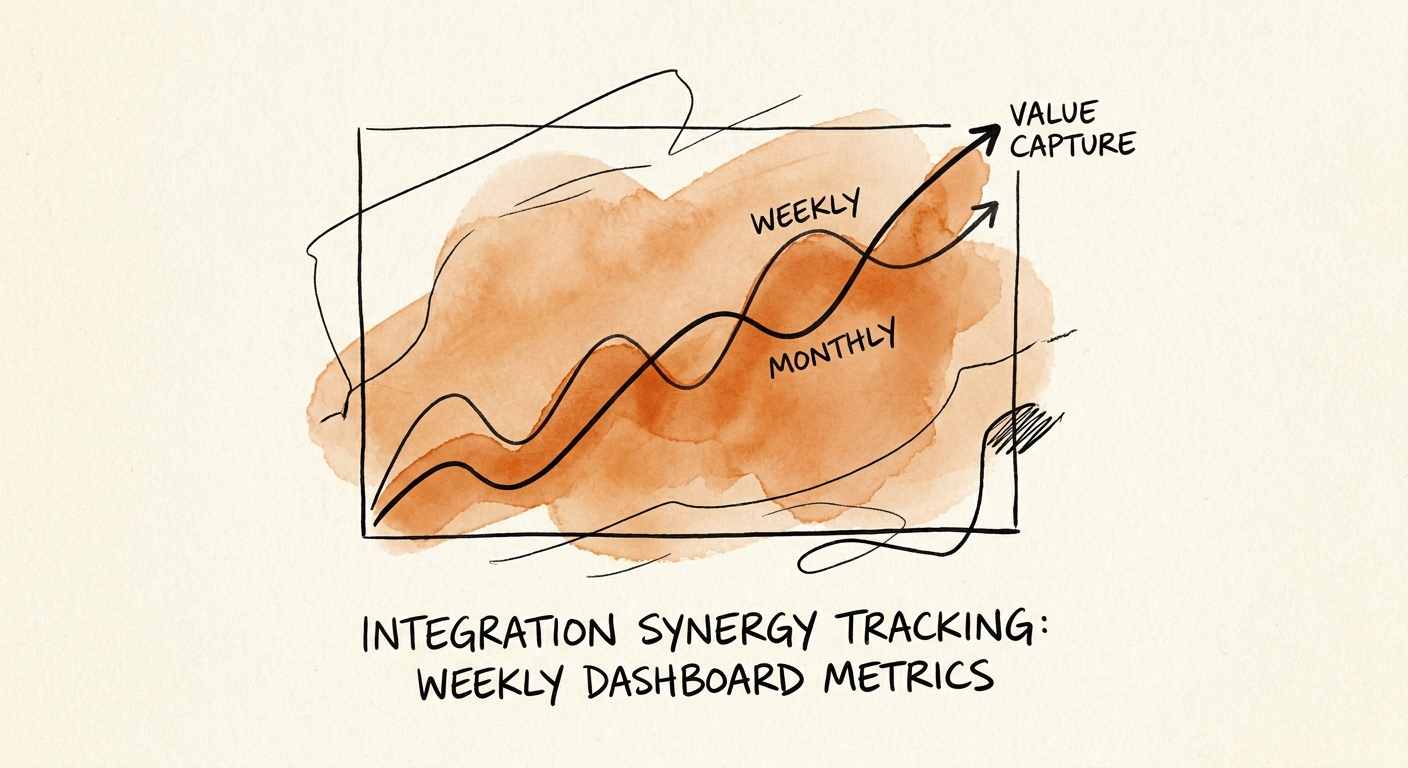
The third pillar is the one operators consistently discover too late: talent flight. By the time you read it in an exit interview, the person is already gone and the knowledge left with them. In a tech-services carve-out, your synergy model is mostly riding on the engineers who know how the acquired platform actually works and the quota-carriers who own the accounts. The dashboard tracks both behaviorally — engineering commit velocity by acquired pod, and weekly sales activity. A 30% drop in commits out of one engineering pod is not a productivity dip; it is people quietly disengaging while they take recruiter calls. PwC's M&A integration survey reports a majority of acquirers lose critical technical talent inside the first 90 days to integration friction. You want to see the velocity drop in week 5, not the resignation in week 11.
What to actually do this Monday
Build the template around 12 metrics, four per pillar, each owned by a named functional lead. The cadence is the product: leads update by Friday noon, you read it over the weekend, anything red gets an intervention scheduled before Monday's standup. That is the entire enforcement mechanism — not a prettier dashboard, but a rhythm short enough that nobody can let a number rot for a month. Building the template is maybe 10% of the work; holding the Friday-noon line is the other 90%, and it is where most operators quietly give up and drift back to the monthly deck. Pair the dashboard with the operational discipline in our integration manager's playbook, and stand it up on day one — every week you wait, organizational inertia is writing facts into the P&L that you will spend three quarters unwinding. Stop accepting "in progress" as a status. Demand the weekly number, and you protect the multiple your model was underwritten on.