
The practical answer
- Short answer
- Post-merger integration playbook for Palo Alto Networks partners. How to consolidate SOC stacks, protect Diamond status, and avoid the 22% EBITDA leak in MSSP roll-ups.
- Best fit
- Industry: Cybersecurity & Managed Services. Function: Post-Merger Integration
- Operating path
- Migration & Integration → Turnaround & Restructuring → Transaction Advisory Services
- Key metric
- 22% EBITDA Margin Leakage caused by running dual SOC stacks (Legacy SIEM + Cortex) post-merger.
The 'Two-SOC' Trap: Why Platform Consolidation Can't Wait
In the high-stakes world of cybersecurity M&A, the most dangerous assumption Private Equity sponsors make is that technical integration can be deferred. For Palo Alto Networks (PANW) partners, specifically those pivoting to Managed Security Services (MSSP) models, this delay is fatal. The industry is undergoing a massive shift toward 'platformization'—a strategy aggressively pushed by PANW leadership to unify network, cloud, and security operations under single tenants like Cortex XSIAM.
The trap emerges when a PE firm acquires a regional MSSP running a legacy SIEM stack (e.g., Splunk, LogRhythm, or even legacy QRadar) and attempts to run it alongside the platform’s modern Cortex architecture. Our benchmarks indicate that maintaining these dual stacks post-close results in a 22% leakage in EBITDA margins due to duplicate licensing costs, split analyst attention, and fragmented threat intelligence.
The Integration Mandate
Successful integrators don't just 'bolt on' the new asset; they aggressively migrate the acquired customer base to the unified platform. With Palo Alto Networks' recent acquisition of IBM's QRadar SaaS assets, the market signal is clear: migrate to Cortex XSIAM or face obsolescence. Sponsors must budget for a 6-month 'migration sprint' immediately post-close, rather than the traditional 12-18 month integration timeline. Failure to do so doesn't just hurt margins; it creates a 'swivel-chair' SOC environment that increases Mean Time to Response (MTTR) and drives analyst burnout.
The partner ecosystem is bifurcating into product resellers and platform partners. In M&A, buying the former to build the latter is a valid strategy, but only if you have the stomach for a six-month technical gut-renovation.
Protecting the 'Diamond' Asset: The Certification Cliff
Unlike generalist IT services where revenue is the primary tier driver, the Palo Alto Networks NextWave Partner Program is heavily weighted toward technical specialization. The 'Diamond Innovator' status—which unlocks backend rebates often equivalent to 5-8% of gross revenue—is effectively a 'talent asset' tied to specific individuals holding PCNSE (Network Security Engineer) and PCCSE (Cloud Security Engineer) certifications. In due diligence, we often see these credentials treated as corporate assets. They are not.
We define this risk as the 'Certification Cliff.' If an acquisition triggers the departure of just three key architects, a partner can drop from Diamond to Platinum or Innovator status overnight. This downgrade immediately impacts rebate eligibility, effectively erasing the synergy capture modeled in the deal thesis. For a $50M revenue partner, a drop in tier can represent a $1.5M annual hit to the bottom line—often the difference between a successful rollup and a distressed asset.
The Retention Earnout
Smart acquirers structure retention packages specifically for these technical linchpins, distinct from the founder's earnout. The goal is to bridge the gap between signing and the next audit cycle. Furthermore, the integration plan must include an immediate 'certification redundancy' program, cross-training the acquiring team to ensure that the combined entity maintains a buffer of certified professionals well above the NextWave minimums.
The 100-Day Cortex Migration Roadmap
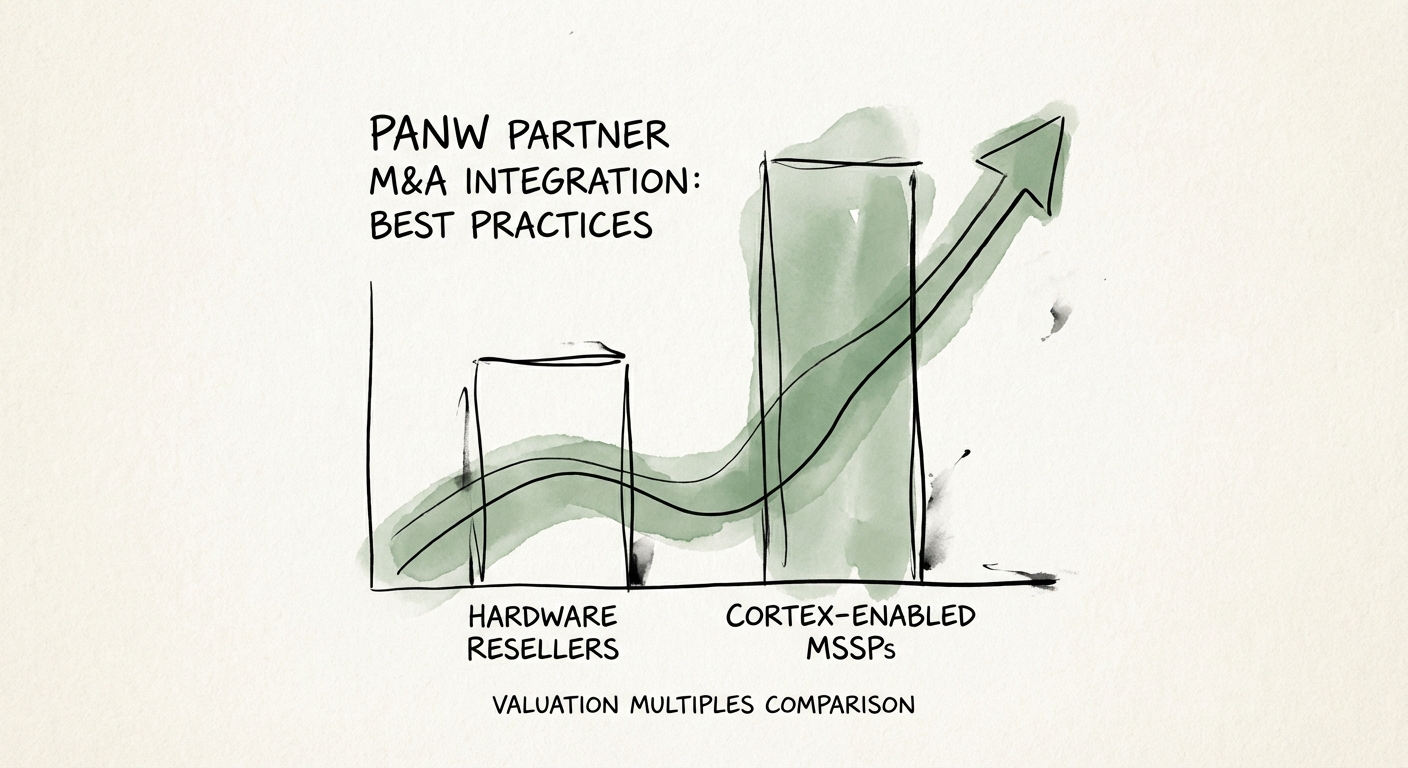
To secure the valuation multiple—typically 10x-12x for pure-play MSSPs with high recurring revenue, compared to 4x-6x for hardware resellers—the post-merger integration must demonstrate a shift from 'resale' to 'managed outcome.' The 100-day plan for a PANW partner acquisition should focus on three critical workstreams:
- Week 1-4: The 'Single Pane' Assessment. Audit the acquired customer base for 'orphan' firewalls that are not connected to the central management plane (Panorama) or are lacking Cortex Data Lake integration. Identify the 'low hanging fruit' for XSIAM migration.
- Week 5-8: The QRadar-to-XSIAM Pivot. If the acquired asset has a QRadar install base (on-prem or SaaS), leverage the PANW migration incentives to move these customers to Cortex. This is not just a technical migration; it is a commercial renegotiation that locks in 3-year recurring revenue streams.
- Week 9-12: The SOC Unification. Decommission the legacy Tier 1 SOC tooling of the acquired entity. Route all telemetry to the master Cortex instance. This is where the 22% EBITDA recovery is realized.
By executing this roadmap, PE sponsors convert a traditional Value-Added Reseller (VAR) into a high-margin Platform Player, aligning perfectly with the 'Platformization' thesis that drives premium exits in the current market.