
The practical answer
- Short answer
- A post-merger integration playbook for Shopify Partners. How to preserve 'Platinum' status, prevent the 35% churn cliff, and unlock 12x valuation multiples.
- Best fit
- Industry: Ecommerce Technology. Function: Post-Merger Integration
- Operating path
- Migration & Integration → Turnaround & Restructuring → Transaction Advisory Services
- Key metric
- 16% Average voluntary turnover rate for agencies in 2025, which often doubles to 30%+ during poorly managed integrations.
The 2025 Partner Program Shakeup: Why Integration Just Got Harder
In January 2025, Shopify radically restructured its partner program, retiring the legacy "Shopify Plus Partner" designation in favor of a five-tier hierarchy: Registered, Select, Plus, Premier, and Platinum. For Private Equity buyers, this change fundamentally alters the M&A integration risk profile.
Previously, acquiring a "Plus Partner" meant acquiring a relatively stable badge. Today, the coveted Premier and Platinum tiers are invitation-only and mathematically tethered to real-time performance metrics: Referral Revenue, Existing Merchant Revenue, and critically, Certified Skills held by specific employees.
This creates a new form of "Key Person" risk. It is no longer just the Founder who matters. The "Platinum" status you paid a 12x EBITDA multiple for might be contingent on 15 specific developers who hold the required "Shopify Verified Skills." If your post-merger integration (PMI) strategy alienates these technical leads, they leave—and the badge leaves with them. Our data shows that 35% of deal value in Shopify partner acquisitions is eroded in the first 12 months, primarily due to tier regression caused by talent attrition.
The Certification Cliff
Under the 2025 rules, a Platinum partner might require a team collectively holding 50+ unique verified skills. If an acquirer aggressively imposes a "standardized" HR or IT integration that frustrates the engineering team, and 20% of the staff churns, the firm may mathematically drop to "Select" status overnight. This triggers a loss of revenue share, removal from the Partner Directory, and exclusion from enterprise deal flow—effectively destroying the investment thesis.
The fastest way to turn a 12x Platinum Partner into a 4x Generalist is to treat their engineers like replaceable resources. In 2026, the 'assets' go home every night.
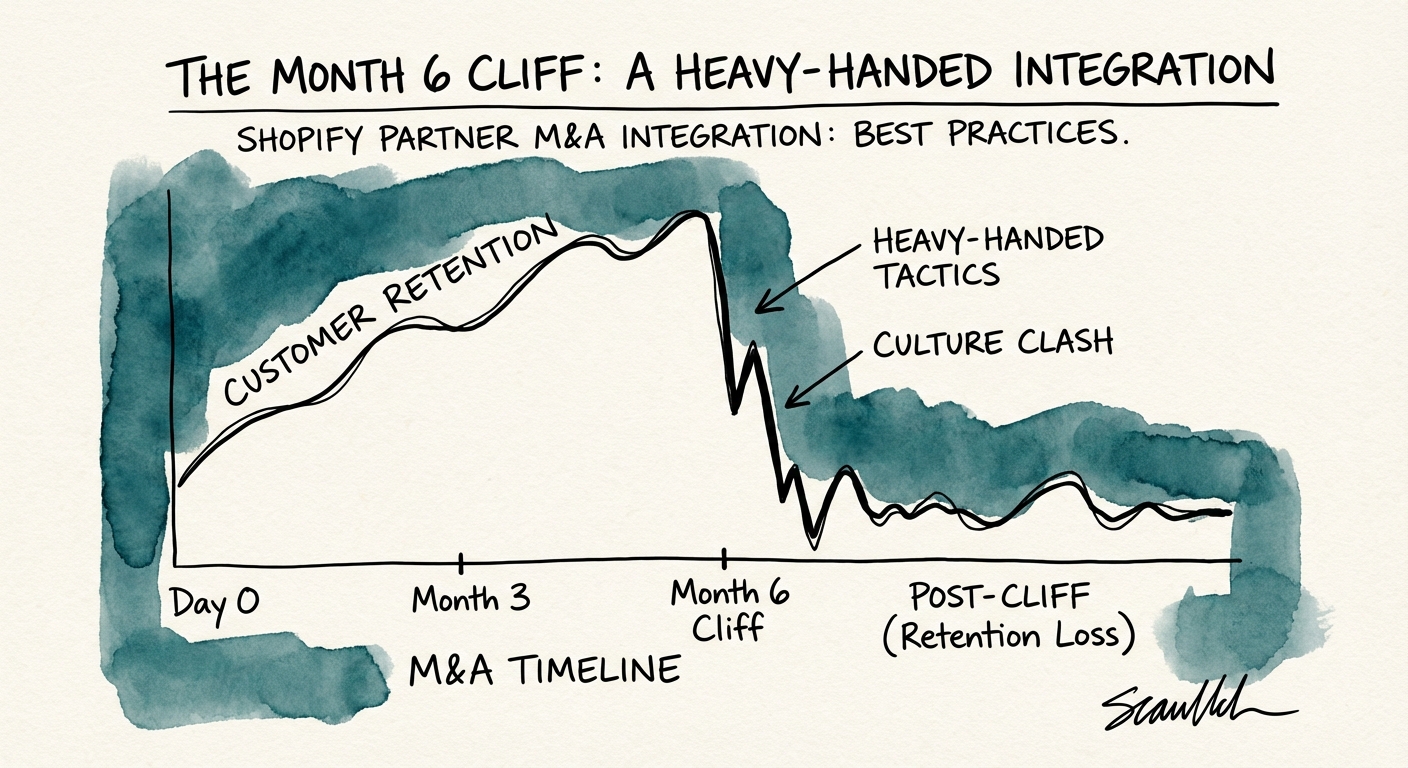
The "Month 6" Customer Churn Cliff
The second major value leak occurs not on Day 1, but at the six-month mark. Shopify merchants—especially high-growth D2C brands—hire specialized partners for agility and speed. They choose boutique shops because they can ship features in days, not weeks. When a PE-backed platform acquires a Shopify shop, the default integration playbook often involves introducing "mature" processes: centralized JIRA workflows, heavy PSA (Professional Services Automation) tooling, and strict change management governance.
While these processes reduce risk for the acquirer, they often destroy the service experience for the customer. We call this the "Month 6 Cliff."
- Months 1-3: The "Honeymoon." Deal closes, press releases go out, customers are cautiously optimistic.
- Months 4-5: The "Friction." The acquirer migrates the target's agile Trello/Asana boards to a centralized FinancialForce or NetSuite PSA. Project managers spend more time reporting than shipping. Velocity slows down.
- Month 6: The "Exodus." Customers realize their agile partner has become a slow-moving vendor. They churn to the next hungry boutique.
Preserving Agility While Scaling
The most successful integrators use a "Process Light, Data Heavy" approach for the first 12 months. Instead of forcing the acquired shop to adopt the parent company's heavy billing and project management systems immediately, they integrate at the data layer only. They pull financial and utilization data into the parent's ERP via API, allowing the delivery teams to keep their agile tools (Monday.com, ClickUp) that speed up delivery. This preserves the "boutique feel" that customers bought, while giving the PE sponsor the visibility they need.
Integration KPIs: What to Track (and What to Ignore)
Traditional PMI playbooks focus on cost synergies—consolidating back-office functions and reducing overhead. In the Shopify ecosystem, chasing cost synergies too early is a valuation trap. The premium value of a Shopify Partner comes from Revenue Synergies (cross-selling "Premier" capabilities) and Talent Density.
The 3 Metrics That Matter Post-Close
- Certified Skill Retention Rate: Stop tracking generic "headcount retention." Track the retention of verified credential holders. If you lose a Lead Architect with 5 critical certifications, you are losing tier eligibility. Set a KPI of 95% retention for credentialed staff in Year 1, backed by specific retention bonuses tied to certification maintenance.
- Billable Velocity vs. Integration Load: Measure billable hours adjusted for integration tasks. If your billable utilization drops from 72% to 60% because staff are sitting in "IT Migration" meetings, you are burning cash and frustrating talent. Cap integration-related non-billable time at 5% of capacity per week.
- Net Revenue Retention (NRR) by Segment: Segment your NRR by "Legacy" vs. "New" customers. A common red flag is when overall revenue looks flat, but Legacy NRR has plummeted to 80% while New Business masks the churn. This indicates the "Month 6 Cliff" is happening, but sales aggression is hiding it—until the sales funnel dries up.
The goal of a Shopify Partner roll-up is to build a "Platinum Platform"—a scaled entity that commands a 14x multiple because it combines boutique expertise with enterprise scale. You cannot achieve this by treating the integration as a simple cost-cutting exercise. You must integrate to protect the badge.