The practical answer
- Short answer
- A post-merger integration playbook for Private Equity firms acquiring Databricks partners. How to preserve 'Brickbuilder' IP, retain data talent, and maintain Elite status.
- Best fit
- Industry: Private Equity. Function: Post-Merger Integration
- Operating path
- Migration & Integration → Turnaround & Restructuring → Transaction Advisory Services
- Key metric
- 12x EBITDA multiple premium for Databricks partners with validated 'Brickbuilder' solutions vs. generalist service firms.
The 'Brickbuilder' Trap: Why Generalist Integration Models Fail
In the generalist IT services roll-up playbook, the integration strategy is usually simple: collapse back-office functions, unify the salesforce, and push for utilization efficiency. When acquiring a Databricks partner, this playbook is a value-destruction engine.
Databricks partners are not typically trading on headcount; they are trading on 'Brickbuilder' Solutions—industry-specific accelerators (like 'Retail Lakehouse' or 'Health Interoperability') that have been validated by Databricks engineering. These assets command valuation multiples of 12x–15x EBITDA because they act as products, shortening time-to-value for enterprise clients.
The integration failure happens when the acquiring platform views these engineers as 'fungible resources.' We see PE-backed platforms acquire a specialized Databricks boutique for its Manufacturing IP, only to reassign those engineers to generic Azure data migrations to hit a quarterly utilization target. The result? The 'Brickbuilder' status lapses because the team isn't updating the IP, and the specialized talent—who joined to build cutting-edge Lakehouse solutions—leaves for a competitor who will let them build.
The Integration Fix: IP Protection Zones
Successful acquirers create 'IP Protection Zones' for the first 18 months. The acquired Brickbuilder teams should maintain a distinct P&L or at least a distinct delivery mandate, protected from the broader bench utilization pressure. Your integration KPI shouldn't be 'staffing synergy'; it should be Brickbuilder attachment rate to the broader platform's customer base.
You don't buy a Databricks partner for their backlog; you buy them for their 'Brickbuilder' IP. If you integrate them into a generalist staffing model, you can damage the asset within 90 days.
The Technical Culture War: Unity Catalog vs. Corporate IT
The fastest way to lose a $200k/year Data Engineer is to force them to work in a restricted, legacy IT environment. Databricks talent is accustomed to the agility of the Unity Catalog governance model and the open flexibility of Delta Lake (and now Iceberg, following Databricks' acquisition of Tabular). They live in a world of serverless compute and automated CI/CD pipelines.
When a large PE-backed platform acquires these firms, the 'Corporate IT' integration stream often forces the new subsidiary into a restrictive security posture—blocking access to the latest Databricks runtimes, enforcing draconian laptop policies that break local development environments, or mandating legacy VPNs that choke data transfer speeds.
This isn't just an annoyance; it's an existential threat to the 'Elite' status you just bought. Databricks partner tiers are heavily dependent on technical certifications and the ability to execute on the latest features (e.g., Mosaic AI, Serverless). If your corporate integration creates a 'technical debt' environment where engineers can't use the tools they are certified in, two things happen:
- Certification Drift: Engineers stop renewing certifications because they aren't using the new features in production.
- Silent Resignation: Top architects quietly interview with born-in-the-cloud boutiques.
The Playbook Move: Treat the Databricks practice as a 'Green Zone' for IT policy. Adhere to security standards, yes, but do not force-fit them into a legacy endpoint management strategy designed for generalist helpdesk support.
The 'Portal Hygiene' Cliff: Losing Elite Status in Month 6
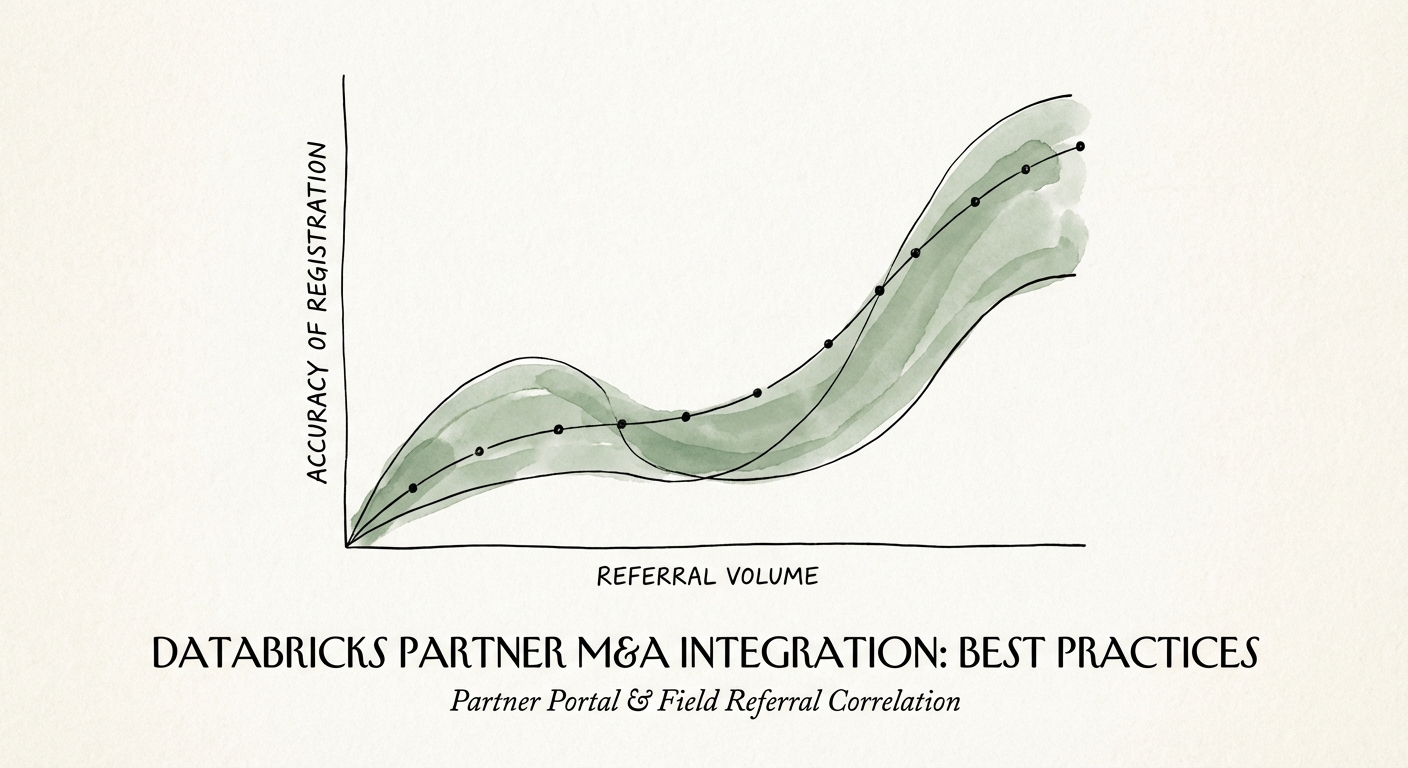
Valuation in the Databricks ecosystem is binary: you are either an 'Elite' partner with strategic relevance, or you are a 'Select' partner with limited leverage. The difference isn't just revenue; it's Portal Hygiene. Databricks measures partner impact through registered projects and consumption influence recorded in the Partner Portal.
During post-merger integration, sales operations often get chaotic. The acquired firm's CRM is migrated to the parent company's Salesforce instance, and the 'connective tissue'—the API or manual process that pushes deal registrations to the Databricks portal—breaks.
We consistently see a 'Month 6 Drop' where the acquired entity's influence score plummets to zero, not because they stopped selling, but because the new RevOps team didn't prioritize the partner portal integration. The consequences are severe:
- Loss of Rebates: Databricks partner incentives are tied to accurate consumption reporting.
- Lead Dry-Up: The Databricks field sales team stops referring deals because they don't see the partner 'registering' activity.
- Tier Downgrade Risk: Falling out of Elite status can trigger valuation adjustment clauses in earnouts.
The fix: Day 1 integration must include a 'Portal Continuity' audit. Ensure that every closed-won opportunity in the parent company's CRM that involves Databricks is automatically flagged and registered. Do not leave this to the individual sales reps.