
The practical answer
- Short answer
- Why 70% of Salesforce partner acquisitions miss EBITDA targets. A diagnostic guide for PE Operating Partners on merging utilization, instances, and talent.
- Best fit
- Industry: Private Equity. Function: Post-Merger Integration
- Operating path
- Migration & Integration → Turnaround & Restructuring → Transaction Advisory Services
- Key metric
- 47% Average employee turnover within Year 1 of a professional services merger.
The Utilization Trap: Why Billable Hours Die in Due Diligence
The math on your spreadsheet is seductive. You combine Firm A ($20M revenue, 15% EBITDA) with Firm B ($10M revenue, 10% EBITDA), cut some back-office redundancy, and voila—you’ve created a platform asset with multiple expansion potential. But in the Salesforce partner ecosystem, 1 + 1 rarely equals 2 immediately. It usually equals 1.5 for the first three quarters.
The culprit is the "Utilization Trap." In the weeks following an acquisition, billable utilization—the heartbeat of any professional services firm—almost invariably drops. Our data across mid-market consolidations shows an average 8-12% decline in billable utilization during the first 90 days post-close. Why? Because your best billable resources (Solution Architects and Technical Leads) are pulled into internal integration meetings, data migration planning, and "culture melds."
Every hour a $250/hour architect spends debating which PSA tool to use (Certinia vs. Kimble) is an hour of vanished revenue that flows straight to the bottom line. This isn't just an operational annoyance; it’s an EBITDA killer that triggers covenant breaches before you’ve even printed new business cards. For a deeper dive on valuation impacts, see our analysis on Salesforce Implementation Partner Valuations.
The "Bench Freeze" Phenomenon
Simultaneously, a "Bench Freeze" occurs. Delivery leads, unsure of the new org structure, hesitate to assign resources to long-term projects. Sales teams, unsure of the new "combined capabilities" narrative, pause on aggressive pursuits. The result is a revenue air pocket that financial engineering cannot fix. You must fence off your delivery teams from integration chaos. Designate a specific Integration Management Office (IMO) whose only job is integration, allowing your fee-earners to keep earning fees.
In a manufacturing rollup, the assets are bolted to the floor. In a Salesforce consultancy, the assets take the elevator down at 5 PM and check LinkedIn.
The "Single Source of Truth" Fallacy
It is the ultimate irony: Companies that sell digital transformation and "Customer 360" often have the messiest internal Salesforce instances on the planet. When you acquire two Salesforce consultancies, you are almost guaranteed to inherit two highly customized, technically indebted orgs that refuse to talk to each other.
The standard PE playbook is to force a migration to a single instance immediately to achieve "data visibility." This is a mistake. Merging Salesforce orgs is not a drag-and-drop exercise; it is a forensic data project. One firm uses Products object for billing; the other uses a custom object. One tracks utilization in hours; the other in days. One relies on CPQ; the other uses spreadsheets and determination.
Our diagnostic data suggests that 70% of immediate org merges fail to deliver the promised "single pane of glass" within 6 months. Instead, they create a Frankenstein environment where reporting is broken for everyone. We explore this technical debt extensively in The Single Source of Truth Lie.
The "Two-Tier" Integration Strategy
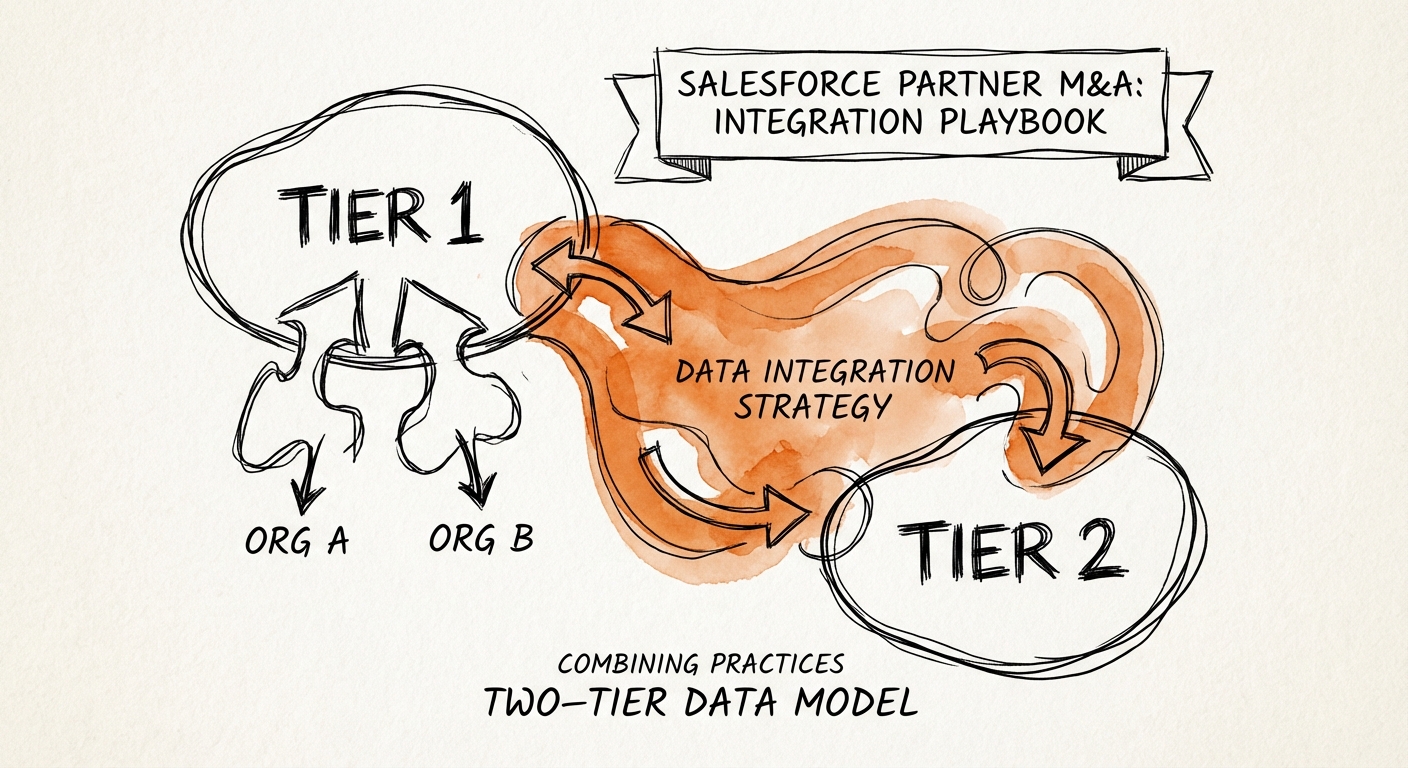
Instead of a shotgun marriage of metadata, adopt a "Two-Tier" strategy. Keep the operating instances separate for the first 6-9 months (Tier 2). Build a lightweight data warehouse layer (Tier 1) using a tool like Tableau or CRM Analytics to pull key financial signals (Bookings, Billings, Utilization, Pipeline) into a unified board report. This gives you the visibility you need without paralyzing the field operations with a botched migration.
The Talent Exodus: Protecting Your Assets (Who Have Legs)
In a manufacturing rollup, the assets are bolted to the floor. In a Salesforce consultancy, the assets take the elevator down at 5 PM and check LinkedIn. The most chilling statistic for any Operating Partner is this: Average employee turnover hits 47% within the first year of a merger in professional services sectors.
Salesforce architects and developers are in the top 1% of in-demand talent globally. They do not tolerate uncertainty. If they smell "synergy" (read: layoffs) or if their compensation plans are harmonized downward, they will leave. And they will take their clients with them. A departure of a single Principal Architect can jeopardize $2M in annual recurring services revenue.
We detail the financial impact of this attrition in Post-Acquisition Attrition: The 33% Cliff. To prevent this, you must over-communicate on three things immediately post-close:
- Tech Stack: "We are keeping the best tools from both sides."
- Comp Plans: "No sales commissions or utilization bonuses change for 12 months."
- Career Path: "The combined firm offers more tracks for promotion, not fewer."
Integration is not a spreadsheet exercise; it is a retention campaign. If you lose the people, you have bought an empty shell.