
The practical answer
- Short answer
- Why customer churn risk can rise after a SaaS acquisition, and how to spot the 'Retention Cliff' before it destroys your exit multiple.
- Best fit
- Industry: Private Equity. Function: Post-Merger Integration
- Operating path
- Migration & Integration → Turnaround & Restructuring → Transaction Advisory Services
- Key metric
- 3x Increase in customer churn risk following an M&A announcement.
The 'Month 6' Retention Cliff
In the spreadsheets of a private equity deal, "synergies" are calculated in headcount reductions and cross-sell opportunities. But in the reality of B2B SaaS, the most dangerous risk to deal value is the "Retention Cliff"—a spike in customer churn that typically hits between months 6 and 12 post-close.
Research indicates that customers are 3x more likely to switch providers after an M&A announcement in their vendor base. This isn't just about product changes; it is an emotional reaction to uncertainty. When an acquirer merges two Customer Success (CS) teams, the resulting internal distraction often creates a "service vacuum" for the customer.
While the integration team obsesses over merging Salesforce instances or unifying product roadmaps, the CS function—the primary defense against churn—often faces an identity crisis. Are we high-touch or tech-touch? Do we own the renewal or does Sales? When these questions remain unanswered for more than 90 days, the "Green" accounts on your dashboard silently turn red. By the time the NRR (Net Revenue Retention) dip shows up in the board deck, the damage to the exit valuation is already irreversible.
In SaaS M&A, the spreadsheet synergies are often paid for by the customer's patience. When that patience runs out around month six, the 'deal value' evaporates.
The 3-Point Integration Diagnostic
How do you know if your CS integration is heading toward a cliff? Do not wait for the churn report. Run this 3-point diagnostic on your portfolio company today.
1. The 'Green Account' Audit
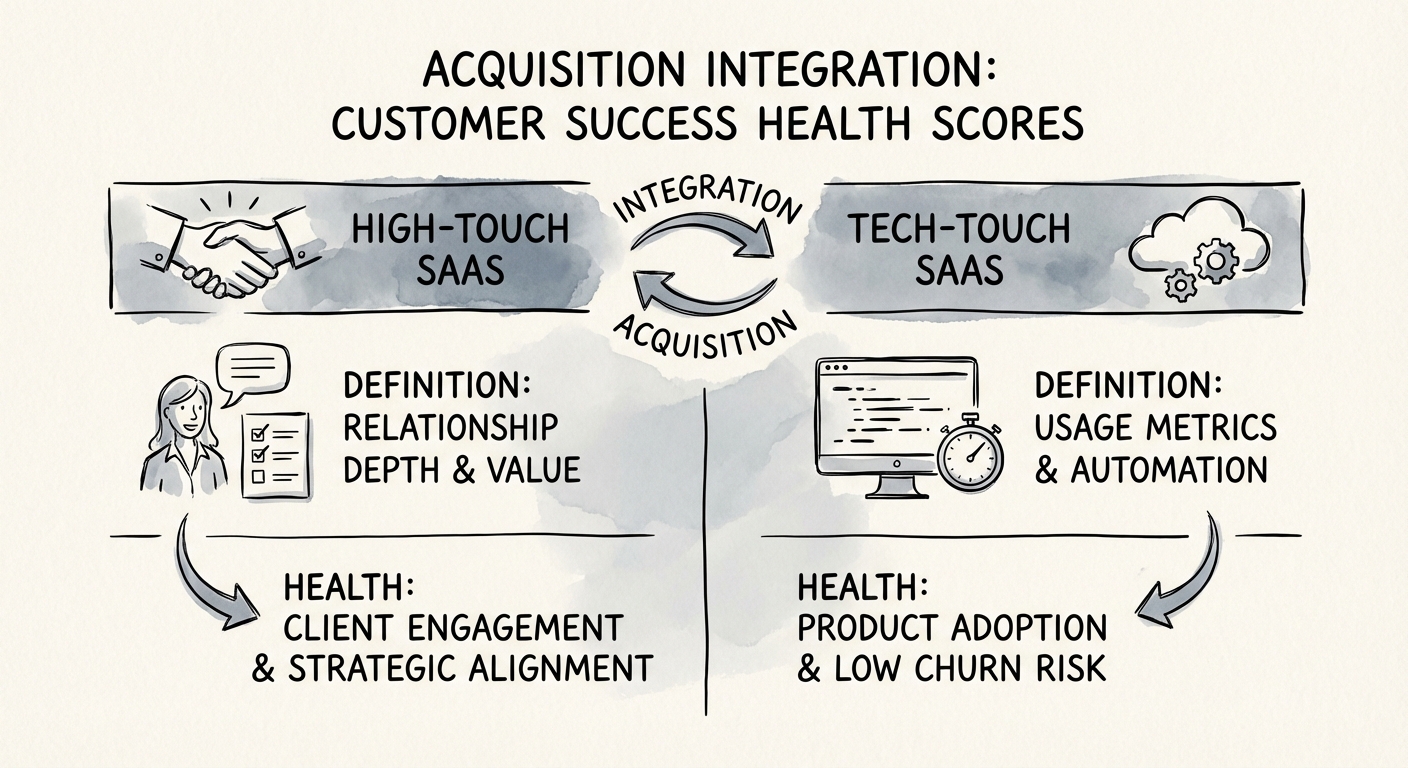
Ask the CS leaders from both the platform and the add-on company to provide a list of their top 20 "healthiest" accounts. Then, ask for the specific criteria that make them healthy. In 90% of integrations, we find a fatal definition gap:
- Company A (High-Touch): Defines "Green" as "we had lunch with the VPs last week."
- Company B (Tech-Touch): Defines "Green" as "login activity is above the 30-day moving average."
If you merge these dashboards without standardizing the definition of "health," you lack the operating visibility to steer. You must normalize the "Health Score" logic within the first 60 days, even if the underlying data sources remain separate.
2. The Compensation Clash
Nothing destroys morale faster than misaligned incentives. Check the comp plans immediately:
- Hunter vs. Farmer: If Company A's CSMs are paid a base salary + bonus on retention, and Company B's CSMs are paid a lower base + commission on expansion, you have created a civil war.
- The "Sales" Conflict: If CSMs are expected to own renewals but the Account Executives (AEs) still hold the quota, you will see immediate friction.
The Fix: Freeze existing comp plans for 6 months (the "Do No Harm" period) while you design a unified revenue architecture.
3. The Methodology Gap
Are you merging a "White Glove" shop with a "Ticket Factory"? If Company A assigns 15 accounts per CSM and Company B assigns 200, simply "averaging" the headcount will kill both models. You cannot scale the high-touch model without destroying margins, and you cannot force the high-volume model onto enterprise clients without spiking churn.
The 100-Day 'Do No Harm' Roadmap
Successful CS integrations follow a "federated to unified" path. Do not attempt to smash the teams together on Day 1.
Days 0-30: The 'Safety Net' Phase
Goal: Zero disruption to the customer.
- Action: Keep CSM account assignments exactly as they are.
- Action: Establish a "SWAT Team" for at-risk accounts that crosses both legacy teams.
- Metric: Daily churn monitor (leading indicators only, like support ticket volume).
Days 31-60: The 'Definition' Phase
Goal: Speak the same language.
- Action: Agree on a unified definition of "Churn," "Expansion," and "Customer Health."
- Action: Map the customer journeys of both companies side-by-side to identify the integration friction points.
Days 61-90: The 'Structure' Phase
Goal: Design the future state.
- Action: Segment the combined customer base by value (ARR) and complexity, not by legacy product lines.
- Action: design a tiered service model (Enterprise, Mid-Market, Tech-Touch) that applies to the entire portfolio.
By prioritizing customer stability over operational efficiency in the first quarter, you protect the asset you just bought. Synergies can wait; retention cannot.