
The practical answer
- Short answer
- Don't let your HubSpot partner roll-up fail in integration. A diagnostic playbook for PE investors on valuing, merging, and scaling Elite HubSpot agencies.
- Best fit
- Industry: Private Equity. Function: Post-Merger Integration
- Operating path
- Migration & Integration → Turnaround & Restructuring → Transaction Advisory Services
- Key metric
- 237x HubSpot's EV/EBITDA trading multiple (2026), creating massive pressure for partners to demonstrate 'tech-like' growth.
The Badge vs. The Business: Why "Elite" is a Vanity Metric
You bought the badge. You saw the "Elite" tier status, the 5,950+ points, and the shiny logo on the HubSpot Solutions Directory. You modeled a 12x exit based on the premise that you were acquiring a high-margin recurring revenue engine. But six months post-close, you're discovering the dirty secret of the ecosystem: Points do not equal profit.
In the 2025/2026 Partner Program, HubSpot shifted the goalposts. The new "Partner Sourced" requirements mean that many agencies are burning 40% of their margin just chasing the license resale metrics to keep their tier. They are acting as unpaid sales reps for HubSpot rather than profitable service providers for you. When you integrate two "Elite" partners, you aren't just merging P&Ls; you are often merging two frantic sales cultures that have neglected their delivery infrastructure.
The Diligence Diagnostic: Look at the Managed Points ratio, not the Sold Points. A healthy, exit-ready practice has a 60/40 split favoring managed services. If your target is 80% "Sold Points," you haven't bought a consultancy; you've bought a commission check that's about to bounce. The real IP isn't in the license resale—it's in the RevOps architecture that keeps clients sticky.
You can't buy 'Elite' status. You can only rent it. If you don't integrate the delivery engines, the badge remains but the margins vanish.
The Portal Paradox: The Technical Integration Killer
The most dangerous sentence in a HubSpot roll-up investment memo is: "We will achieve synergies by consolidating all acquired agencies into a single HubSpot portal." This is the fastest way to destroy value. I have seen firms burn $500k in consulting fees trying to merge three distinct HubSpot instances, only to create a "Franken-portal" that destroys data governance and churns customers.
The Playbook for Portfolio Oversight:
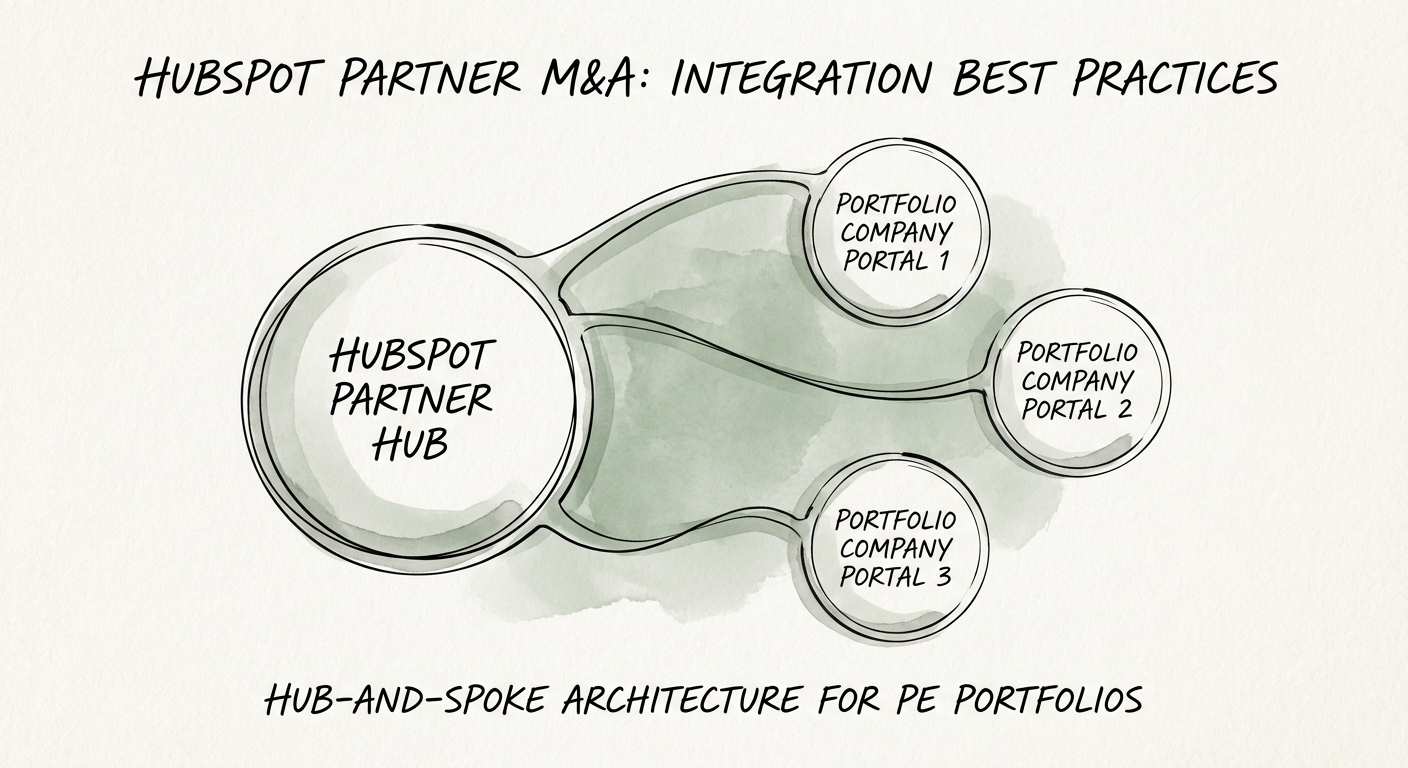
Stop trying to merge instances. Instead, leverage the "Partner Clients" object (released in 2025) to centralize telemetry without breaking the underlying data models. Your integration strategy should follow a "Hub-and-Spoke" architecture:
- Centralized RevOps Center of Excellence (CoE): Shared resources for complex automations and API integrations.
- Decentralized Client Delivery: Keep client portals distinct to maintain data hygiene and security compliance.
- Unified Reporting Layer: Use a data warehouse (Snowflake/BigQuery) to pull from disparate HubSpot instances for board-level reporting.
Attempting a "lift and shift" migration of thousands of workflows during the first 100 days is not integration; it's suicide. Focus on standardizing the data model first, not the database itself.
The Talent Cliff: Protecting the "RevOps Architects"
In the HubSpot ecosystem, the "Senior Consultant" title is meaningless. The individuals who actually drive your valuation are the Accredited RevOps Architects. These are the people who understand how to map a complex manufacturing sales process into a Service Hub pipeline without breaking the ERP integration. They are rare, they are expensive ($180k+), and they hate uncertainty.
When you announce the acquisition, your competitors—other PE-backed roll-ups—will have offers in their inboxes within 48 hours. If you lose the Architects, you lose the ability to deliver on the "Elite" promise. Your process documentation is likely non-existent, living entirely in their heads.
The Retention Framework
Do not rely on standard earnouts for these key employees. They aren't founders; they don't care about the second bite of the apple in 5 years. They care about tooling, autonomy, and not cleaning up someone else's mess.
1. The "Tools Budget" Guarantee: Promise immediate investment in their tech stack (programmable automation, data quality tools).
2. The Accreditation Bonus: Tie retention bonuses to achieving advanced HubSpot Accreditations (not just certifications), which aligns their career growth with your firm's valuation multiple.
3. The "No-Clean-Up" Clause: assure them that a dedicated junior team will handle data cleansing, allowing them to focus on architecture.