The practical answer
- Short answer
- Two definitions of "qualified lead," two forecasts, two data models. Here's the structural fix B2B tech CEOs need crossing $10M ARR, and who it should report to.
- Best fit
- Industry: B2B Tech. Function: Revenue Operations
- Operating path
- GTM Execution → Commercial Performance → Performance Improvement
- Key metric
- 19% Faster Revenue Growth in Aligned Orgs
Three teams, three forecasts, one Tuesday standup
Picture the moment it actually breaks. It's a Tuesday revenue meeting at a B2B software company somewhere north of $10M ARR. The CMO pulls up a slide: 1,400 MQLs last quarter, goal crushed. The VP of Sales has a different slide: of those 1,400, his reps "couldn't work" most of them, and pipeline is light. Customer Success chimes in last, quietly, that two of the deals Sales closed in Q3 churned in Q4 because they were sold a roadmap feature that doesn't exist yet.
Nobody in that room is lying. They're each reading from a different instrument. Marketing's "qualified lead" is a HubSpot score above 40. Sales' "qualified" means a discovery call happened and budget was confirmed in Salesforce. CS's reality lives in a third tool entirely. You don't have a lead-quality argument. You have three systems of record that were never told they describe the same customer.
This is the residue of how almost every tech company staffs up. Early on you hired one person to "own the CRM," usually a sharp Salesforce admin whose job was to build pipeline reports and stop reps from skipping required fields. That's Sales Operations, and it's genuinely valuable: it makes the selling motion more efficient. The question it answers is narrow on purpose: how do we get a rep through the pipeline with fewer clicks and cleaner data? Separately, Marketing hired its own ops person for Marketo or HubSpot, with its own data model and its own definition of a hand-raise.
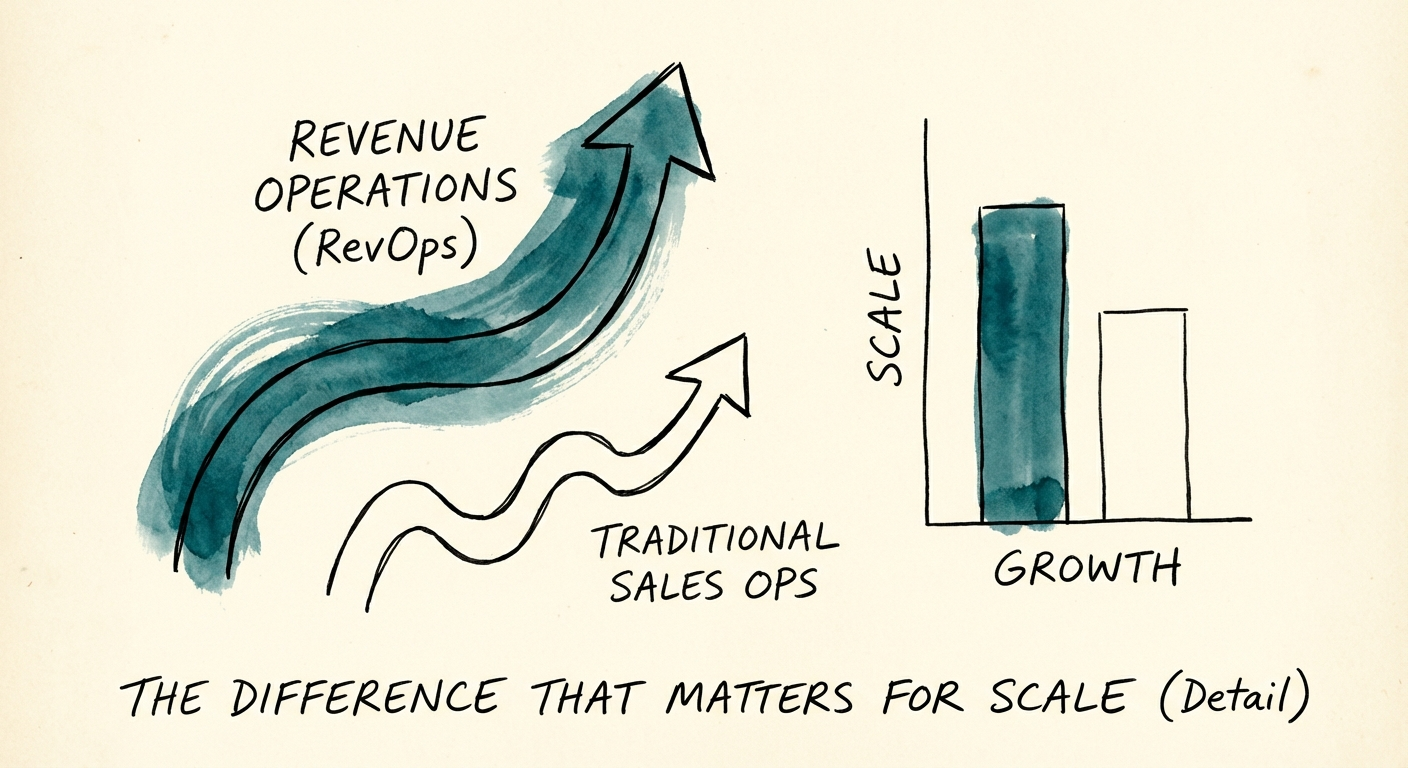
Revenue Operations answers a fundamentally different question: how do we accelerate a dollar from the first marketing touch all the way through the fifth renewal? That's not a bigger version of Sales Ops. It's a different discipline that happens to share some tools. Gartner's read on the function frames it as governing the entire revenue process, not optimizing one slice of it. The gap between those two questions is exactly where your growth is leaking, and at $10M ARR it stops being a nuisance and starts being a ceiling.
Sales Ops makes the rep click fewer buttons. RevOps makes Finance, Sales, and Success agree on what a dollar of ARR even is. If those three numbers don't match in your board deck, you don't have a sales problem, you have a definitions problem.
The three lines where the two functions actually diverge
Forget the title debate. The useful test is whether your current setup can answer three specific questions. If it can't, you've outgrown Sales Ops.
1. Who owns the handoffs, not just the stages? Sales Ops owns the bottom of the funnel: opportunity created to closed-won. That's a clean, defensible scope. But the expensive failures live in the seams between teams: the marketing-to-sales handoff where leads die in a queue, and the sales-to-success handoff where over-promised deals turn into early churn. If your net revenue retention is sitting below 100%, no Sales Ops hire will move it, because the leak isn't in their scope. The job of diagnosing that friction across the full lifecycle is the thing RevOps exists to do.
2. Whose number wins when Finance, Sales, and Success disagree on ARR? In a Sales Ops world, the answer is "the VP of Sales' number, because they built the report." RevOps inverts that: it governs the definitions so "ARR" means the identical thing in the board deck, the Salesforce dashboard, and the CFO's model. This is unglamorous and it is the whole game. It's also the precondition for fixing a forecast you can't trust, because a forecast is only as honest as the shared math underneath it.
3. Is your tech stack a product or a junk drawer? Left to silos, Marketing buys an attribution tool, Sales buys a dialer and a conversation-intelligence platform, CS buys a health-score system, and none of them speak to each other. You end up paying integration engineers to build brittle bridges between tools that should have been bought as one system. RevOps treats the stack as a single product with one data contract from lead capture to revenue recognition. The more workarounds you've built to paper over the gaps, the more "process debt" you're carrying, and like any debt it compounds against your velocity.
The reason to take this seriously now rather than at $40M ARR is that the market already moved. Gartner projects that by 2026 roughly three-quarters of the highest-growth companies will run a RevOps model, up from under a third. And the economics back it: Forrester's analysis of alignment ties tightly-aligned revenue engines to materially faster growth and higher profitability versus siloed peers. BCG's work on operational excellence in revenue teams lands in the same place: the advantage isn't a tool, it's the discipline of running the funnel as one system.
What to do before you post the job req
The instinct at this stage is to hire a VP of RevOps and call it solved. That's backwards. The title can't fix what the org chart and the definitions won't let it. Three moves, in order, before you spend a dollar on a search firm.
Lock the definitions in a room first. Get your CMO, VP of Sales, and head of CS in a room and force agreement on the words. What exactly converts a lead to an SQL? What are the explicit entry and exit criteria for each pipeline stage? What counts in ARR and what doesn't? Until those are written down and signed off, every tool you buy will faithfully amplify the disagreement. This is also the only way to stop pipeline-coverage theater, because "3x coverage" is meaningless if three teams stage opportunities differently.
Decide the reporting line, and don't bury it under Sales. The single most common way founders neuter this function is by having it report to the VP of Sales. That guarantees it stays tactical and politically captured, because it can never tell its own boss the pipeline is inflated. Put it under the COO, the CFO, or a CRO who genuinely owns marketing, sales, and success together. The whole value of the function is its standing to walk into your office and say "the CMO's leads aren't converting" and "the VP of Sales' pipeline is padded" in the same breath. Strip that standing and you've hired an expensive report-builder.
Hire for the P&L, not the platform. Resist promoting your best Salesforce admin into the seat by default. Administering the CRM and engineering revenue are different jobs. The person you want can read unit economics, knows what's eating your CAC payback, and can look at a cohort curve and tell you where retention is bleeding. They're not there to reset passwords. They're there to find the dollar that's leaking and stop it.
Say you're a 60-person SaaS company at $14M ARR with a forecast nobody on the board fully trusts. Don't start with a hire. Start with a half-day where the three GTM leaders agree on the words, then decide who the function answers to. Do those two things and the hire becomes obvious, the candidate pool gets sharper, and you stop running a revenue engine on three incompatible dashboards. Sales Ops keeps the lights on. RevOps builds the grid.