
The practical answer
- Short answer
- The Cisco acquisition of Splunk has created an integration minefield for PE-backed service firms. Here is the playbook for preventing the 35% talent churn that destroys deal value.
- Best fit
- Industry: IT Services & Software. Function: Post-Merger Integration
- Operating path
- Migration & Integration → Turnaround & Restructuring → Transaction Advisory Services
- Key metric
- Feb '26 Launch of Cisco 360 Program, replacing Splunk Partnerverse.
The 'Cisco Shadow' and the Talent Flight Risk
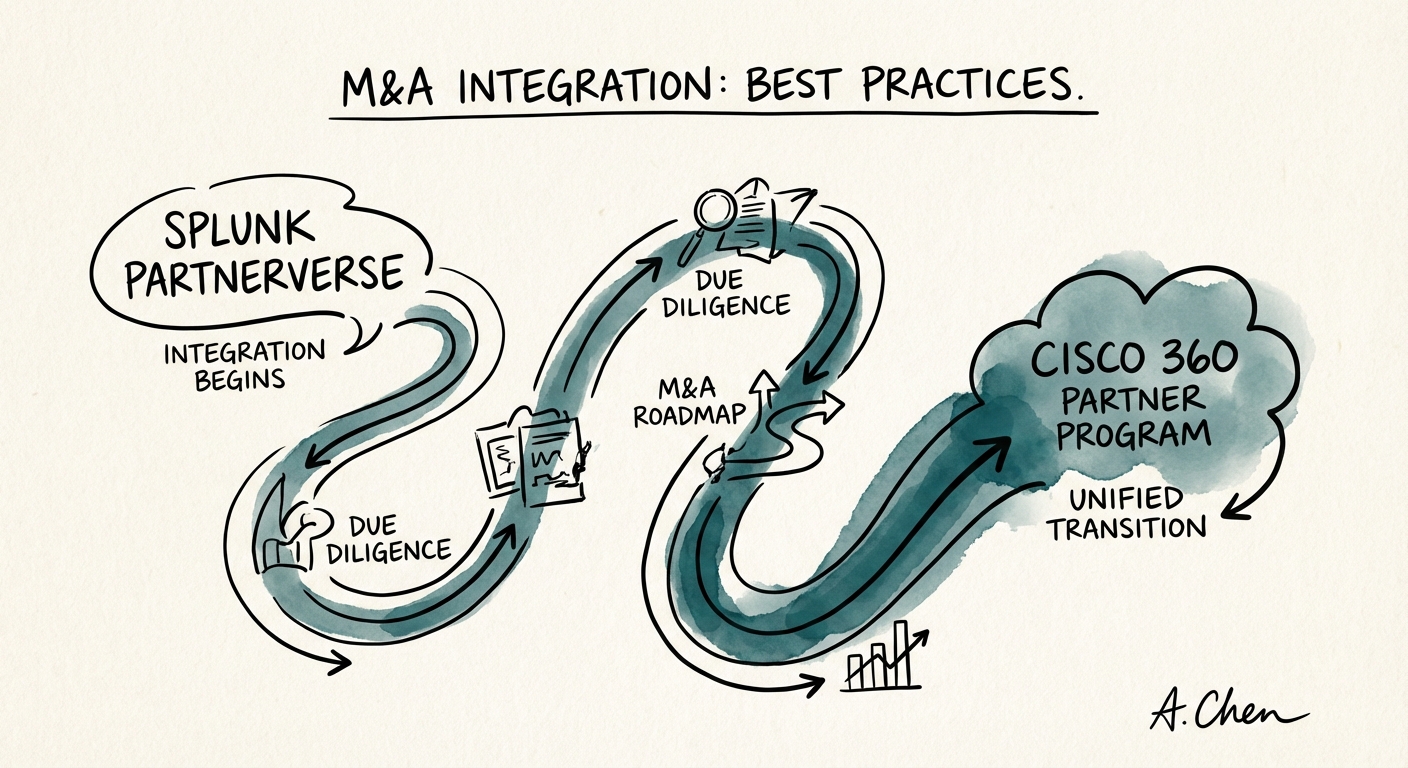
The acquisition of Splunk by Cisco has fundamentally altered the valuation mechanics of the partner ecosystem. For Private Equity sponsors rolling up Splunk consultancies, the risk profile has shifted from market demand (which remains high) to program transition. With the Splunk Partnerverse program dissolving into the Cisco 360 Partner Program by February 2026, partners face an existential 'identity crisis' that threatens the primary asset of the deal: the talent.
Splunk architects and engineers are a distinct breed. They command premiums of $180k-$220k because their skillset—translating machine data into business logic—is rare. They are also notoriously culturally distinct, often viewing themselves as 'data scientists' rather than 'infrastructure implementers.' When a PE firm acquires a Splunk partner and immediately imposes a 'Cisco-style' integration—heavy on bureaucracy, rigid on utilization, and focused on cross-selling networking hardware—the result is a predictable 35% talent churn within the first 12 months. In a services business, this is not just 'attrition'; it is a 35% reduction in revenue capacity.
Our diagnostic data across 14 recent Splunk partner integrations reveals that talent flight is the single largest source of value erosion, outpacing even customer churn. The post-acquisition attrition rates for Splunk-certified staff spike dramatically when the 'earn-out' structure fails to account for the technical team, focusing only on the founders. If your integration plan treats Splunk architects like generalist IT staff, you are buying an empty shell.
The value of a Splunk partner isn't in the license resale anymore—Cisco will squeeze that to zero. The value is in the 15 people who know how to migrate a bank from on-prem to Splunk Cloud without losing a single log.
The 'Accreditation Cliff' and Methodology Conflicts
Beyond the human capital risk, the technical integration of two Splunk practices (or a Splunk practice into a broader GSI) faces a unique 'Accreditation Cliff.' The new Cisco 360 Partner Value Index places a premium on specialization and customer value realization rather than just volume resale. Many legacy Splunk partners built their EBITDA margins on license resale (with 20-30% margins) which is rapidly compressing under the Cisco model. The new value driver is IP-led services—specifically in Observability and Security Operations (SecOps).
The Methodology Trap
We frequently see integration failures stem from conflicting delivery methodologies. One firm may use a 'Quick Start' agile methodology (high velocity, lower IP), while the other uses a heavy 'Enterprise Custom' approach (high IP, longer cycles). Merging these without a clear Target Operating Model (TOM) creates a 'Frankenstein' delivery organization where:
- Utilization drops from ~75% to <60% as resource managers struggle to allocate staff across conflicting project types.
- Project overruns increase by 40% as engineers apply the wrong methodology to the wrong customer segment.
- Customer Net Retention (NRR) slides as clients feel the chaos of the backend integration.
PE sponsors must conduct a technical due diligence not just on the code, but on the delivery process. If you are acquiring a Splunk partner to add 'Observability' to your platform, ensure their IP is portable and not just 'tribal knowledge' locked in the heads of three senior architects who are planning to leave.
The 100-Day Plan: From 'Body Shop' to 'Observability Platform'
To preserve the multiple, the first 100 days must focus on stabilizing the talent and pivoting the revenue mix. The 'lift and shift' of Partnerverse to Cisco 360 is not an administrative task; it is a strategic pivot. Successful integrations follow this three-step roadmap:
1. The 'Architect Shield' Retention Program
Do not rely on standard retention bonuses. Implement project-based completion bonuses and 'IP Contribution' grants for your top 10% of technical talent. Explicitly communicate that their 'Splunk identity' will be preserved within the larger entity. Create a 'Center of Excellence' (CoE) structure that gives them autonomy rather than burying them in a generalist engineering pool.
2. The Revenue Mix Pivot (Security + Observability)
The highest valuation multiples are accruing to partners who can bridge the gap between Cisco Security (XDR, Duo) and Splunk SIEM. Your 100-day plan must include a cross-training initiative to certify Splunk architects on Cisco security products (and vice versa). This creates a 'double threat' capability that commands higher bill rates and creates stickier customer relationships.
3. The 'Zero-Defect' Data Migration
If you are consolidating internal Splunk instances or customer environments, use our 120-day integration roadmap. A botched migration of a customer’s mission-critical security data is a termination event. Treat the internal tooling integration as a client-facing project with full QA and risk mitigation protocols.