
The practical answer
- Short answer
- 70% of M&A synergies fail due to poor integration. Here is the post-merger playbook for PE-backed Zendesk partners to consolidate instances, retain talent, and unlock value.
- Best fit
- Industry: Customer Experience (CX) Technology. Function: Post-Merger Integration (PMI)
- Operating path
- Migration & Integration → Turnaround & Restructuring → Transaction Advisory Services
- Key metric
- 47% Attrition rate of key employees within 12 months of acquisition in the technology services sector.
The 'Instance Sprawl' Trap: Why 1 + 1 = 1.5
In the rush to consolidate the fragmented Zendesk partner ecosystem, Private Equity sponsors often overlook the most obvious technical debt: the partners' own internal operating systems. Unlike generalist IT shops that run on a mix of Jira and Excel, Zendesk partners invariably run their businesses on Zendesk. When you acquire a target, you aren't just acquiring a customer list; you are acquiring a distinct, often heavily customized instance of Zendesk Support, Sell, and Sunshine.
The default integration strategy is usually "leave them alone for 12 months." This is a mistake. Our data shows that maintaining separate instances post-close creates a "Shadow Cost" of 15-20% of EBITDA due to duplicated licensing, fragmented resource scheduling, and the inability to cross-sell. You cannot have a "unified bench" if your engineers are logging time in two different systems.
The 100-Day 'Single Pane' Mandate
Do not attempt a full data migration in the first 90 days—that is a recipe for operational paralysis. Instead, implement a "federated" model using API connectors (often built on Zendesk Sunshine) to push financial and utilization data into a central data warehouse. This gives you immediate visibility into the 68.9% utilization danger zone without breaking the target's day-to-day operations. The goal is financial integration by Day 30, operational integration by Day 90, and platform consolidation by Month 9.
The 47% attrition rate of key employees post-acquisition isn't a hiring problem; it's an integration problem. In the Zendesk ecosystem, your architects are your IP. If they leave, your multiple leaves with them.
The Talent Cliff: Retaining the 'Zendesk Architect'
The most dangerous metric in a professional services acquisition is not churn; it is Time-to-Replacement for a Senior Solution Architect. In the Zendesk ecosystem, these individuals are not just "certified"; they hold the tribal knowledge of how custom apps and integrations function for your largest enterprise clients. Benchmarks indicate that 47% of key employees leave within 12 months of a transaction if the integration is mishandled.
Why do they leave? Usually, it is because the acquirer imposes a "utilization-first" culture that strips away the R&D freedom they had in the smaller shop. They fear becoming "ticket closers" rather than "CX Strategists."
The 'Golden Key' vs. retention packages
Retention bonuses (retention packages) are necessary but insufficient. You need a "Golden Key" strategy: explicit career pathing into the new high-growth areas of the Zendesk ecosystem, specifically AI Agents and Workforce Management (WFM). If you cannot show your acquired architects how the merger unlocks access to larger, more complex AI projects (the kind that drive 14x valuations), they will leave for a competitor who can.
The Portfolio Pivot: From 'Implementation' to 'CX Transformation'
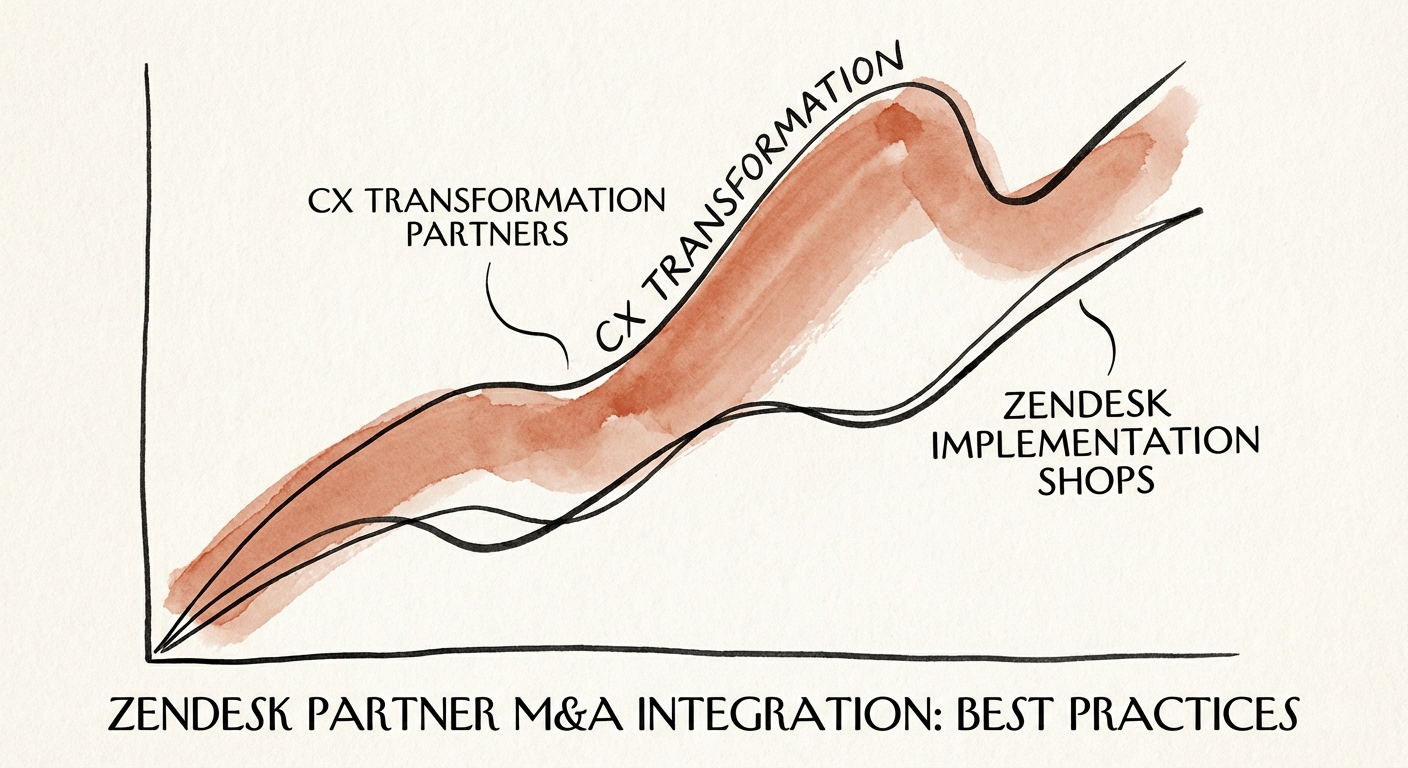
The Zendesk market is bifurcating. On one side are the "Implementation Shops" that trade at 5-7x EBITDA; these firms install the software and walk away. On the other side are "CX Transformation" partners that trade at 10-12x EBITDA; these firms own the customer's entire support logic, data layer, and AI strategy.
Successful M&A integration is the only way to bridge this gap. You must rigorously consolidate the service catalog. An acquired "Help Desk" MSP might have sticky revenue, but it drags down your multiple. The integration plan must involve:
- Killing low-margin legacy services: Stop selling basic "Quick Starts" that erode margins.
- Standardizing the 'AI Assessment': Every acquired customer should receive a standardized AI readiness audit within 60 days of close.
- Unifying the IP: If the target has a proprietary Marketplace App, that IP must be decoupled from their services delivery and cross-sold to the platform's entire base immediately.
Integration is not just about cost-cutting; it is about protecting the deal value by creating a platform that is worth more than the sum of its parts.