
The practical answer
- Short answer
- Workday partners face unique M&A risks. Learn why 33% of talent leaves post-acquisition and how to use the 'Ring-Fence' strategy to protect deal value.
- Best fit
- Industry: Private Equity / Technology Services. Function: Post-Merger Integration (PMI)
- Operating path
- Migration & Integration → Turnaround & Restructuring → Transaction Advisory Services
- Key metric
- 33% Average employee turnover post-acquisition in high-specialization sectors.
The 'Velvet Rope' Paradox: Why Workday Talent Flees
You didn’t just buy a services firm; you bought entry into a gated community. The Workday partner ecosystem is unlike the Salesforce or Microsoft channel. It is smaller, tighter, and infinitely more elitist. We call this the "Velvet Rope" dynamic.
In the Microsoft ecosystem, a developer can leave your firm and code C# for a bank, a startup, or a competitor without losing a step. In the Workday ecosystem, certification is currency. If a consultant leaves the partner network, their certification goes dormant. This creates a false sense of security for acquirers who believe this "lock-in" guarantees retention. It does the opposite.
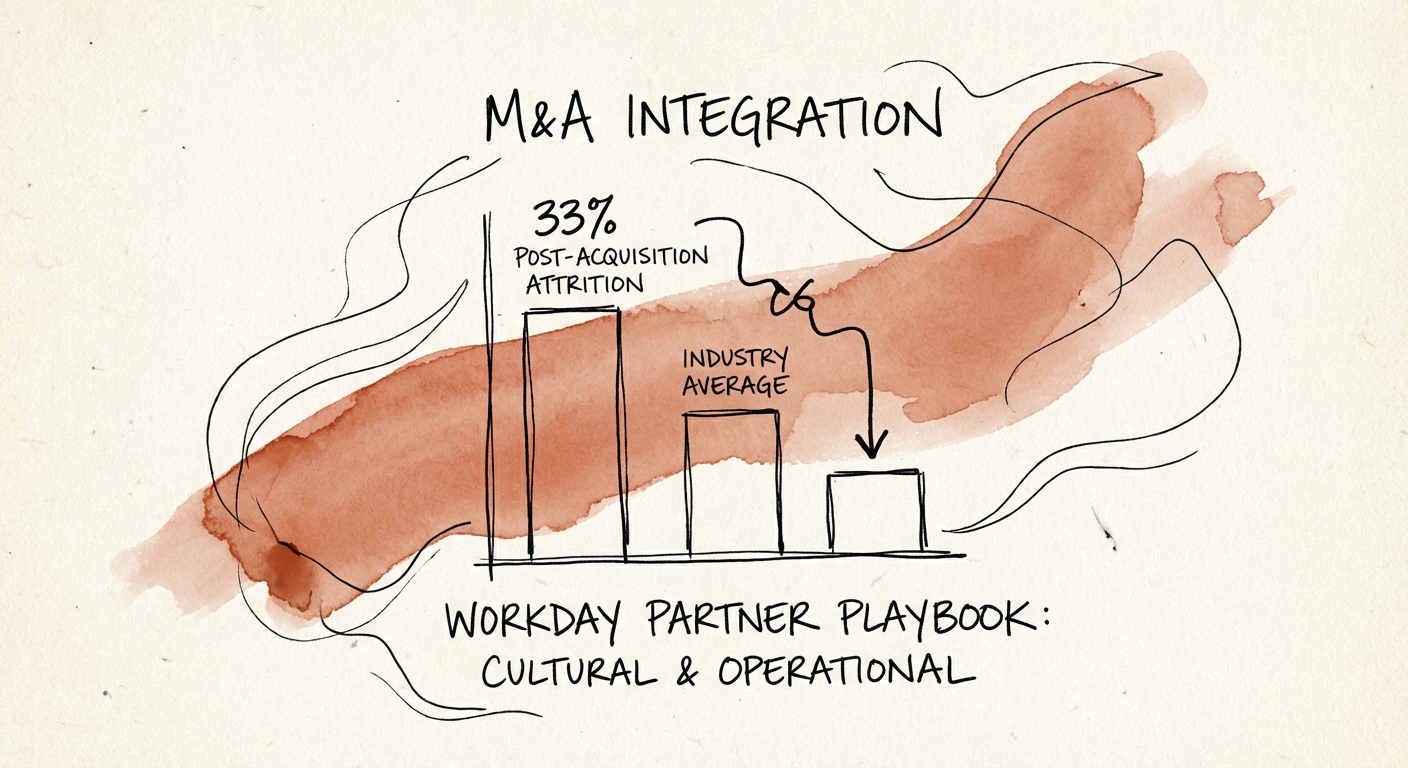
Because the ecosystem is talent-constrained, rival partners are constantly poaching. When you acquire a boutique Workday firm and attempt to "normalize" their culture into a broader IT services generalist, you can trigger a wave of attrition. The data is sobering: 33% of acquired employees leave post-acquisition, with key producer attrition often hitting 47% within the first year. These consultants know their market value is tied to their specialized badges, not your generic firm brand. If you treat them like "staff aug" resources, you increase the odds that they leave for a competitor with a clearer specialist path.
You didn't buy a generic services firm; you bought a gated community. Treat Workday consultants like 'staff aug' resources, and they will walk—taking their certifications and your deal value with them.
The Utilization Trap: 68.9% Is the New Danger Zone
The 2025 Professional Services Maturity Benchmark reveals a terrifying trend: billable utilization across the sector has dropped to 68.9%. For a generalist firm, that’s a bad quarter. For a Workday practice acquired at a 12x EBITDA multiple, it’s a thesis killer.
Why does this happen post-close? We call it "Integration Distraction." PE Operating Partners, eager to capture synergies, flood the schedule with town halls, systems migration meetings, and "culture melds." Every hour a $350/hour Principal Consultant spends in a synergy meeting is an hour of lost revenue and an hour of resentment building.
The Billable Rate Arbitrage Failure
The second economic killer is rate harmonization. Your boutique target likely commands premium rates ($275-$400/hr) because they specialize in complex modules like Workday Prism or Accounting Center. If you fold them into a generalist shop billing $175/hr, two things break:
- The P&L: You cannot support the acquisition multiple on generalist margins.
- The Bonus Pool: High-performing Workday consultants are often paid on billings or realization. Lowering the rate effectively cuts their pay.
Do not attempt to "cross-sell" Workday implementation services at commodity rates to boost volume. You will burn out your bench and erode the premium brand equity you just paid for.
The Operational Playbook: Ring-Fence and Protect
The standard 100-Day Plan for IT services integration—"One Team, One Dream"—is poison for Workday acquisitions. Instead, you need a Ring-Fence Strategy for the first 24 months.
1. Preserve the Identity
Keep the boutique’s brand, titles, and—crucially—their compensation structure distinct. If they are an "Elite" partner, that status is an asset. Diluting it with your generalist "Gold" or "Silver" status in other ecosystems signals a drop in prestige to the market and the talent.
2. Integrate Only the Back Office
Merge Finance, Legal, and HR (compliance only). Do not merge the delivery organizations or the sales overlay immediately. Let the Workday practice run as a specialized unit within your broader platform.
3. The 'Certification Portability' Defense
To combat the 33% attrition risk, structure retention packages that are tied to tenure, not just earn-out. But more importantly, offer a "Certification Scholarship" program. Workday training is expensive. Committing to pay for their next 2 certifications (e.g., Adaptive Planning or Extend) creates a "golden handcuff" that appeals to their career ambition, not just their wallet.
Successful integration isn't about blending everything into a generic operating model. It's about recognizing you bought a specialized practice and protecting the conditions that made it valuable.