
The practical answer
- Short answer
- Prevent the 30% value leak in RPA acquisitions. A diagnostic playbook for PE sponsors integrating UiPath partners, focusing on talent retention, IP audits, and the pivot to Agentic AI.
- Best fit
- Industry: Private Equity / Technology Services. Function: Post-Merger Integration
- Operating path
- Migration & Integration → Turnaround & Restructuring → Transaction Advisory Services
- Key metric
- 19% The minimum annual ARR growth rate for a healthy UiPath partner (tracking the OEM). Anything less signals market share loss.
The Agentic Pivot: Why You Bought a Liability, Not an Asset
In 2026, the valuation spread in the automation services market has bifurcated violently. On one side, Agentic AI specialists—partners deploying autonomous, self-healing agents utilizing UiPath's Autopilot and Agent Builder—are commanding multiples of 12x EBITDA or higher. On the other side, legacy RPA implementation shops—those still selling linear, rules-based ‘screen scraping’ bots—are stalling at 5x-6x.
For Private Equity sponsors, this creates a dangerous due diligence blind spot. Many targets market themselves as ‘AI-driven automation experts’ while their revenue is actually derived from maintaining brittle, legacy scripts that break whenever an underlying application updates. We call this the ‘Bot Rot’ Discount.
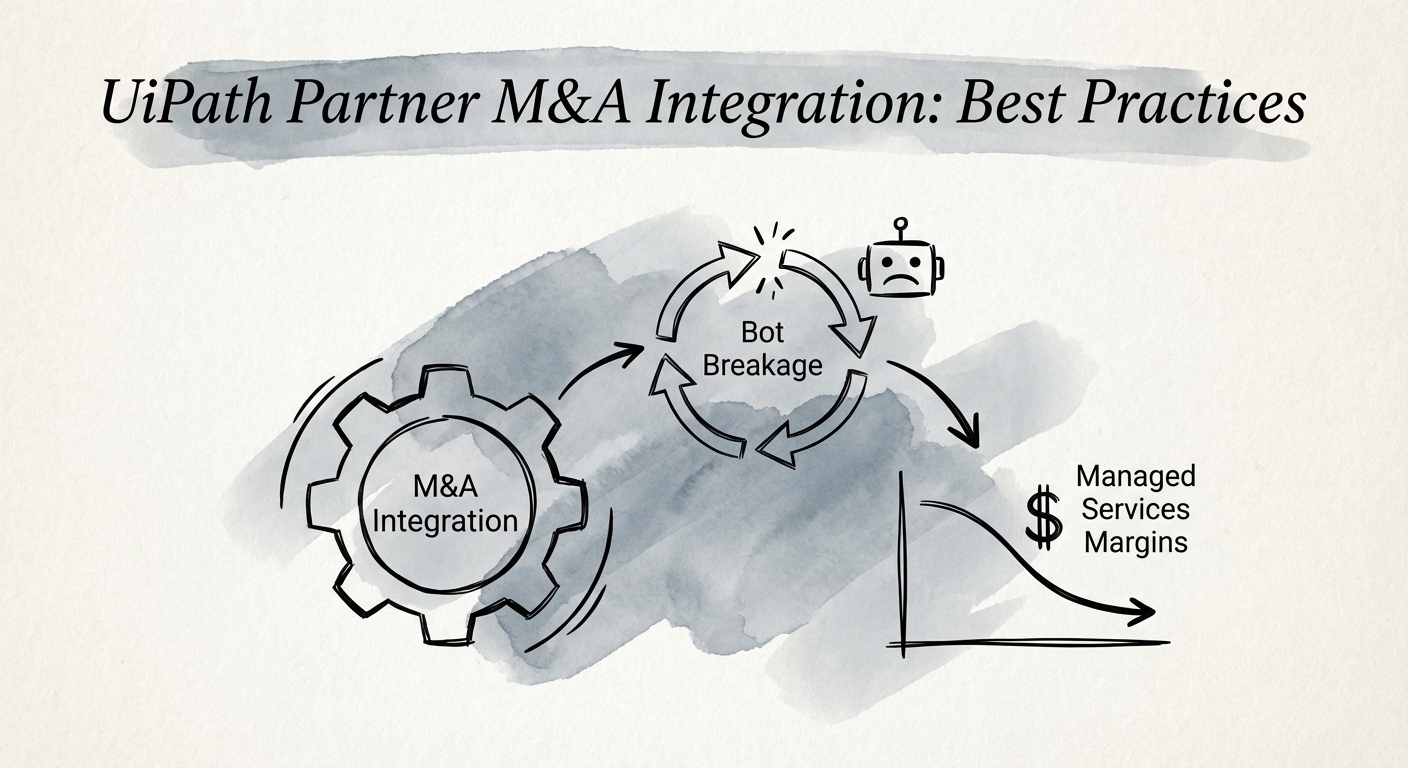
The diagnostic indicator is Maintenance Revenue Quality. In a healthy, modern practice, managed services revenue grows because customers are expanding into new, complex workflows (Agentic Automation). In a decaying practice, managed services revenue is merely a ‘break-fix’ tax—fees charged to constantly repair bots that shouldn't have broken in the first place. If your target’s Bot Breakage Rate exceeds 15% annually, you are not buying recurring revenue; you are buying technical debt disguised as a service contract. This ‘bad revenue’ evaporates the moment a customer migrates to a true AI-native platform.
If your target's 'managed services' revenue is just fees for fixing broken bots, you haven't bought a SaaS-like business. You've bought a janitorial service for bad code.
The Technical Integration: Auditing the ‘Bot Library’
Post-close, the first 100 days must focus on a forensic audit of the code base. Too often, integration teams focus on merging CRMs and financial systems (NetSuite/Salesforce) while ignoring the actual product: the automation IP. A target claiming to have ‘500+ reusable components’ often has a library of unmaintainable ‘spaghetti code.’
The ‘Selector Fragility’ Test
Your technical diligence team must run a ‘Selector Fragility’ test on a random sample of the top 20 revenue-generating bots. Legacy developers often hardcode UI selectors (e.g., looking for a button at specific pixel coordinates or with a specific volatile ID). When the host application (like SAP S/4HANA or Salesforce Lightning) updates its UI, these bots fail instantly.
We recommend a technical debt audit specifically for RPA assets. If more than 30% of the bot library relies on static selectors rather than dynamic, object-based recognition (or UiPath’s modern Computer Vision AI), you must budget for a 20-25% margin erosion in the first year to refactor this code. Failure to remediate this debt leads to the ‘Maintenance Cliff,’ where your best engineers are trapped fixing old bots instead of billing for new ‘Agentic’ projects, killing your growth multiple.
Talent Retention: The ‘MVP’ Flight Risk
The most valuable asset in a UiPath partner acquisition is not the customer list, but the UiPath Most Valuable Professionals (MVPs) and certified Solution Architects. These individuals are the only ones capable of delivering the new ‘Agentic’ roadmap. However, they are also the most likely to leave if the integration feels like a ‘body shop’ roll-up.
Data from 2025 integrations shows that without a specific ‘Innovation Retention’ package, 30% of top-tier RPA talent churns within 6 months. Why? Because they fear being pigeonholed into maintaining the ‘Bot Rot’ described above. They want to work on Agent Builder, Document Understanding, and AI Center.
To stop the bleeding, structure retention bonuses not just on time, but on certification advancement. Tie earnouts and retention packages to the achievement of UiPath Services Network (USN) accreditation or ‘Agentic’ specialization badges. This aligns their career goals with your investment thesis: pivoting the firm from a low-margin implementation shop to a high-margin Managed Automation platform. If you treat them like IT support staff, they will leave for a competitor who treats them like AI engineers.