
The practical answer
- Short answer
- Why 60% of ServiceNow partner acquisitions fail to realize synergies. A diagnostic guide for PE Operating Partners on instance consolidation, technical debt, and talent retention.
- Best fit
- Industry: Private Equity / IT Services. Function: Post-Merger Integration
- Operating path
- Migration & Integration → Turnaround & Restructuring → Transaction Advisory Services
- Key metric
- 60% of M&A deals fail to reach integration targets due to technical and cultural misalignment.
The "Noah's Ark" Problem: Two of Everything, Value of Nothing
You’ve executed the roll-up strategy perfectly on paper. You bought a leading Elite ServiceNow partner in North America, bolted on a specialized boutique in Europe, and acquired a managed services firm to boost recurring revenue. The investment thesis is sound: cross-sell capabilities, consolidate back-office operations, and expand EBITDA margins through scale. But six months post-close, your "platform" isn't a platform. It's a zoo.
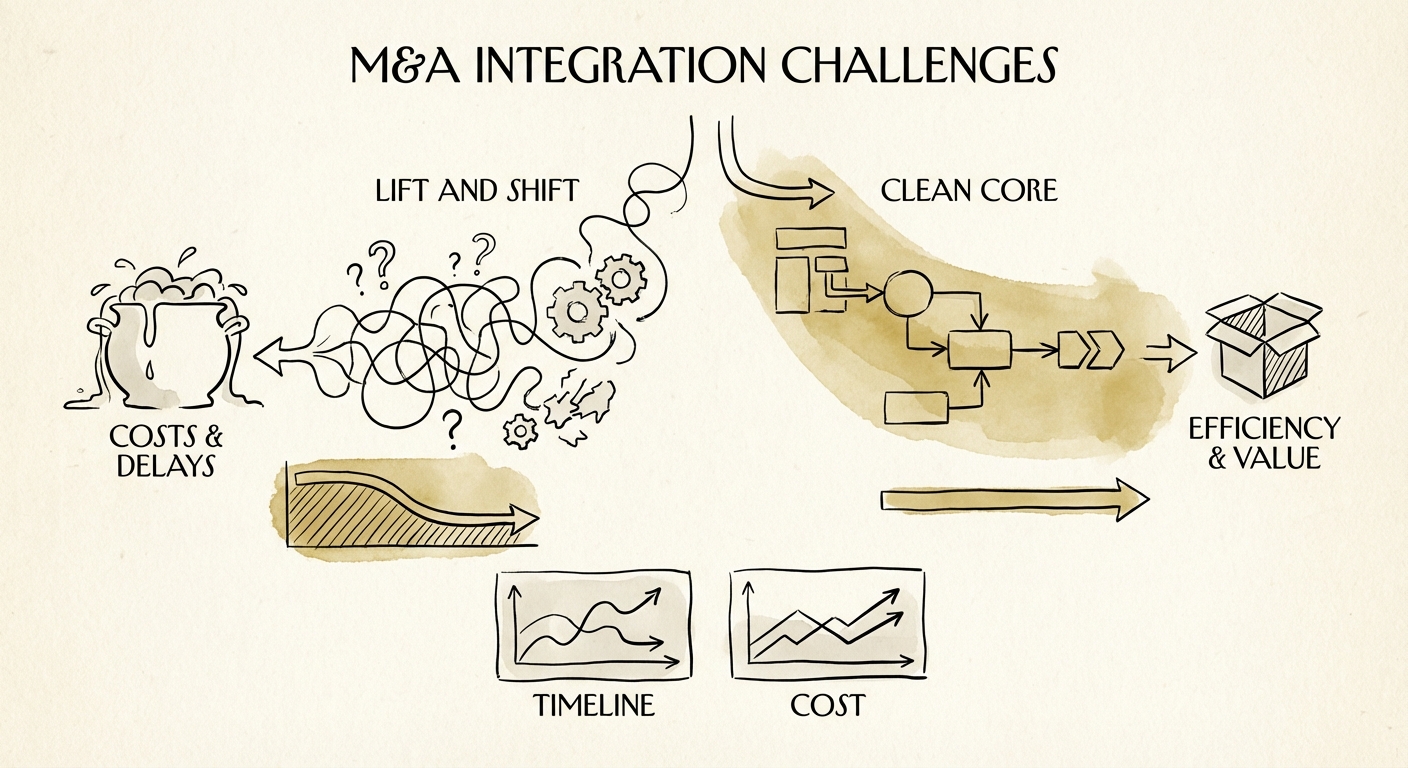
We call this the "Noah’s Ark" architecture: you have two Service Catalogs, two CMDBs, two distinct sets of change management workflows, and two sales teams who can’t quote the same SKU because it doesn’t exist in both instances. Instead of synergy, you have created "swivel-chair" integration—where highly paid engineers manually copy-paste tickets between disparately configured instances to maintain the illusion of a unified company. This isn't just an operational nuisance; it is a valuation killer.
Recent data indicates that integration failures destroy deal value in 60% of M&A transactions. In the ServiceNow ecosystem, the culprit is rarely the market; it’s the technical debt buried in the acquired instances. When you merge two firms, you aren't just merging balance sheets; you are merging years of divergent architectural decisions. One firm used out-of-the-box (OOTB) Flow Designer; the other hard-coded logic in script includes that haven't been touched since the Madrid release. Reconciling these realities often consumes 40% of the total integration budget—a cost line item that rarely appears in the Quality of Earnings (QofE) report.
You didn't just buy a customer list; you bought a technical environment. If you don't audit the code before you sign the check, you're paying for the privilege of fixing someone else's mistakes.
The Instance Strategy Dilemma: Consolidate or Federate?
The first technical decision a PE Operating Partner must force is the Instance Strategy. There are only two viable paths, and "hybrid" is usually a euphemism for "indecision."
Option A: The "Clean Core" Consolidation
This involves migrating all acquired entities into a single, master instance—usually the one with the highest architectural maturity (not necessarily the largest revenue). This maximizes long-term EBITDA by unifying processes, reporting, and licensing costs. However, it is painful. It requires a "rip and replace" of legacy customizations that your acquired teams are emotionally attached to. The benchmark for this migration is 6 to 9 months of focused engineering effort, during which billable utilization will drop.
Option B: Domain Separation (The MSP Model)
If your strategy is purely a financial roll-up of distinct Managed Service Providers (MSPs) who will operate semi-autonomously, Domain Separation allows you to host multiple distinct data environments on a single instance. This protects data sovereignty (crucial for EU/GDPR compliance) but increases administrative complexity. Warning: Moving from a standard instance to a Domain Separated instance is a one-way door. You cannot easily undo it.
The mistake most PE firms make is underestimating the "Configuration Drift." You assume both companies use Incident Management. But Company A defines "Priority 1" as a server outage, while Company B defines it as a CEO password reset. Without a strong governance framework established on Day 1, you spend millions integrating workflows that shouldn't be integrated at all.
The Talent Exodus: When the Assets Walk Out the Door
In a professional services acquisition, the assets go home at 5 PM. In the ServiceNow ecosystem, those assets are Certified Master Architects (CMAs) and Certified Technical Architects (CTAs). These are the people who hold the "tribal knowledge" of how the custom apps actually work. And they are the first to leave when the integration gets messy.
Industry data shows a 33% attrition rate for "acqui-hires" within the first 12 months post-acquisition. Why? Because you asked an architect who loves building solutions to spend their year doing data migration and remediation work. You turned your best innovators into janitors.
Financial retention packages ("golden handcuffs") are necessary but insufficient. To retain the top 10% of technical talent, you must offer a "Technical North Star"—a clear vision of how the combined entity will work on the bleeding edge (e.g., GenAI, Agentic AI). If your integration plan is purely about cost synergies, your best engineers will leave for a competitor who is focused on growth. And in this market, replacing a CMA takes 5.7 months and costs 150% of their annual salary. Protect your intellectual property by protecting the people who wrote it.