
The practical answer
- Short answer
- The 2026 guide for PE Operating Partners integrating AWS consultancies. How to protect the Premier Tier badge, retain certified talent, and capture the $7.13 ecosystem multiplier.
- Best fit
- Industry: Private Equity / IT Services. Function: Post-Merger Integration
- Operating path
- Migration & Integration → Turnaround & Restructuring → Transaction Advisory Services
- Key metric
- $7.13 Partner Ecosystem Multiplier (PEM) value generated for every $1 of AWS spend by integrated partners (Omdia 2026).
The 'Badge Arbitrage' Is Dead
In 2023, the private equity thesis for AWS partner consolidation was simple: buy three Advanced Tier partners, smash them together, achieve the headcount and revenue thresholds for Premier Tier, and flip the combined entity at a 12x multiple. It was a financial engineering play, often called "badge arbitrage."
In 2026, that playbook is a liability.
AWS has fundamentally altered the incentives. The new Partner Paths and the stringent 2025 Premier Tier requirements—requiring not just certified bodies, but 30+ CSAT responses, 6 public reviews, and validated "Launch" opportunities—mean you cannot simply aggregate your way to the top. You have to integrate your way there.
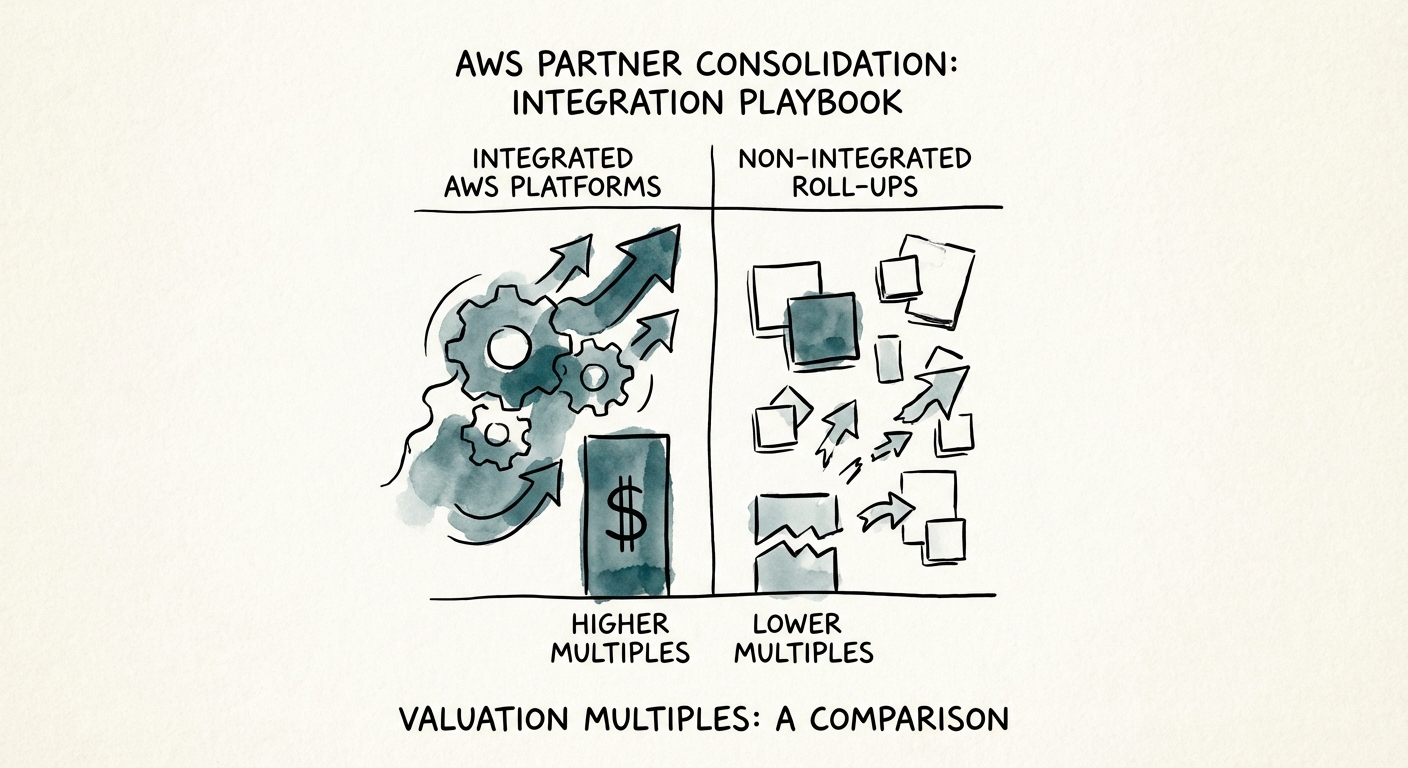
We are seeing a bifurcated market. According to Bain & Company's 2026 Global M&A Report, while average tech services multiples have rebounded to 11.6x EBITDA, there is a "quality chasm" emerging. Integrated platforms that demonstrate true cross-sell capability (Data + Infra + SecOps) command premiums up to 15x. Loose confederations of acquired shops—where the "integration" is just a shared website—are trading at 6x or failing to transact entirely.
The Valuation Gap
The difference between a 6x asset and a 12x asset in the AWS ecosystem is no longer about total headcount. It is about the Partner Ecosystem Multiplier (PEM). Omdia's latest research reveals that for every $1 of AWS spend, integrated partners generate $7.13 in value-added services. If your portfolio company is stuck at $2.50 because your acquired units can't cross-sell, you aren't just leaving money on the table—you are bleeding enterprise value.
You cannot financial-engineer your way to AWS Premier Tier. You have to operational-engineer it. The market pays 6x for a collection of logos and 12x for an integrated platform.
The Integration Death Spiral: Where Value Evaporates
The moment the wire hits, three destructive forces begin to erode your investment. I call this the "Integration Death Spiral." If you don't arrest these within the first 100 days, your thesis fails.
1. The Certification Cliff
You bought the firm for its 500 AWS certifications. But certifications belong to individuals, not companies. When you announce the merger without a clear "Technical Career Path," your top engineers—the ones holding the Professional and Specialty certs required for Premier status—get spooked. Industry data suggests a 15% attrition rate in the first 90 days post-acquisition for technical talent. If three key architects leave, you don't just lose billing capacity; you drop below the Premier Tier threshold, triggering a programmatic downgrade that kills your lead flow from AWS sellers.
2. The 'Shadow Org' Problem
I recently audited a PE-backed platform formed from four acquired MSPs. Eighteen months post-close, they were still running four separate AWS Organizations. They had no consolidated billing, no reserved instance (RI) sharing, and four different support contracts. They were overspending on AWS infrastructure by $1.2M annually—pure EBITDA leakage.
3. The 'Billable Drift'
Acquired Shop A charges $175/hour for a DevOps engineer. Acquired Shop B charges $225/hour. In the absence of a unified rate card, your sales team will naturally gravitate toward the lower internal transfer price to win deals. You effectively commoditize your own business, eroding gross margins by 500-800 basis points across the portfolio.
The Playbook: From 'Roll-Up' to Platform
To capture the 11.6x exit multiple, you must move from financial consolidation to operational engineering. Here is the 120-day roadmap.
Step 1: The 'Cert Defense' Strategy (Days 1-30)
Do not wait for the earnout to end. Immediately audit the certification holding of every employee. Identify the "Lynchpin Holders"—the 10-15 people whose certifications anchor your Premier Tier status. Structure specific retention bonuses tied not to time, but to certification renewal and mentorship. Make them the heroes of the new platform. You are securing your license to operate.
2. Unified Offerings, Not Just Unified Billing (Days 30-60)
Stop selling "hours." AWS sellers do not care about your rate card; they care about Committed Annual Recurring Revenue (CARR). Package your services into "Outcome Pods"—e.g., a Data Modernization Accelerator that pulls resources from all acquired entities. This aligns you with the AWS MAP (Migration Acceleration Program) incentives and forces your delivery teams to integrate. It shifts your revenue mix from volatile project work to predictable managed services.
3. The 'Single Pane' Governance (Days 60-90)
You must consolidate the AWS Organization structure. This is non-negotiable. By moving to a single Control Tower implementation, you gain:
- Margin Expansion: Instant 15-20% savings through RI/Savings Plan sharing across the portfolio.
- Security Posture: A unified perimeter that passes the inevitable PE-grade technical due diligence at exit.
- Data Gravity: A single view of customer consumption, allowing you to spot the "Data & AI" cross-sell opportunities that drive the $7.13 multiplier.
Your goal is not just to be bigger. It is to be dense. Density of talent, density of IP, and density of relationship with the hyperscaler. That is what trades at 12x.