
The practical answer
- Short answer
- The 2026 guide to Veeva partner M&A integration. Avoid the Vault CRM migration cliff, retain specialized talent, and protect 14x valuations.
- Best fit
- Industry: Life Sciences. Function: Post-Merger Integration
- Operating path
- Migration & Integration → Turnaround & Restructuring → Transaction Advisory Services
- Key metric
- 14x EBITDA multiple for 'Vault-Native' practices vs. 6x for legacy Salesforce-based Veeva shops.
The 2026 Context: The 'Great Migration' Trap
In 2026, the landscape for Life Sciences IT services is dominated by a single, seismic shift: the migration from Salesforce-based Veeva CRM to Veeva Vault CRM. For Private Equity sponsors evaluating or integrating Veeva partners, this technical pivot creates a dangerous bifurcation in asset quality.
Historically, a ‘Veeva CRM’ practice was effectively a specialized Salesforce practice. Consultants wrote Apex triggers, managed Visualforce pages, and leveraged the Salesforce ecosystem. Today, that skill set is depreciating rapidly. With Veeva’s cutoff for Salesforce-based CRM support looming in 2030 and the migration window peaking between 2026 and 2029, acquiring a legacy practice that hasn’t retooled is effectively buying a liability.
The Valuation Gap: Legacy vs. Vault-Native
Our analysis of 2025-2026 deal flow suggests a massive valuation divergence:
- Vault-Native Practices: Firms with proven Vault CRM migration methodologies and certified Vault Java SDK developers are trading at 14x-16x EBITDA. These assets own the ‘future state’ of the industry.
- Legacy CRM Shops: Firms still reliant on Salesforce-based Veeva CRM revenue, without a credible Vault pivot, are seeing multiples compress to 6x-8x. The acquirer must fund the retooling, retraining, and potential client churn during the migration gap.
When conducting technical due diligence, you must audit not just the revenue mix, but the delivery capability. Does the target have a ‘Vault Factory’, or are they a ‘Salesforce Shop’ in disguise?
The 2026 Vault CRM migration is a major dislocation in Life Sciences IT. PE firms that treat it as a standard CRM switch will underwrite the wrong risk; those that treat it as a commercial-model replatforming will be better positioned.
The Talent Crisis: Why 'Absorption' Kills Deal Value
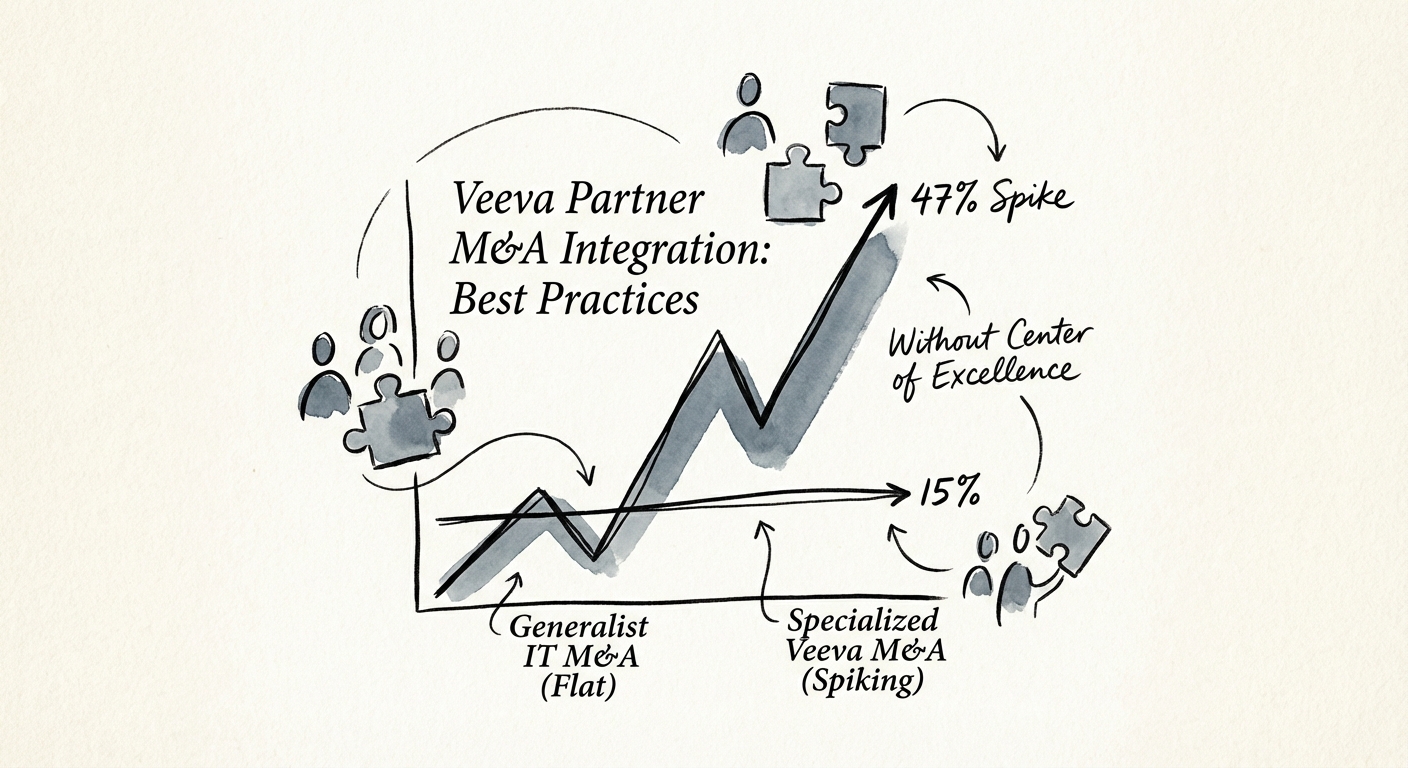
The most common failure mode in Veeva partner M&A is treating the acquisition as a ‘tuck-in’ to a generalist Salesforce or Cloud practice. This strategy almost invariably leads to a 47% attrition rate of key consultants within the first 12 months, destroying the specialized knowledge that justified the premium multiple.
The 'Salesforce to Vault' Skill Gap
Your acquired talent pool faces an identity crisis. For a decade, their value was tied to Salesforce expertise. Now, the new platform (Vault) requires a different architectural mindset (document-centric vs. record-centric) and a different coding language (Java vs. Apex). If you integrate them into a generalist Salesforce practice, you signal that their specialized future is dead. They will leave for a boutique that promises to train them on Vault.
Retention Strategy: The Life Sciences Center of Excellence
Instead of absorption, successful integrators deploy a Center of Excellence (CoE) model. This structure preserves the ‘Life Sciences Premium’ by:
- Isolating Compensation: Maintaining higher bill rates and comp bands for Veeva specialists compared to generalist CRM staff.
- Funding Retraining: Allocating a specific post-close budget (typically $15k-$20k per head) for Vault CRM certification and ‘Sandbox’ time.
- Protecting Culture: Keeping the ‘white glove’ service culture required by Pharma clients, which often clashes with the ‘volume/velocity’ model of generalist SIs.
See our benchmarks on post-acquisition attrition rates to model the cost of failing this retention test.
The 120-Day Integration Roadmap
To capture synergies without breaking the business, PE operators should follow a specialized 120-day roadmap tailored for the Life Sciences market.
Days 1-30: Stabilize and Segregate
Do not merge Salesforce orgs or email domains immediately. Pharma clients are risk-averse; any sign of operational chaos triggers ‘vendor review’ clauses. Your priority is client assurance. Jointly present a ‘Vault Migration Roadmap’ to top accounts to show that the acquisition accelerates, rather than hinders, their transition.
Days 31-90: The 'Cross-Sell' Trap
Avoid the temptation to immediately cross-sell generalist IT services (e.g., ‘we can also do your Azure hosting’) to R&D stakeholders. This erodes credibility. Instead, focus on adjacent Veeva clouds. If the target specializes in Commercial Cloud (CRM), cross-sell Quality or Regulatory services if your platform has them. This reinforces domain expertise.
Days 91-120: Unified Resource Management
By month 4, integrate back-office finance and HR, but keep delivery resource pools distinct. Use a ‘soft bridge’ for resource sharing—allow generalist developers to ‘intern’ on Veeva projects to build a lower-cost delivery bench, but do not dilute the expert tier with generalist staff. For a detailed breakdown of integration phasing, refer to our 120-day IT integration guide.