
The practical answer
- Short answer
- A diagnostic guide for PE Operating Partners integrating NetSuite Solution Providers. Benchmarks on utilization, technical debt, and the 'Cobbler's Children' trap.
- Best fit
- Industry: Professional Services / SaaS Implementation. Function: Post-Merger Integration (PMI)
- Operating path
- Migration & Integration → Turnaround & Restructuring → Transaction Advisory Services
- Key metric
- 68.9% Average billable utilization in 2025, a critical bleeding point for post-merger services firms.
The 'Cobbler's Children' Paradox: Why NetSuite Partners Have the Worst NetSuite Instances
There is a specific irony in the private equity roll-up of NetSuite Solution Providers. You are acquiring firms whose entire value proposition is optimizing business processes for clients, yet their own internal operations are often held together by duct tape and tribal knowledge. In my experience auditing over 50 post-merger technical stacks, NetSuite partners are the worst offenders of the "Cobbler's Children" syndrome.
When you acquire a bolt-on to your platform asset, the assumption is that integration will be seamless because "both companies run on NetSuite." This is the most dangerous assumption in the deal. One firm might use standard SuiteSuccess methodology with rigid workflows, while the other runs a highly customized instance with 15 years of technical debt in SuiteScript. Merging these isn't a data migration; it's a re-implementation.
The Multi-Instance Trap
I frequently see PE sponsors delay technical integration to avoid disrupting the P&L. They leave the acquired entity on their legacy instance for "observation." This creates a data silo that blinds your operating partners. You cannot get a consolidated view of the pipeline, resource availability, or true project profitability. You are effectively running two small businesses instead of one platform.
The Diagnostic Test: Ask your CTO or CIO to pull a single report showing global resource utilization by role across both entities for next week. If they have to open Excel to combine two exports, you have failed the integration test.
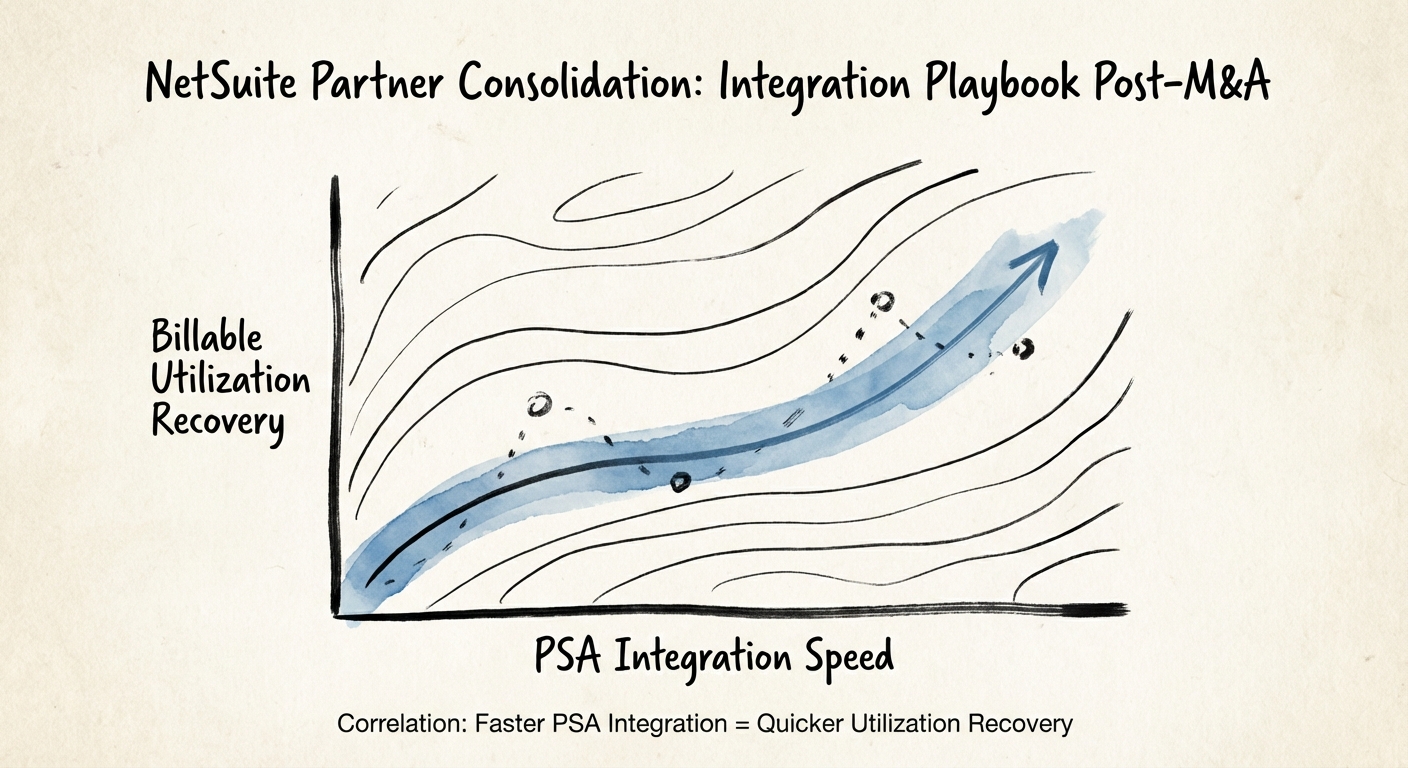
You cannot model synergy on a spreadsheet if your resource managers need Excel to find a developer. If you don't integrate the PSA tool in 90 days, you aren't running a platform; you're running a holding company.
The Utilization Dip: Why 1+1 Usually Equals 1.5
The mathematics of a services roll-up rely on synergy—specifically, the ability to deploy a larger bench of consultants against a unified pipeline. However, the 2025 benchmarks for professional services paint a grim picture: average billable utilization has dropped to 68.9%, a decade low. In the quarter following an acquisition, I often see this dip even further, sometimes hitting 60%.
Why does this happen? It is rarely a lack of work. It is a lack of visibility and trust.
Resource Hoarding
Without a unified PSA (Professional Services Automation) tool—ideally NetSuite OpenAir or a properly configured native NetSuite Resource Allocation chart—delivery managers will hoard their best talent. The platform company's delivery lead doesn't know the bolt-on's consultants, so they don't staff them. The bolt-on's team sits on the bench while the platform company turns away work or hires contractors.
The EBITDA Impact
Let's do the math on a $50M NetSuite consultancy. A 5% drop in utilization (from 75% to 70%) erodes approximately $2.5M in EBITDA annually. This completely wipes out the cost synergies you modeled in the deal thesis (back-office consolidation, insurance savings, etc.). To protect your multiple, you must force a "One Bench" strategy within the first 90 days. This means a single resource pool, a single skills matrix, and a single scheduling protocol.
The Cultural Clash: 'SuiteSuccess' vs. 'Engineered to Order'
Beyond the GL and the code, the biggest risk to your investment is the exodus of the "Revenue Architects"—the senior solution architects who actually close deals. In the NetSuite ecosystem, there are two distinct delivery cultures:
- The Volume Shops: These firms sell "out of the box" implementations (SuiteSuccess) with low hourly rates, high volume, and rigid scope.
- The Custom Shops: These firms behave like traditional systems integrators, building complex, custom-scripted solutions for enterprise clients.
If you merge a Volume Shop into a Custom Shop (or vice versa) without acknowledging this difference, you will lose your top talent. The Volume consultants will flounder when asked to architect complex solutions, and the Custom architects will quit if forced to deliver "cookie-cutter" projects.
The Integration Playbook
Do not try to homogenize the delivery model immediately. Instead, segment your service lines. Create a "SMB/Rapid" practice for the volume work and an "Enterprise/Custom" practice for the complex work. Map your acquired talent to the practice that fits their skills, not just their job title. This preserves the specialized value of the acquired firm while allowing for shared back-office leverage.