The practical answer
- Short answer
- Acquired customers don't churn randomly after a tech deal closes — they leave in three predictable waves. Here's the 90-day defection curve and how to flatten it.
- Best fit
- Industry: Private Equity & Technology. Function: Post-Merger Integration (PMI)
- Operating path
- Migration & Integration → Turnaround & Restructuring → Transaction Advisory Services
- Key metric
- 22.4% Average acquired customer ARR lost in the first 90 days of poorly managed post-merger integration.
The deal model assumed 5% annual churn. Ninety days after close, the acquired book is down 22.4%, and the operating partner is staring at a synergy case that no longer pencils. Here's the part nobody puts in the LOI: that churn didn't arrive randomly. It arrived on a schedule — three distinct waves, each triggered by a specific integration decision the buyer made on purpose.
I have run this gauntlet from the inside. On one four-company roll-up in compliance software, the acquirer was so focused on the target operating model that $18.4 million in ARR walked out the door before the steering committee finished arguing about the org chart. The product was sticky. The customers stayed loyal to the product right up until the day the people and the plumbing around it broke. That's the trap: leadership confuses product stickiness with relationship stickiness, and the two have almost nothing to do with each other in the first quarter post-close.
The pattern is consistent enough to benchmark. Harvard Business Review found that roughly 90% of acquisitions miss their anticipated synergies, with customer defection as the leading cause — and the defection isn't spread evenly across the year (Harvard Business Review). It's front-loaded into 90 days, and it moves through three phases you can predict and pre-empt.
Wave one (Days 1–30): the silence that competitors fill
The first wave is worth 8.5% of total acquired churn, and it costs you almost nothing to prevent — which is exactly why it's so maddening to watch happen. The trigger is a communication vacuum. The customer reads the "exciting news" announcement, then hears nothing from the human they actually trust. Into that silence walks a competitor's rep who has been waiting for this exact moment, armed with a "we heard about the acquisition — want to talk before things get messy?" email.
The fix is unglamorous and effective: a named-human outreach to every top account inside the first ten business days, from a face they recognize, saying nothing about back-office strategy and everything about "your service does not change, your contact does not change." A disciplined post-acquisition customer communication timeline turns this wave from a leak into a non-event. Over-communicate, or your competitors will do the communicating for you.
Acquired customers don't leave because the deal was bad. They leave because on Day 14 their account manager stopped answering and on Day 30 the invoice arrived broken. Churn after close isn't a market event. It's a self-inflicted one.
Wave two (Days 31–60): the plumbing you broke to hit a synergy date
The second wave is the biggest — 9.2% of acquired churn — and it is the one buyers cause with their own hands. Month two is when the integration management office starts collapsing systems to book cost synergies: one CRM, one ERP, one billing platform, one support desk. Every one of those migrations is a tripwire the customer feels. Tickets route to a queue nobody is watching. An implementation that was 80% done resets and slips 45 days. The first consolidated invoice double-bills, or arrives in a format the customer's AP system rejects. Bain found that organizations that fumble operational integration lose around 20% of their customer base outright (Bain & Company). You do not get the cost synergy if you snap the revenue engine reaching for it.
The single worst move in this window is dissolving the acquired delivery and support team into the parent's shared desk. That team is not a cost line — it's the carrier of the tribal knowledge holding fragile accounts together. The senior engineer who knows that Account X always escalates through their VP, not the ticketing portal, is worth more than the desk-consolidation savings. I have rebuilt a wrecked customer-success function for mid-market platforms more than once, and the lesson never changes: ring-fence the acquired support and delivery team for at least 180 days. Don't merge the Jira instances yet. Don't force acquired users onto a new portal until the new workflow is genuinely better than the old one, not just cheaper to run. Protecting customer success team integration sequencing here is the difference between a 9.2% wave and a rounding error.
The line item that hides a seven-figure loss
Customer retention and key-personnel retention are not two problems. They're one. When the lead account executive on a relationship leaves, the top accounts they owned tend to follow within a quarter — the bond was with the person, not the logo on the contract. So when someone cuts a customer-facing role in month two to hit a headcount synergy, read what the spreadsheet actually says: a $150,000 payroll line goes green, and three accounts worth $1.2M in ARR go quietly into the pipeline of whoever that AE joins next. You did not save money. You moved it off the P&L and handed it to a competitor.
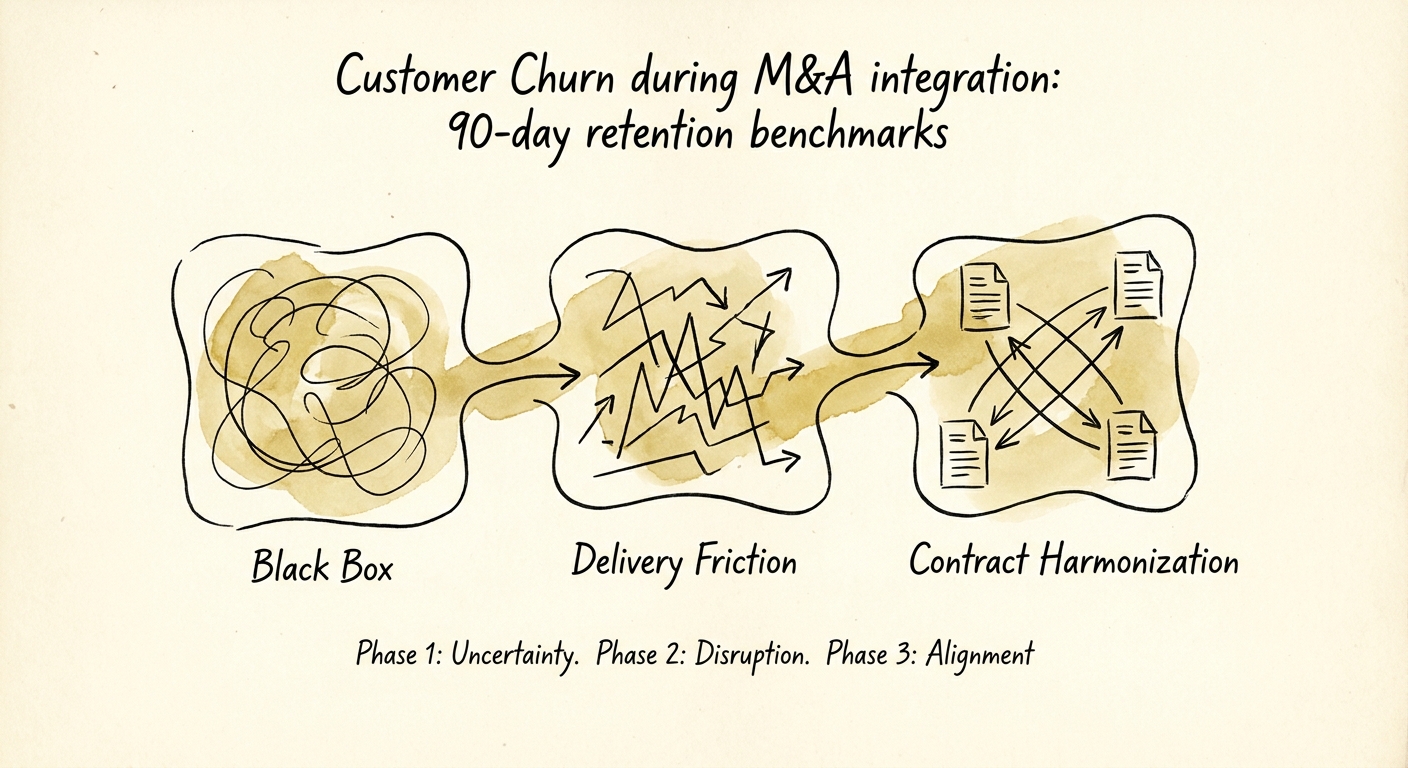
Wave three (Days 61–90): the contract review you invited
The final wave is the smallest — 4.7% — but it's the one that turns a retained customer into an active shopper. It's triggered by commercial harmonization: migrating legacy accounts onto standard paper, forcing a tier upgrade, bundling them into platform pricing. Every one of those moves drags the customer into a procurement evaluation they weren't planning to run. And the moment you reopen a contract mid-cycle, you've effectively invited them to take it to market and see what else is out there. The discipline I push every operating partner toward: a hard freeze on acquired commercial terms for the first 12 months. The repricing upside is real, but it is a year-two move, not a month-three one. Let the relationship stabilize before you touch the money.
Beating the benchmark is a sequencing problem, not a willpower problem. McKinsey's work on what separates successful acquirers shows the strongest ones wall their go-to-market teams off from integration disruption entirely while the back office churns (McKinsey & Company). Concretely: run a 90-day white-glove cadence for the top 20% of acquired accounts — the slice that usually carries the bulk of the target's enterprise value — and instrument an integration office that reports on one number, customer health, not on systems-migration milestones. Watch the leading signals, not the lagging ones: declining login frequency, professional-services engagements quietly going on hold, invoices slipping past their usual payment window. Those move weeks before a cancellation notice does.
Here's the Monday version. Pull your acquired-account list and rank it by ARR. For the top 20%, assign a named human owner, freeze their commercial terms for a year, and ring-fence the support team that serves them for 180 days. Then map your planned system migrations against the 90-day clock and push every customer-facing cutover past day 90. Separate the operational plumbing from the customer experience and the three waves flatten — and that's what protects the multiple you paid at close. Sequencing this against the broader M&A integration timeline benchmarks keeps the cost-synergy work moving without using the revenue base as collateral.