The practical answer
- Short answer
- Post-acquisition customer success integration failures cost PE firms 18% of deal value. Learn the diagnostic framework to prevent the 'Month 6 Cliff' and merge CS teams without destroying NRR.
- Best fit
- Industry: Private Equity / B2B SaaS. Function: Customer Success
- Operating path
- Migration & Integration → Turnaround & Restructuring → Transaction Advisory Services
- Key metric
- 47% Turnover rate of key employees within Year 1 of an acquisition (EY Study).
The 'Integration Paradox': Why Merging Teams Accelerates Churn
In the first 100 days of a SaaS acquisition, private equity operating partners obsess over the "hard" integrations: consolidating ERPs, merging Salesforce instances, and rationalizing product roadmaps. Yet, the single largest source of value erosion in the first year is the mishandling of the Customer Success (CS) team integration. We call this the Integration Paradox: the faster you force two distinct CS cultures to merge without a stabilizing framework, the faster your Net Revenue Retention (NRR) collapses.
Data from recent M&A studies indicates a significant 47% turnover rate for key employees within the first year of an acquisition. In the context of Customer Success, this is catastrophic. Unlike engineering code or marketing collateral, CS value is often locked in relationships and tribal knowledge. When a CSM leaves, the "at-risk" signal for their accounts often goes silent until the renewal notice bounces.
This creates the "Month 6 Cliff." For the first few months post-close, customers are in a "wait and see" mode. But as the acquired CSMs—who shielded customers from operational chaos—begin to exit due to culture clashes or compensation uncertainty, the protective layer dissolves. By Month 6, the combined effect of lost institutional knowledge and neglected accounts manifests as a sharp spike in churn, often shocking the board just as the integration is marked "complete."
If you break the customer relationship to 'fix' the org chart, you will lose the very value you bought. The goal of CS integration isn't efficiency in Year 1; it's protecting NRR.
The Three 'Silent Killers' of CS Integration
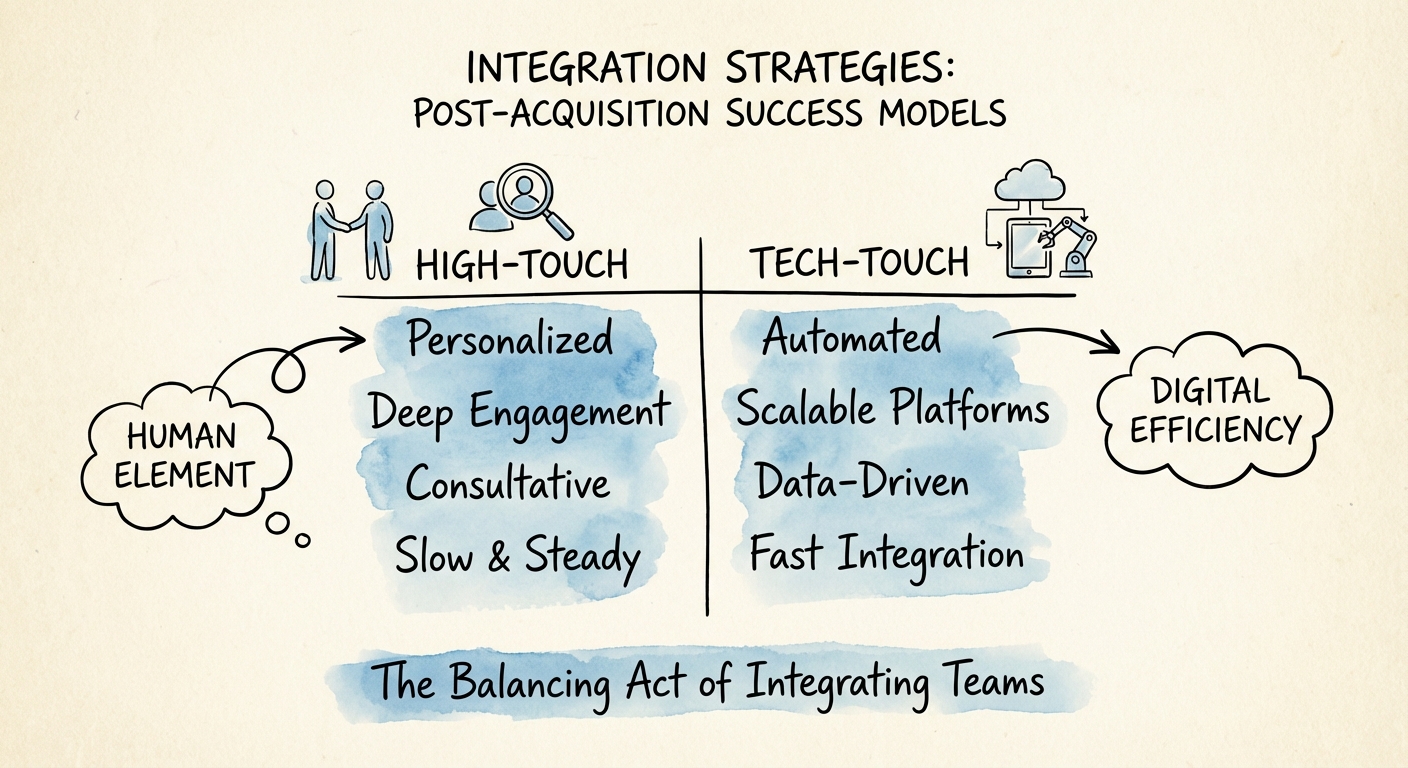
1. The Operating Model Mismatch (High-Touch vs. Tech-Touch)
The most common failure mode we see is merging a "white-glove" CS team (from a specialized, lower-volume target) into a "digital-first" or "tech-touch" CS organization (the platform acquirer). The acquirer views the target's CSMs as "inefficient" because they manage only $1M ARR each, compared to the acquirer's $4M. They mandate a shift to pooled resources or automated QBRs.
The result? The target's customers, accustomed to strategic partnership, feel abandoned. They don't churn immediately; they quietly disengage. When the renewal arrives, they've already evaluated competitors. Diagnostic Question: Are you imposing a "scale" model on a "value" customer base before proving the tech can handle the load?
2. The Compensation Quagmire
Nothing accelerates the 47% attrition rate faster than comp plan ambiguity. Acquired CSMs often have different base/variable splits. One team might be compensated on net retention (upsell focused), while the other is paid on gross retention (defense focused). Forcing a "Hunter" CS team into a "Farmer" comp plan (or vice versa) triggers an immediate exodus of top performers.
3. The 'Phantom Data' Trap
While IT spends months merging CRM instances, CS leadership often flies blind. Without a unified view of "Customer Health," you cannot see the aggregate risk. We frequently see a 90-day "data blackout" where the acquiring leadership has no visibility into the target's support tickets or usage drops because "the dashboards haven't been migrated yet." During this blackout, the Month 6 Cliff is built.
The Playbook: A 'Do No Harm' Integration Timeline
To avoid the Month 6 Cliff, Portfolio Operating Partners must execute a phased integration that prioritizes relationship continuity over operational efficiency in the short term.
Phase 1: Stabilization (Day 1-30)
Do not merge the teams. Do not change account assignments. Your only goal is retention of the CSMs who control the top 80% of revenue. Implement a "bridge comp" plan that guarantees their variable earnings for 6 months to prevent the post-acquisition exodus. Reference our guide on post-merger integration mistakes to see why protecting this talent layer is non-negotiable.
Phase 2: The 'Talent Triage' (Day 31-60)
Conduct a skills assessment. Identify which acquired CSMs have the "commercial DNA" to thrive in the larger entity and which are purely "support" oriented. Re-segment the customer base not just by ARR, but by strategic value. High-value customers from the acquired entity should retain a high-touch model, even if it defies the acquirer's standard ratios, at least for the first renewal cycle.
Phase 3: The Unified Health Score (Day 61-90)
Before the CRMs are fully merged, build a "Minimum Viable Dashboard" (MVD) that pulls key risk indicators from both systems into a single spreadsheet or BI view. You need to know if the acquired customers are logging support tickets at a higher rate. See our analysis on the 'Month 6 Cliff' for the specific leading indicators to track.
Final Verdict: Integration is inevitable, but speed is not the metric of success; retention is. If you break the customer relationship to "fix" the org chart, you will lose the very value you bought.