
The practical answer
- Short answer
- Forced product migrations often trigger 32% churn. Learn the retention strategy for sunsetting acquired products without destroying deal value.
- Best fit
- Industry: B2B Technology. Function: Customer Success & Product Strategy
- Operating path
- Migration & Integration → Turnaround & Restructuring → Transaction Advisory Services
- Key metric
- 32% Average revenue churn during forced product migrations when managed as a 'technical' rather than 'commercial' event.
The 'Forced March' Fallacy: Why Sunsetting Triggers a Re-Sale Event
In the private equity 'buy-and-build' playbook, the logic of sunsetting acquired products is mathematically irrefutable. Why maintain three different ERPs, four CRMs, or two project management tools when you can consolidate onto a single 'platform' and eliminate millions in R&D and support redundancy? The financial model assumes that if you shut down Product B and tell customers to move to Product A, they will comply because the alternative is leaving.
This is the Forced March Fallacy. In reality, a 'forced migration' is not a continuation of service; it is a re-sale event with negative brand equity. You are asking a customer who has likely spent years customizing their workflow, training their staff, and integrating their data to rip it all out and start over—often for a product they explicitly chose not to buy three years ago.
The 32% Revenue Cliff
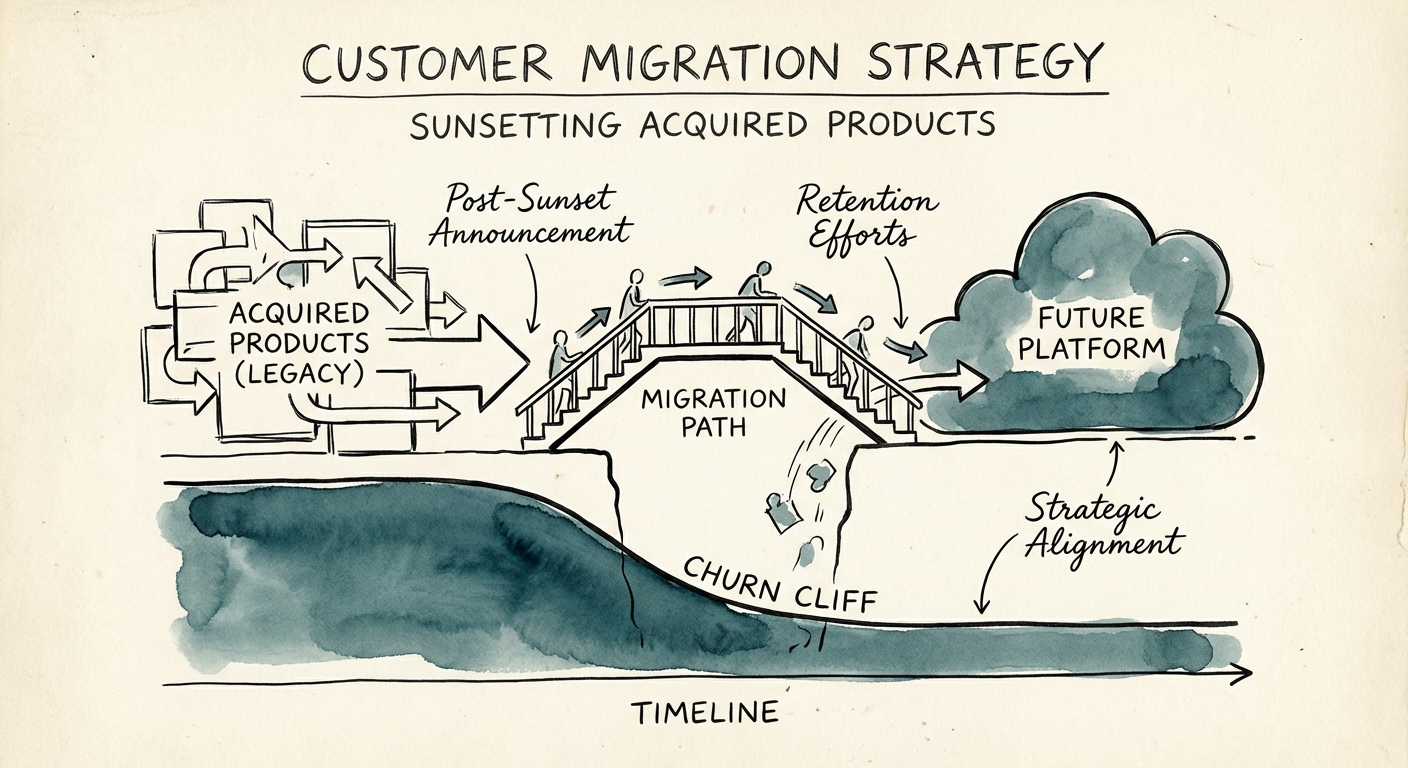
Our analysis of post-merger integration data indicates that poorly executed forced migrations trigger an average 32% churn rate within 18 months of the 'End of Life' (EOL) announcement. This figure is nearly 3x the industry average annual churn rate for B2B SaaS (10-14%). The churn doesn't happen immediately; it happens in the 'Evaluation Gap'—the 3-6 month window where the customer realizes they have to migrate anyway, so they decide to evaluate your competitors alongside your platform.
By forcing a migration, you have inadvertently broken the vendor lock-in you paid for. You have put the contract back in play.
By forcing a migration, you have inadvertently broken the vendor lock-in you paid for. You have put the contract back in play.
The Migration Matrix: Not All Revenue Is Worth Saving
The mistake most Portfolio Operating Partners make is treating the entire acquired customer base as a monolith. They send the same 'We are sunsetting Product X' email to the $500k/year enterprise account as they do to the $5k/year SMB transactional customer. This 'fairness' is fatal.
Successful migration strategies rely on a Migration Matrix that segments acquired customers based on two axes: Strategic Value (ARR + Logo Quality) and Migration Complexity (Data Schema + Customizations).
1. The Anchor Tenants (High Value, High Complexity)
These are the top 20% of customers driving 80% of revenue. For them, 'migration' is the wrong word. This is a Strategic Account Expansion. You do not send them an email. You assign a Solutions Architect to map their current workflows to the new platform before you mention the sunset. You offer 'Dual-Running Rights'—allowing them to run both systems simultaneously for 12 months at no extra cost—and cover 100% of the data migration implementation fees. The goal here is not efficiency; it is retention.
2. The Mid-Market Majority (Medium Value, Medium Complexity)
For this segment, you need a 'Bridge to Value.' Financial incentives (like a 20% discount) are often less effective than operational incentives. Offer a 'Fast Track' migration wizard that automates 80% of the data transfer. If the new platform is more expensive, grandfather their current pricing for 24 months, with a pre-agreed step-up clause. This removes the immediate friction of the price objection.
3. The Long Tail (Low Value, High Complexity)
This is the uncomfortable truth: You might want these customers to churn. If a $2k/year customer requires $5k in support costs to migrate because of their messy data, they are diluting your EBITDA. For this segment, provide a self-service migration tool and a generous deadline. If they leave, they are likely improving your 'Rule of 40' metrics by shedding inefficient revenue.
The 'Stale Code' Tax vs. The Migration Budget
The most common objection to a high-touch migration strategy is cost. 'We can't afford to pay for their data migration,' argues the CFO. This view ignores the massive 'Inactive Code' Tax of keeping the legacy product on life support. Maintaining a legacy B2B SaaS application costs an average of $1.5M to $3M annually in server costs, security patches, compliance audits, and—most critically—engineering focus.
Structuring the 'Sunset' Incentive
Instead of viewing migration support as a cost of goods sold (COGS), view it as a one-time restructuring charge that unlocks the retirement of that $1.5M/year liability. A $50,000 investment in white-glove migration services for a key account is cheaper than maintaining a deprecated code branch for another year because that single customer refuses to move.
Actionable Playbook:
- Month 1-3: Silent Phase. Migrate internal teams and 'friendly' beta customers to validate data mapping tools.
- Month 4: The 'Velvet Rope' announcement to Anchor Tenants only. Personal calls from leadership.
- Month 6: General Announcement. Public EOL date set for 18 months out.
- Month 12: The 'Carrot becomes the Stick.' Incentives for early migration expire.
- Month 18: Hard Sunset. Read-only access enabled.
Ultimately, a sunset is a trust exercise. If you treat it as a technical ticket, you will lose the customer. If you treat it as a partnership upgrade, you will retain the revenue.