
The practical answer
- Short answer
- A diagnostic guide for Private Equity sponsors on navigating brand architecture post-acquisition. Learn the 4-part decision matrix to preserve brand equity.
- Best fit
- Industry: Private Equity / B2B Technology. Function: Marketing / Strategy
- Operating path
- Migration & Integration → Turnaround & Restructuring → Transaction Advisory Services
- Key metric
- 230% Revenue outperformance of high-relevance brands vs. S&P 500 (Prophet Index).
The 'Frankenstein' Portfolio vs. The 'One Firm' Fantasy
For Private Equity sponsors, the operational logic of a "Branded House" is seductive. Consolidating five acquired add-ons under a single master brand promises marketing cost synergies, a unified sales motion, and a cleaner narrative for the eventual exit. However, the market logic often tells a violent counter-story. Research from the Rotterdam School of Management (RSM) reveals a startling penalty: simply knowing a brand has been acquired can reduce consumer preference by 80%. In B2B technology, where trust and category expertise are the primary currencies, erasing a legacy name is not just a cosmetic change—it is a revenue risk event.
We call this the Acquisition Brand Paradox. The very attributes that made the target attractive—niche authority, loyal user bases, and specialized reputation—are often the first casualties of a clumsy "one firm" integration. When a specialized healthcare IT firm is abruptly renamed "Global Tech Health Division," the emotional connection with the buyer is severed. The cost of this severance is rarely modeled in the Deal Thesis. While the integration budget may account for logo redesigns and website redirects, it almost never accounts for the 18-24 month dip in lead velocity that occurs when a high-equity name vanishes from the Gartner Magic Quadrant.
The "Frankenstein" alternative—keeping every acquired brand independent—is equally dangerous. It creates a "House of Brands" that bleeds efficiency. You end up with five marketing teams, five disparate websites, and a confused sales force trying to cross-sell products that look like competitors rather than a suite. The diagnostic challenge for Operating Partners is to find the "Brand Bridge"—the strategic middle ground that preserves equity while capturing synergy.
If you delete the name before you transfer the trust, you have deleted the asset. The goal of brand integration is not uniformity; it is the successful migration of customer loyalty.
The Brand Decision Matrix: When to Kill, Keep, or Endorse
Deciding the future of an acquired brand should not be a creative debate; it must be an asset valuation exercise. We utilize a 4-Quadrant Brand Decision Matrix to remove emotion from the process. This diagnostic evaluates two axes: Brand Equity (market recognition, SEO authority, customer loyalty) and Strategic Fit (product overlap, cross-sell potential, platform alignment).
Quadrant 1: High Equity / High Strategic Fit (The Endorsement Strategy)
Scenario: You acquire a category leader (e.g., Slack) that complements your platform.
Action: Endorsed Brand. Keep the name but attach the master brand as a guarantor.
Example: "Slack by Salesforce." This transfers the platform's stability to the acquired asset without destroying its distinct identity. This strategy typically requires a 24-36 month transition period before full absorption is even considered.
Quadrant 2: High Equity / Low Strategic Fit (The 'House of Brands' Strategy)
Scenario: You acquire a company in a distinct vertical or with a conflicting buyer persona (e.g., a discount brand bought by a premium player).
Action: Stand-Alone. Killing this name destroys value because the master brand cannot credibly stretch to cover this segment. The efficiency loss is the "insurance premium" you pay to retain the customer base.
Quadrant 3: Low Equity / High Strategic Fit (The 'Branded House' Strategy)
Scenario: You acquire a smaller competitor or a feature-set company (acqui-hire or tech tuck-in).
Action: Flash Cut. The acquired name has no leverage. Migrate immediately to the master brand. The value is in the technology, not the label. Delaying this integration creates integration confusion and slows down the unified sales motion.
Quadrant 4: Low Equity / Low Strategic Fit (The Harvest Strategy)
Scenario: A distressed asset bought for customer contracts only.
Action: Sunset. Migrate customers quietly and retire the brand. Investing in rebranding here is throwing good money after bad.
The Migration Roadmap: Avoiding the 'Flash Cut' Disaster
Once the architecture decision is made, the execution risk lies in velocity. The most common mistake in PE-backed roll-ups is the "Flash Cut"—overnight redirecting URLs and changing email signatures without preparing the market. This triggers the "Vendor Uncertainty" reflex in customers, leading to churn spikes during renewal cycles.
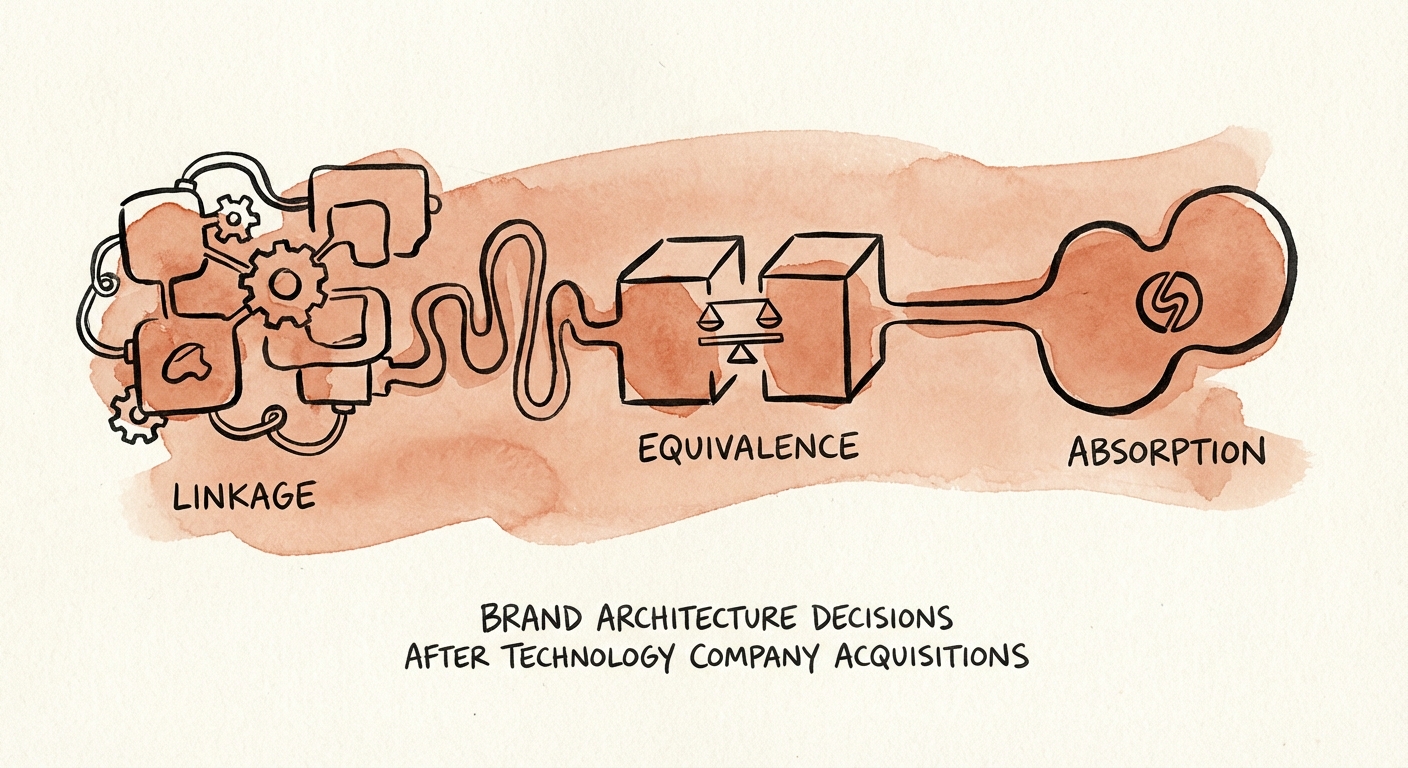
A high-authority migration follows a "Bridge" Protocol over 12-18 months:
- Phase 1 (Months 0-6): Linkage. The acquired brand remains dominant, but the master brand appears as "A [Master Brand] Company." This signals financial backing without signaling operational disruption.
- Phase 2 (Months 6-12): Equivalence. The visual hierarchy shifts. The master brand logo grows in size; the acquired brand moves to a product name. "Acme Analytics" becomes "The Acme Platform by MasterCo."
- Phase 3 (Months 12+): Absorption. The legacy name becomes a product feature or is retired entirely, but only after specific retention metrics (NPS, renewal rates) confirm the customer base has transferred their trust.
Data from the Prophet Brand Relevance Index suggests that brands successfully navigating this relevance transfer outperform the S&P 500 by 230%. The goal is not just to change the sign on the door, but to transfer the goodwill from the old balance sheet to the new one. If you delete the name before you transfer the trust, you have deleted the asset.