
The practical answer
- Short answer
- A diagnostic framework for Private Equity Operating Partners to rationalize product roadmaps post-acquisition. Learn why 80% of features are waste and how to realign engineering with EBITDA.
- Best fit
- Industry: Private Equity. Function: Product & Engineering
- Operating path
- Migration & Integration → Turnaround & Restructuring → Transaction Advisory Services
- Key metric
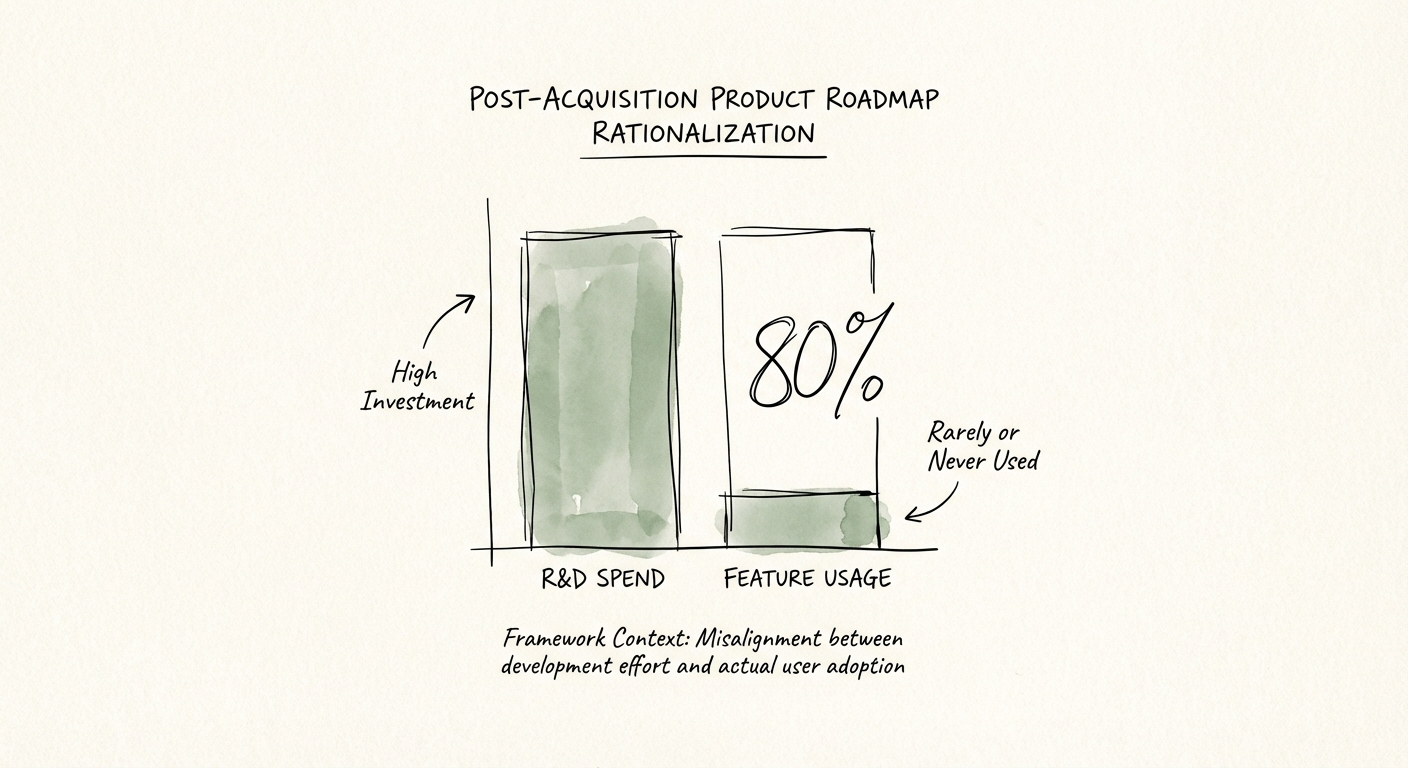
- 80% of software features are rarely or never used, representing billions in wasted R&D spend.
The 'Innovation' Trap: Why You Bought a Sales Demo, Not a Product
In the rush of due diligence, Operating Partners often confuse a robust roadmap with future enterprise value. You see a slide deck promised to the board: AI agents, multimodal interfaces, and cross-platform integrations scheduled for Q3. It looks like growth. In reality, it is likely a liability.
Significant research from Pendo reveals a significant inefficiency in software development: 80% of features in the average software product are rarely or never used. For a Private Equity firm, this means for every $10 million you spend on R&D post-close, $8 million is effectively incinerated on shelfware that drives neither retention (NDR) nor new logo acquisition.
The roadmap you inherited was not built for EBITDA expansion. It was likely built for:
- Sales Objection Handling: Features built to close one specific deal that never scaled.
- Founder Vision: Pet projects that stroke the ego but ignore the market.
- Technical Vanity: Refactoring code for 'purity' rather than performance.
Post-acquisition, your goal is not to execute the founder's vision. It is to rationalize the asset. You must shift from a 'feature factory' mindset—measuring success by shipping speed—to a 'value factory' mindset, where success is measured by feature adoption and revenue impact. If you do not pause and audit the roadmap within the first 100 days, you will spend the next hold period maintaining technical debt instead of building equity.
Capital poured into a company with broken unit economics acts like fuel on a fire—it doesn't fix the engine; it just accelerates the burnout.
The Diagnostic: The 4-Box Roadmap Rationalization Matrix
To stop the bleeding, you must audit the existing backlog and live product against two axes: Strategic Value (does it drive ARR or Retention?) and Technical Health (is it expensive to maintain?). This framework forces a decision on every single epic and feature.
Quadrant 1: The Growth Engine (High Value, High Health)
Action: Accelerate. These are the 6.4% of features that, according to Pendo, drive 80% of usage. They are stable codebases that customers love. Your post-acquisition capital should flow here to defend the moat. Double down on UX improvements and adjacent workflows.
Quadrant 2: The Hidden Liability (High Value, Low Health)
Action: Refactor. This is your biggest risk. These features drive revenue (e.g., the core checkout flow or main reporting dashboard) but are built on 'spaghetti code' or legacy frameworks. If you ignore them to build new 'AI' features, they will break, causing churn. Redirect 'Innovation' budget to 'Stabilization' here. See Why Your Product Roadmap Is Sabotaging Your Exit.
Quadrant 3: The Commodity (Low Value, High Health)
Action: Maintain or Deprecate. These are 'table stakes' features—login screens, basic admin settings—that work fine but differentiate nothing. Do not spend a single developer hour improving them. If possible, replace them with third-party components (e.g., Auth0 for login) to reduce TCO.
Quadrant 4: The EBITDA Drain (Low Value, Low Health)
Action: Kill. These are legacy features used by three customers who pay $5k/year, costing you $200k/year to maintain. The 'Sunk Cost Fallacy' lives here. M&A failure rates hover around 70-90% largely because acquirers are afraid to cut bloat. Kill these features immediately. Offer the affected customers a migration path or fire them. You cannot scale with an anchor.
Execution: The 100-Day Realignment Playbook
Rationalization is not a philosophical exercise; it is an operational mandate. Here is how to execute the framework in your first quarter.
Days 1-30: The Telemetry Audit
You cannot rationalize what you cannot measure. Install product analytics (Pendo, Amplitude, Mixpanel) immediately. Do not trust the founder's anecdote that 'everyone uses the reporting module.' The data often proves that users only export to Excel. If a feature has <5% adoption after 6 months, it is a candidate for the chopping block.
Days 31-60: The CapEx Reallocation
Once you identify the 'EBITDA Drain' (Quadrant 4), freeze all work on those areas. Reallocate those engineering hours to Quadrant 2 (Refactoring the core). This will be unpopular with the legacy product team. This is why you must rely on data-driven roadmap presentation best practices to justify the shift to the board.
Days 61-90: The Synergy Pivot
If this was a strategic acquisition, the roadmap must now include integration. However, McKinsey data suggests 70% of synergies fail due to poor execution. Do not layer integration on top of a bloated roadmap. You must substitute, not add. For every new integration feature added to the roadmap, two legacy features must be deprioritized. This 'One-In-Two-Out' rule prevents the engineering team from collapsing under the weight of the new strategy. Review 12 Post-Merger Integration Mistakes to avoid common pitfalls.